Image


Vapormatt wet blasting machines hone, deburr, clean and prepare cutting tools for PVD and CVD coating in one controlled process. Manufacturers and regrinders use them on solid carbide drills, end mills, taps and microtools, indexable inserts, files, rasps, hobs and bandsaw blades. Edge radii are held from 5 to 70µm, to as tight as ±2µm, with K-factor control and without the micro-chipping that dry methods can cause.
We developed the first edge honing machines in the 1980s and hold the patent for K-factor edge control (GB2590936B). In one production case study, a 10–15µm hone was held to Six Sigma and cutting performance improved by up to 50%. Before you choose a machine, we process your own tools in our R&D facility and return them with edge measurements. Compare our machines for cutting tools.




Hone carbide teeth, peen gullets and braze points against fatigue cracking, and clean blades for coating or laser marking in one in-line pass.

Hone edges to 15–60µm within ±5µm with K-factor control, deburr and clean before CVD or PVD coating, then polish and peen the coating afterwards.

Edge honing to a defined K-factor held to ±2µm, deburring, cobalt smear removal before PVD coating and droplet removal after it, for drills, end mills, taps and thread mills.
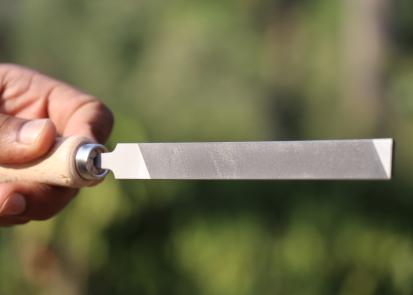
Removes heat scale and quench residue from every tooth after hardening and sharpens the cutting edge in the same pass, so each file bites from its first stroke and stays sharp for longer.
Wet blasting, also known as vapor blasting, uses a slurry of water, abrasive and compressed air to hone, deburr, clean and prepare cutting tools for coating. The water cushions each abrasive particle. That lets it remove the fragile as-ground edge and grinding residue without micro-chipping carbide or HSS. Tool manufacturers and regrinders use it to get a consistent edge, stronger coating adhesion and more predictable tool life.
Wet blasting suits most cutting tools, new or reground:
Wet blasting produces edge radii from 5 to 70µm across the cutting tool range. Typical results by tool type:
K-factor describes how an edge hone is split between the rake face and the clearance face of a cutting tool:
Controlling K-factor lets the edge be matched to the cutting application. Vapormatt holds the patent for K-factor control by wet blasting (GB2590936B).
Wet blasting gives more control and consistency than the alternatives:
The right machine depends on tool type, volume and level of automation:
Yes. Send us sample tools and our applications engineers will process them in our R&D facility to your target edge. They return each tool with per-edge radius and K-factor measurements, so you can judge the result before a machine is specified.
Cost depends mainly on throughput, the level of automation, how parts are loaded and held, and whether washing, drying and process data logging are included. Vapormatt specifies each machine to your output requirements, so a sample trial is the quickest route to an accurate quote.