Image




Water cushions the abrasive on impact, leaving fibres and substrates undamaged
Creates a fully activated surface where adhesives and coatings bond completely
The flowing slurry opens cracks rather than concealing them, improving NDT accuracy
Every parameter is controllable, delivering the same verified finish every cycle
Every blade that leaves your facility carries a certification of airworthiness. The surface preparation beneath that certification is where risk is either introduced or eliminated.
For OEM manufacturers, the priority is consistency. Composite blades need autoclave residues and surface contamination removed before bonding, coating or leading edge attachment, and the process must produce the same result every cycle.
For MRO and overhaul operations, the priority is accuracy. Paint must come off metallic and composite blades cleanly, without substrate damage. Inspection for cracks, geometric changes and defects depends on a surface that exposes discontinuities rather than conceals them. Every manual step in that sequence is a variable your quality system must account for.
Wet blasting handles both. Clean, de-paint and prepare in one operation, on aluminium, alloy and composite surfaces, with a controlled and recordable process each time.
Learn about jet engine component and aircraft wheel NDT preparation

vs. Manual sanding and hand finishing: Slow and aggressive, with no process record and no repeatability guarantee. On composite blades, sanding risks fibre damage. Finish quality varies between operators and cycles, making bond strength inconsistent. Hand arm vibration risk is present throughout.
vs. Chemical stripping: Effective at removing paint but the compliance burden is significant. Multi-stage handling, solvent residue clean-up, COSHH controls and PPE all add time and complexity. For aluminium blades going to dye penetrant NDT, chemical residues in surface micro-cracks can mask defects and compromise results.
vs. Dry blasting: Cannot degrease simultaneously, so a separate cleaning stage is always required before or after. On metallic blades, dry blasting closes surface cracks rather than opening them, which is the wrong outcome for NDT preparation.
Find out how wet blasting compares with other finishing processes

Wet blasting projects a controlled slurry of water and abrasive media on to the blade. The water cushions the abrasive on impact and is what separates this process from every alternative.
For OEM composite blade manufacture, that cushioning effect removes autoclave residues without touching the fibres beneath. What remains is a wet-out surface where adhesives, primers and coatings cover completely rather than beading, giving maximum bond area for leading edge attachment and coating application.
For MRO on metallic blades, the slurry strips paint, corrosion, grease and oils without removing substrate material. Dimensions are unchanged. Critically, the flowing slurry opens surface cracks rather than peening them closed, so blades arrive at dye penetrant or fluorescent penetrant inspection in the best possible condition for accurate defect detection. For composite blades in MRO, the process prepares surfaces for adhesive rebonding or heater mat replacement without fibre damage.
| Composite blades | Aluminium / alloy blades | Typical context | |
|---|---|---|---|
| OEM manufacturing | Surface activation after autoclaving; leading edge bonding prep | Pre-treatment before coating or anodising | High-volume, consistent blade dimensions |
| MRO / overhaul | Inspection prep; de-paint before adhesive rebond; heater mat replacement | De-paint before dye penetrant NDT; corrosion removal; recoat prep | Variable blade types and geometries between cycles |
Aluminium oxide media is used for composite blade surface preparation. Plastic media with mild detergent and hot water is used for paint stripping on metal blades without substrate damage.
Vapormatt has supplied wet blasting equipment to propeller and rotor blade manufacturers and MRO facilities for decades. There are approximately 15 measurable parameters in a wet blasting operation and Vapormatt holds multiple patents across process control, media filtration and blast gun design. The patented elutriation tower removes spent abrasive continuously without sieves, keeping media concentration consistent from the first blade to the last.
Vapormatt 4.0 records every process parameter for every component, supporting quality management traceability requirements and giving procurement and quality teams the documentation they need at audit.
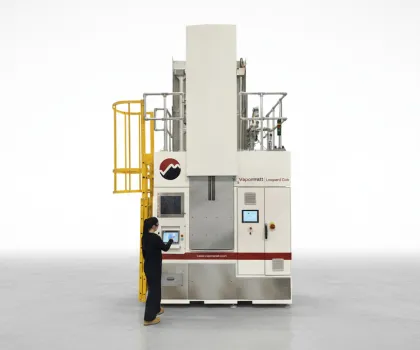
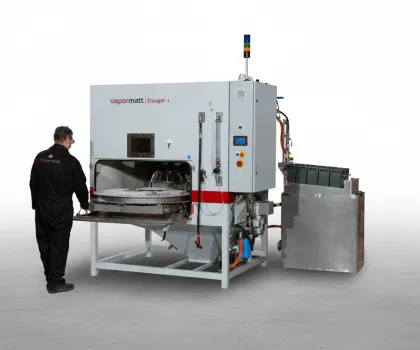
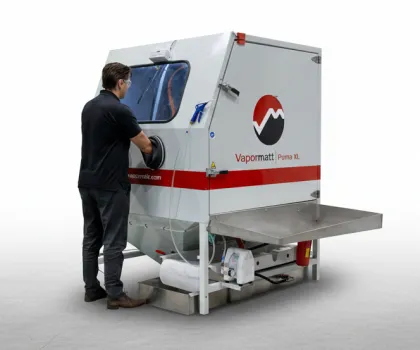
The Puma and Puma XL manual machines suit MRO environments where blade geometries vary between cycles. The Cougar+ automatic machine, with a working envelope up to 1,200mm diameter, is designed for OEM production volumes where the same verified finish is needed on every blade. A dedicated case study for composite propeller blade repair and preparation is available in the downloads section.
Manual sanding produces inconsistent results with no process record. Chemicals add compliance obligations and multi-stage handling. Dry blasting closes the cracks that NDT needs to find and, on titanium alloys, carries explosion risk.
Wet blasting eliminates those risks in a single, controlled, recordable operation. Composite fibres intact. Metal substrate untouched. Cracks exposed. Bond surfaces activated. Paint removed cleanly.
No. The water in the slurry cushions the abrasive on impact, buffering the force before it reaches the fibres. This is the defining difference between wet blasting and dry blasting for composite surfaces. The process removes surface contamination and activates the surface for bonding without compromising the structural integrity of the component.
Yes. Using plastic media, mild detergent and hot water at controlled pressure, wet blasting removes paint coatings without touching the aluminium substrate. The blade emerges dimensionally unchanged. This is critical for maintaining airworthiness tolerances and for preparing blades for dye penetrant NDT, where substrate integrity must be confirmed.
Wet blasting cleans surface cracks by flowing slurry through them rather than peening over them. Dry blasting can close or obscure surface discontinuities, reducing the sensitivity of subsequent dye penetrant or fluorescent penetrant inspection. Wet blasting exposes cracks, making them more visible and improving detection reliability.
Vapormatt 4.0 records all process parameters for each component processed. This data log supports AS9100 quality management system traceability requirements. Wet blasting process specifications can be validated against OEM and industry requirements including relevant AMS specifications for surface preparation of aerospace components. Your Vapormatt application engineer can advise on process qualification for your specific blade application.
Yes. The wet blast recipe is the variable, not the machine. Aluminium oxide media is used for composite blade surface activation. Plastic media with detergent and hot water is used for aluminium and alloy blade de-painting. A single Vapormatt machine can switch between recipes, making it suitable for mixed-fleet MRO operations processing different blade materials and types in the same facility.