
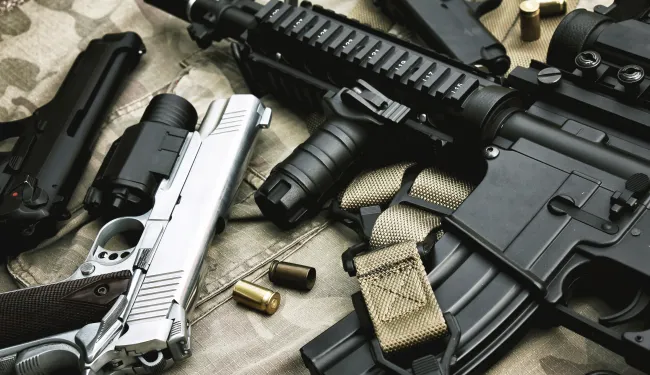
Vapormatt designs and builds wet blasting machines, also known as vapor blasting machines, for firearms manufacturers, defence suppliers and armouries. One machine deburrs, conditions and cleans slides, receivers, barrels and bolt carriers to a repeatable Ra before Cerakote, Parkerizing or nitride, and strips carbon, corrosion and worn coatings from service weapons.
Consistent
Same surface. Start of shift to end.
Compliant
NCAGE code U5895. In service with the RAF and Fleet Air Arm.
Safe
Dust-free. Closed-loop. No silica risk
Single-pass
Deburr, lap, and clean in one operation
Your finishing process is the last thing standing between a machined part and a reliable weapon. Most processes leave the job half done.
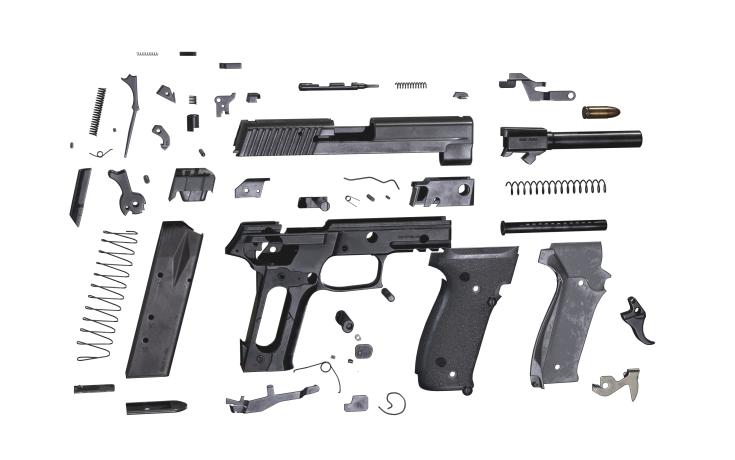
Post-machining finishing in firearms manufacturing is not a cosmetic step. Burrs on slides, receivers, and bolt carriers cause assembly failures. Surfaces contaminated with embedded abrasive from dry blasting deliver inconsistent Ra profiles that undermine Cerakote adhesion and accelerate coating failure in service. Finishing lines that chain together deburring, lapping, and cleaning as separate operations consume floor space, accumulate operator hours, and carry ongoing silica dust liability under COSHH and OSHA regulations.
Why the standard approach to firearms finishing is costing you more than you realise
vs. dry blasting: Abrasive particles embed into steel and aluminium substrates under blast pressure, introducing surface voids that compromise adhesion for Cerakote, Parkerizing, and black nitride finishes. Beyond coating quality, dry blasting generates silica dust requiring collector infrastructure, floor space, and respiratory and ignition risk management regardless of production volume.
vs. vibratory and tumble finishing: Mass finishing cannot access the recesses of a pistol slide, the bore entry of a barrel, or the internal geometry of a bolt carrier group. Media pools in internal cavities and requires manual extraction before downstream processing, reintroducing the operator handling your line was designed to eliminate.
vs. manual hand deburring: Outcomes vary by shift, by operator, and by fatigue level. At production volume, manual deburring is simultaneously a safety liability and a quality control problem that cannot be validated or demonstrated repeatable to a procurement or quality director.
Learn how wet blasting compares with other finishing processes
Wet blasting applications for firearms manufacturing and maintenance
- Pistol slides: deburring of recesses and undercuts, lapping to final Ra specification, and cleaning in a single operation
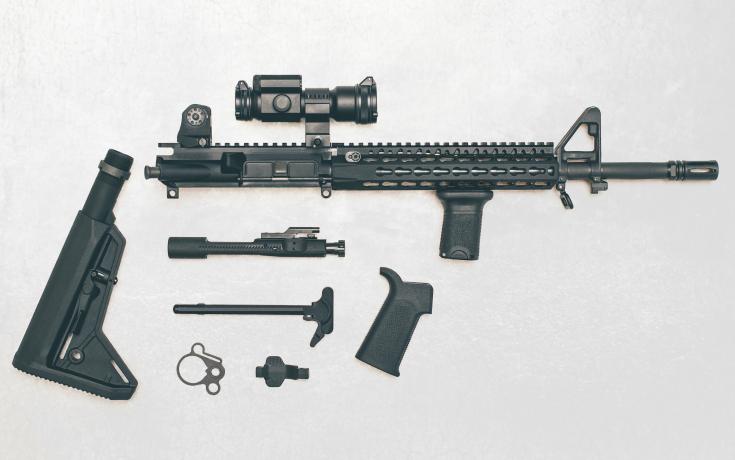
- Receivers and frames, including upper and lower receivers: uniform surface preparation for Cerakote, Parkerizing, anodising, black nitride and MIL-SPEC coatings, including internal geometry and threaded features
- Barrels: carbon fouling removal, bore cleaning, and surface preparation for chrome lining, nitride treatment, or Cerakote
- Bolt carriers and bolts: deburring of machined features and surface conditioning for reduced friction and extended service life
- Triggers and firing mechanisms: deburring without dimensional change to functional geometry
- Upper and lower receivers: full surface preparation including internal geometry and threaded features
- Magazines: cleaning and deburring of stamped or machined components at volume
- Silencer and suppressor components: precision finishing of internal geometry where surface condition affects performance
- Spent brass and steel casings: cleaning and preparation for recycling or re-manufacture
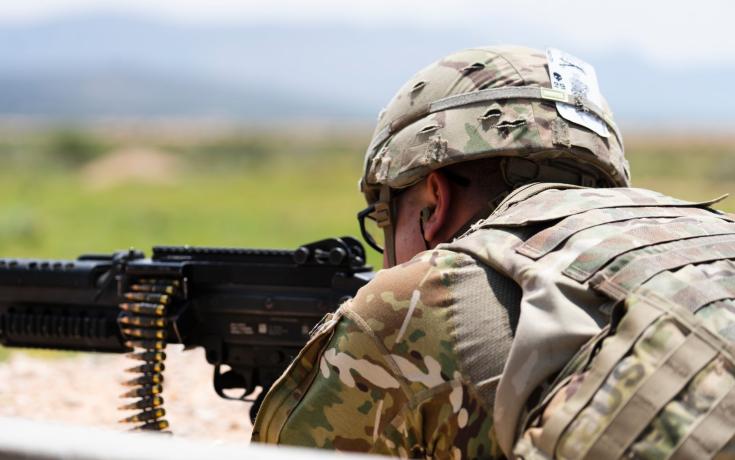
- Armoury and depot maintenance: removing carbon, corrosion and worn Cerakote, paint or Parkerizing from service weapons before inspection and refinishing, without changing critical dimensions
Why Vapormatt
Norman Ashworth invented the process, which he called liquid honing, in the late 1940s. His family founded Vapormatt in 1978 and still runs it. More than 2,000 Vapormatt machines now work in over 50 countries, backed by 12 patents and ISO 9001 certification.
NCAGE code U5895. For manufacturers supplying MIL-SPEC firearms components to NATO member armed forces or approved defence primes, this credential simplifies supplier qualification and supports procurement compliance from the outset. Our machines are used by the RAF for aircraft wheel crack detection and by the Fleet Air Arm for helicopter maintenance.
Process control that produces a surface you can audit. Vapormatt machines deliver precisely metered slurry at locked, repeatable parameters. The surface produced at the start of a production run is the surface produced at the end of a twelve-hour shift, allowing your quality team to validate, log, and defend the surface condition entering your coating line.
Learn about Vapormatt's R&D and patents
The Vapormatt Promise: the machine meets the agreed specification, or we make it right.
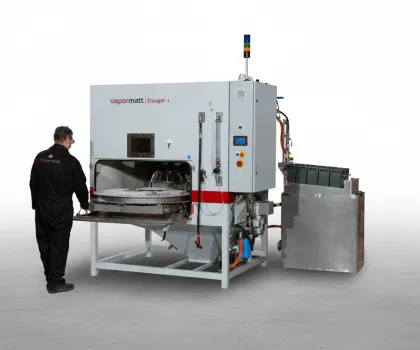
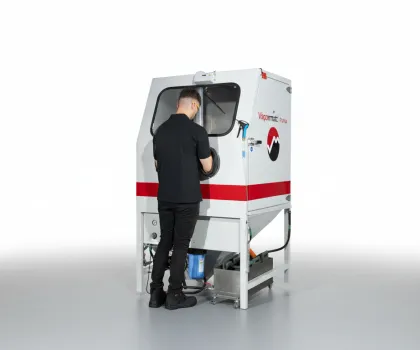
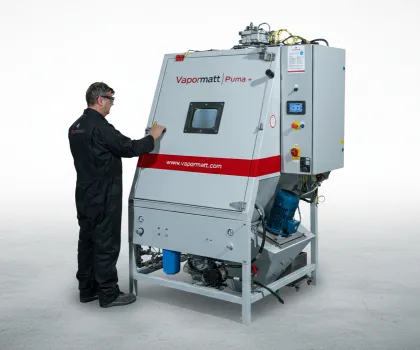
Wet blasting machines for firearms
FAQs
How do I choose a wet blasting or vapor blasting company for firearms manufacturing and maintenance?
Look for four things: process control that holds the same Ra across a full shift, the option to trial your own parts before buying, defence supplier credentials, and service support near you. Vapormatt, the UK company that invented the wet blasting machine (also called vapor blasting machine), meets all four. It has NCAGE code U5895, equipment in service with the RAF and Fleet Air Arm, a sample-trial facility, and more than 2,000 machines supported in over 50 countries.
Can wet blasting be used to maintain and refurbish service firearms?
Yes. Armouries and maintenance depots use wet blasting to remove carbon fouling, corrosion and worn Cerakote, paint or Parkerizing before inspection and refinishing. The water cushions the abrasive, so bores, threads and locking surfaces are cleaned without dimensional change, and the part is ready to recoat. A manual machine suits most armouries; high-throughput depots typically use an automatic one.
What is the best surface finishing process for firearms before Cerakote application?
Wet blasting. Cerakote adhesion depends on a clean, consistent Ra profile across every part, and wet blasting achieves this in a single operation by deburring, surface-conditioning and cleaning without embedding abrasive into the substrate. Dry blasting creates surface voids that produce variable Ra values and reduce coating adhesion. Wet blasting removes that variable and delivers a repeatable substrate every time.
Does wet blasting leave embedded media in the substrate?
No. Water in the slurry cushions the abrasive particle on contact and continuously flushes the surface during processing. Substrates finished by wet blasting (also known as vapor blasting) do not carry the embedded particle voids that dry-blasted surfaces show under profilometry, and require no separate cleaning stage before coating.
Can wet blasting meet MIL-STD-171 surface preparation requirements for firearms components?
Wet blasting (also known as vapor blasting) produces surfaces that meet the cleanliness and controlled profile requirements for protective coating application under MIL-STD-171. Vapormatt holds NCAGE code U5895 and supplies equipment to NATO member armed forces and approved defence contractors. For confirmation that a specific process configuration meets your compliance position, Vapormatt’s application engineering team can work with you directly.
Can one Vapormatt machine handle multiple firearms component types?
Yes. Slurry concentration, blast pressure, media selection, and cycle time can be saved as named programmes for each component type. A single machine can process slides, barrels, bolt carriers, triggers, and receivers with programme changes between batches. Automatic machines (also known as vapor blasting machines) with rotary indexing or inline configurations handle high-volume mixed-component production across shifts without operator variation.
Is wet blasting safe to operate adjacent to firearms assembly areas?
Yes. Wet blasting (also known as vapor blasting) is a fully contained, closed-loop, dust-free process. There is no airborne silica, no exhaust ducting requirement, and no dust collector installation. The wet blasting machine (also known as vapor blasting machine) can be positioned directly on the production floor next to sensitive assembly areas, reducing component handling between finishing and assembly stages while introducing no compliance risk to the surrounding environment.