
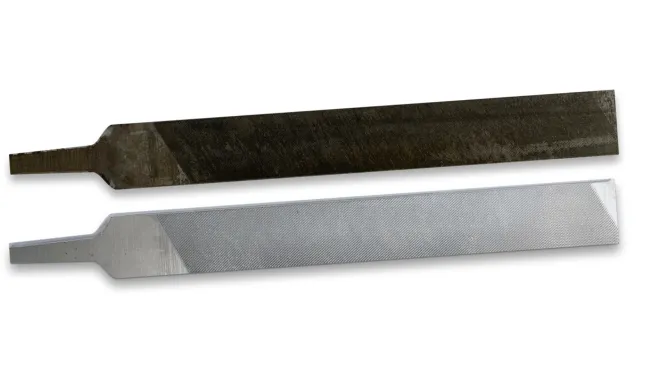
Clean
Heat scale and quench residue out of every tooth
Sharp
Cutting edge sharpened on new files
Lasting
Edges that stay sharp for longer
Consistent
The same finish on every file
Every file you ship is judged twice: on its first stroke, and on how long it keeps cutting. Heat scale and quench residue spoil the look of a new file and stop filings clearing from the teeth as it cuts, so it loads up. Vapormatt wet blasting cleans them away and sharpens every tooth, so your file bites from first use instead of feeling dull from the box.
Four generations of the Ashworth family, from Norman Ashworth and his son Stewart to Robin and Terry and now Ryan and Matt, have built and developed wet blasting machines for file processing, holding patents in wet blasting along the way. We can replicate your existing process, matching media, blast angles and pressures, or develop new recipes for your cut, size and steel, then prove them on your own files before you commit.
Steam blasting, dry blasting and acid cleaning: why each falls short for new files
Each carries a cost that wet blasting for files and rasps removes.
vs. steam-driven slurry blasting: many file makers still drive their slurry with steam. The boiler is expensive to run, pressurised steam adds a serious safety risk, and the heat and noise make the blast room one of the hardest places in the factory to work.
vs. dry blasting: the hard dry abrasives used for decades are harsh on fine tooth edges and fill the air with dust.
vs. acid and chemical cleaning: a chemical dip loosens scale, and acid etching has long been used to sharpen files, but it leaves a poorer edge than blasting and adds handling, neutralising and waste treatment.
Find out how wet blasting compares with other finishing processes
Wet blasting applications for file and rasp manufacturing
Wet blasting for files and rasps cleans and sharpens in a single pass, as each file travels past processing nozzles set at specific angles.
Cleaning
After hardening, the cleaning recipe flushes heat scale, quench residue and grinding fines from each tooth profile and gullet. In a Vapormatt sample trial, hardened files 100 to 250mm long were cleared of all heat scale at up to 3,000mm/min.
Sharpening
A file straight from cutting and hardening is rarely as sharp as it could be. The sharpening recipe drives the slurry at a shallow angle onto the back of each tooth, sharpening the cutting edge so the file bites from its first stroke and stays sharp for longer.
Products handled:
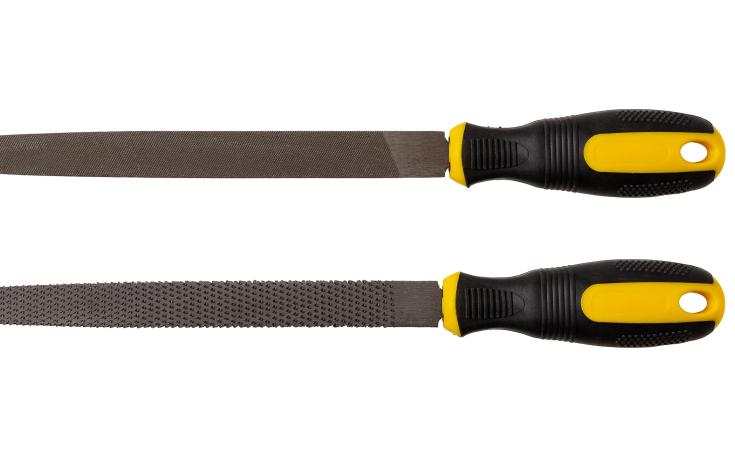
- Engineers', saw, needle and precision files: flat, half-round, round and square
- Wood and metal rasps, including farrier (hoof) rasps
Why Vapormatt
Since 1978 we have engineered wet blasting for cutting tool makers, and the Vapormatt Profelis FR (File and Rasp) brings that to files and rasps.
Both processes, every file type, one machine: the same machine cleans and sharpens every file type, with process parameters set to suit each component and requirement.
A closer look at the cutting edge: we use Alicona 3D microscopy and surface measurement to understand tooth profiles and surfaces in a detail most file makers have never measured. We are also working with a leading UK engineering university on a file performance test that gives more consistent results than the traditional bite test.
Proven on your files before it leaves us: we trial your own files and your quality team judges the result with its own bite test. We can add a full laboratory analysis of the surface geometry we create, and advise on applying those mechanised tests in your QA process. Every machine then passes factory acceptance testing on your own files, backed by the Vapormatt Promise: it meets the agreed specification, or we make it right. All trial and test work runs under our ISO 9001 certified quality system.
Watch the Profelis FR clean and sharpen a hand file
The bottom line
A file that bites on its first stroke wins the sale. Wet blasting gets you there with compressed air, not steam, and without the dust of dry blasting or the hazards of harsh chemicals. Safer for your operators, sharper for your customers.
FAQs
How do you remove heat scale from files after hardening?
Wet blasting for files and rasps removes heat scale and quench residue in one conveyor pass, with no acid dip. Media grade and gun angle are set for your cut, so the scale goes and the tooth geometry stays. Each file is then rinsed and blown dry, ready for oiling or corrosion protection.
Will files rust after wet blasting?
Not straight away. We can add a corrosion inhibitor to the rinse water, so each file leaves the machine dry and protected in the short term, ready for your normal oiling or anti-corrosion treatment. Dry blasting leaves bare steel exposed until that step.
Can wet blasting sharpen new files and rasps?
Yes. Cleaning and sharpening happen in the same pass. A shallow-angle slurry works on the back of each tooth and sharpens the cutting edge, so the file bites on its first stroke and stays sharp for longer. We prove the recipe on your own files, against your own bite test, before you commit.
What is the difference between cleaning and sharpening files by wet blasting?
Cleaning removes heat scale, quench residue and grinding fines from the teeth and gullets after hardening. Sharpening works on the cutting edge itself, with the slurry directed at a shallow angle onto the back of each tooth. Both happen in a single pass, as the file travels past nozzles set at specific angles for each effect.
Will wet blasting damage or round the teeth on my files?
No, when the recipe suits the cut. The water cushions each particle, so the slurry cleans and sharpens without the impact damage of dry grit. Gun angle, pressure and media are matched to your file type and cut, and we check the edge with Alicona 3D microscopy during trials.
Can wet blasting replace acid cleaning and etching of files?
In many cases, yes. Wet blasting removes heat scale and residue mechanically, and it sharpens more selectively than acid: the blast takes metal mainly from the back of each tooth, while acid etches every surface evenly. Depending on the abrasive and set-up, wet blasting alone can give an edge as sharp as acid etching, or sharper, with no follow-on chemical step, so there is no acid to store, neutralise or treat as waste. In some installations, wet blasting runs after acid etching instead, to clean and finish the etched file. We confirm the best route in a sample trial on your files.
Find out how wet blasting compares with other finishing processes
Can wet blasting replace steam slurry blasting for files?
Yes. Vapormatt wet blasting drives the slurry with compressed air, so there is no boiler to run and no pressurised steam. The whole process runs far cooler and quieter, so processed files are safer to handle and the machine is safer and more pleasant to maintain. Conveyor feed and stored recipes replace hand-fed operation, so every file gets the same process. Already running steam generating equipment? The Profelis FR runs on compressed air as standard, and can be adapted to run from your existing steam generator system.
Can wet blasting replace a dry blasting line for file sharpening?
Yes. Many file makers sharpen on belt-fed dry blasting lines. The Profelis FR (File and Rasp) takes the same place in the line and is conveyor fed too, but the water cushions each particle, so it cleans and sharpens with no dust, no dust extraction plant and no sealed blast room. Files leave rinsed and dry, ready for oiling. We can trial your files side by side with your current dry-blasted output.
Is wet blasting safe for operators, and does it use silica?
Yes. We avoid abrasives containing free silica, as UK rules have required in blasting since 1950. Typical media include glass beads, glass grit, silicon carbide and aluminium oxide, among many others. The slurry keeps every particle wet, so no respirable dust forms at the gun, and the enclosed cabinet runs under negative pressure. There is no acid on site and no separate dust cell to manage.
Is there a standard for file sharpness?
No international standard measures it. ISO 234-1 covers file dimensions, not cutting performance, and India's IS 1931:2000 comes closest, requiring properly cleaned files and setting cut and endurance tests. Most file makers rely on their own bite test instead: an inspector draws the file across a softer test bar or block and judges by feel whether it grabs or skates. With a leading UK engineering university, we are developing a material removal test that measures how much a file actually cuts under a set load and stroke, giving a more specific result than a bite test. Our trial reports give your quality team before and after images and edge measurements to support your own acceptance test.
Which Vapormatt machine is used for files and rasps?
The Vapormatt Profelis FR (File and Rasp), an in-line conveyor machine with blast guns above and below the file, a recirculated rinse and a blow-dry stage. One machine cleans and sharpens every file type, with process parameters set to suit each component.
How many files per hour can a wet blasting machine process?
Around 500 files an hour for a typical 200mm file, cleaned and sharpened in one pass, as a conservative working figure. Some file types run well above that, and heavier work, such as coarse rasps, runs more slowly. Capacity scales with the number of blast guns, so we can configure the machine for higher or lower volumes to match your line, and confirm the rate for your files in a sample trial.
Can I test wet blasting on my own files before buying?
Yes. Send us samples of each file type, and tell us your steel, current process and what you want to improve. We process them at our test facility and return them with before and after images and edge measurements, for you to evaluate against your own standards.