
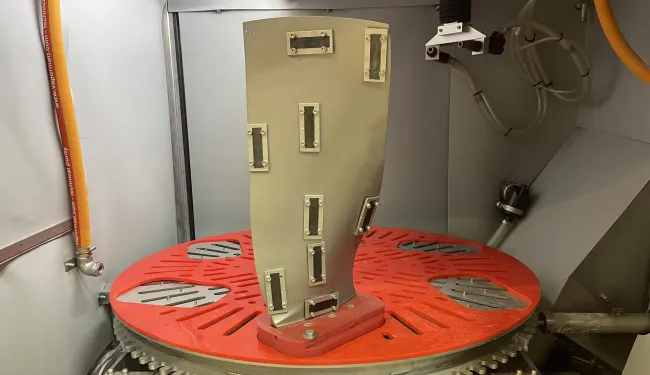
Vapor blasting is a surface finishing process that puts water between the abrasive and the part. That single change - cushioning each particle in a film of water rather than firing it dry - is what produces the soft, even satin finish the process is known for, and why it can clean, degrease and finish a component without leaving grit embedded in the surface or dust in the air.
It's the same process the industry also calls wet blasting. Vapormatt invented it in the late 1940s and has built nothing else since. What follows is what it actually delivers on a production line or a workshop floor, and how it compares to the dry processes it usually replaces.
New to the process? Read the full explanation of how it works
What vapor blasting delivers
- A single-pass result. Cleaning, degreasing, and finishing happen in one operation, rather than as separate steps requiring separate equipment.
- No embedded media. Because the abrasive is cushioned by water on impact, it doesn't lodge in the substrate the way dry abrasive can.
- No airborne dust. Nothing to extract, no ATEX compliance burden, no respirable particulate to manage.
- A repeatable finish. Run correctly, the same settings produce the same surface roughness and appearance on part one and part ten thousand.
- No heat distortion. The water carries heat away as it works, so thin or heat-sensitive sections aren't put at risk the way they can be with dry blasting.
- Extended component life. Removing coatings, corrosion, or contamination without damaging the substrate underneath means parts can be refinished and returned to service rather than scrapped.
Where vapor blasting is used
Aerospace components - coating removal and surface preparation for inspection, wet shot peening jet engine fan and turbine blades, and the preparation of propeller blades for bonding or recoating.
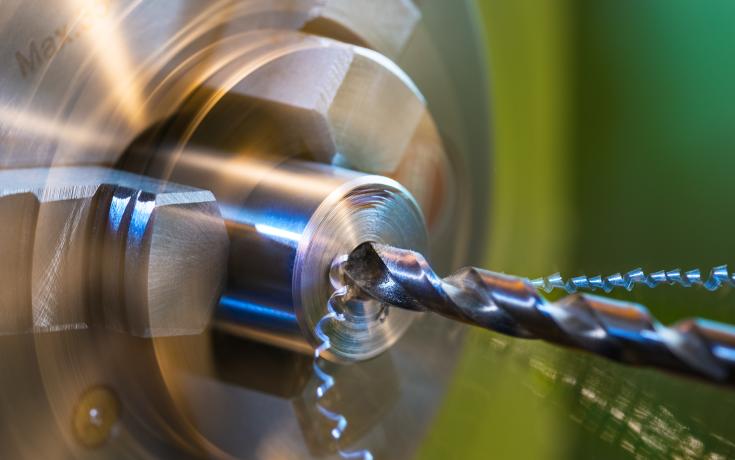
Cutting tools - deburring and edge preparation where the finish has to be controlled precisely, preparation for coating, and peening for durability.
Industrial cleaning, degreasing, and deburring - removing burrs, oils, contamination, and residue from components before assembly, inspection, or coating.
Paint and coating removal - stripping coatings back to bare substrate without the substrate damage associated with more aggressive methods.
What 'good' looks like in practice
The measure of a well-run vapor blasting process isn't just 'is it clean' - it's whether the result is the same every time it runs. That depends on the process being engineered rather than operator-dependent: media concentration, air pressure, and slurry quality all have to stay within tolerance across the whole cycle, not just at the start of it. Machines that recycle and continuously monitor the slurry hold that consistency automatically; machines that don't drift, and produce the same surface roughness and appearance on part one as part 10,000.
See how Vapormatt engineers that consistency into every machine
Is vapor blasting the same as wet blasting?
Yes. Vapor blasting and wet blasting are two names for the same process - water and abrasive media mixed into a slurry and projected under compressed air. 'Vapor blasting' is the more commonly searched name; 'wet blasting' is the more precise industrial and engineering term.
What results can I expect from vapor blasting?
A consistent, dust-free finish achieved in a single pass, with no embedded media and no damage to the underlying substrate - the specific outcome (roughness, appearance, degree of material removal) depends on the media and settings used.
Is vapor blasting effective for removing rust and corrosion?
Yes. The water-cushioned abrasive removes corrosion and scale back to clean substrate without the aggressive material loss or heat generation associated with dry blasting methods.
How long does a vapor blasting machine take to pay for itself?
This depends on production volume and the process it's replacing, but because vapor blasting combines cleaning, finishing, and degreasing into a single pass, it commonly reduces cycle time and the number of separate process steps a component previously required.