
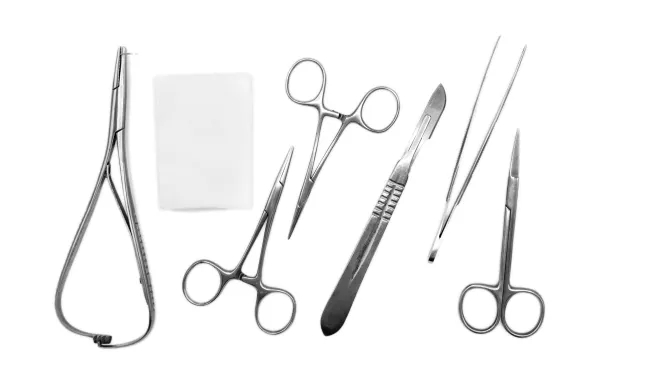
Sterilising
Surfaces finished to 0.25–0.6µm Ra - the precise range autoclave sterilisation requires
Validated
Measurable, repeatable processes - built for ISO 13485 and FDA 21 CFR 820 validation
Precise
Controlled media delivery reaches complex geometry without distortion
Clean
No embedded abrasive. No residual contamination. Surface ready for the next step.
The instruments that enter a patient's body carry no margin for error. A burr left on a scissor jaw. A surface too rough to sterilise reliably in an autoclave. A finish that varies between production batches and cannot be validated. These are not quality concerns. They are compliance failures and patient safety risks. Every one of them is traceable to how the instrument was finished.
Wet blasting resolves all three in a single, controllable, and validated process. Vapormatt is the world's leading wet blasting company, with decades of process engineering, a portfolio of patents in slurry conditioning and process control, and a track record across the most demanding surface finishing specifications in advanced manufacturing.
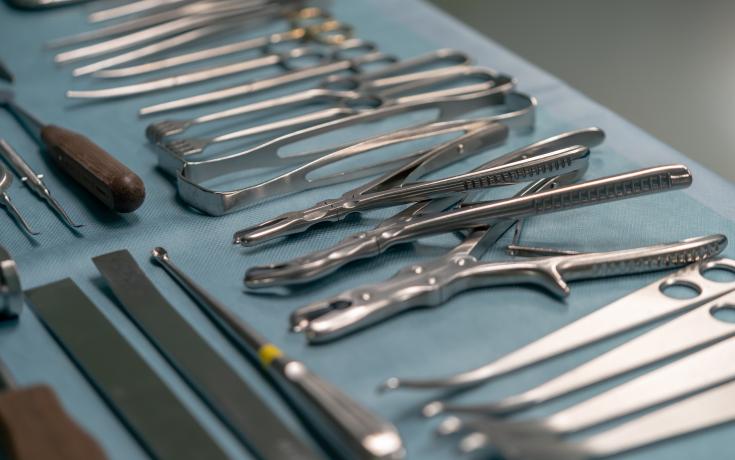
Why traditional instrument finishing methods create compliance exposure
Instrument manufacturers regularly use dry blasting, manual polishing, or mass finishing as standalone finishing processes.
vs. dry blasting: The European Hygienic Engineering and Design Group (EHEDG) identifies surfaces above Ra 0.8µm as areas where bacterial retention risk increases materially. Dry blasting typically produces instrument surfaces at Ra 1.3µm or above. That is not a marginal overshoot. It is a surface that cannot be reliably sterilised by autoclave, and it cannot be validated to a consistent Ra output. Dry blasting also embeds abrasive particles in the substrate. No downstream cleaning step reliably removes them.
vs. manual polishing: Manual polishing introduces operator variability into a process that ISO 13485 requires to be documented, controlled, and validated. Batch-to-batch Ra deviation becomes unquantifiable and uncontrollable - and indefensible under audit. At production volume, the inconsistency compounds. It is not a finishing process. It is a risk.
vs. mass finishing as a standalone step: Mass finishing handles bulk surface smoothing effectively, but cannot deliver the spatial precision that complex instrument profiles require. Box-lock joints, cannulated shafts, serrated jaw faces, and fine hinge pins need controlled, directed media delivery. Mass finishing averages across the geometry. Wet blasting addresses it.
Find out how wet blasting compares with other finishing processes
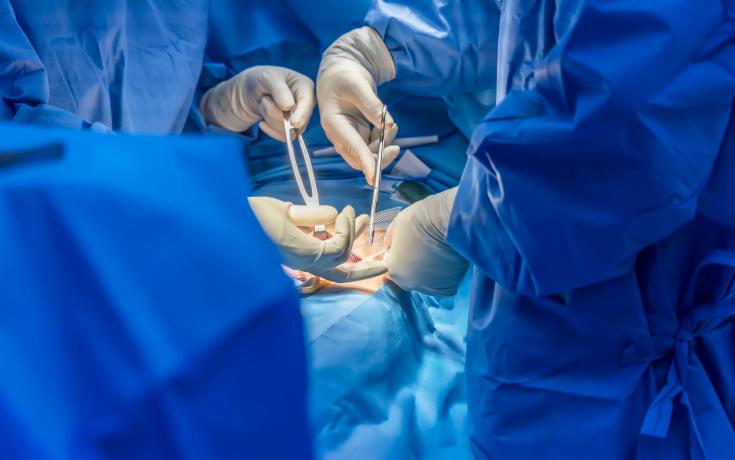
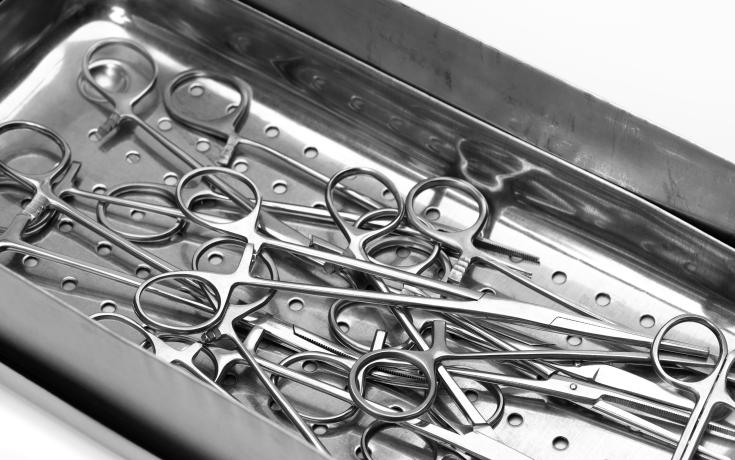
Wet blasting applications for medical and dental instrument manufacturing
The addition of water cushions media impact, prevents abrasive embedment, eliminates airborne particulate, prevents and continuously carries debris away from the surface. The result is a finish that dry processes cannot replicate on a repeatable basis.
Wet blasting with glass beads consistently produces surface roughness between 0.25 and 0.6µm Ra across instrument production runs. That is the clinically optimal window: below the EHEDG threshold for bacterial retention risk, within the range that allows autoclave steam to penetrate surface topography fully during the sterilisation cycle, and consistently achievable in an automated, parameterised process that can be documented for ISO 13485 or FDA 21 CFR 820 validation.
Wet blasting is applied across the following medical and dental instrument manufacturing operations:
- Deburring and edge radiusing of surgical scissors, clamps, needle holders, bone rongeurs, and retractors
- Non-reflective satin finishing of scalpel handles, probe shafts, and speculum bodies to eliminate operative glare during procedures
- Surface cleaning, descaling, and oxide removal following forging, heat treatment, casting, or welding operations
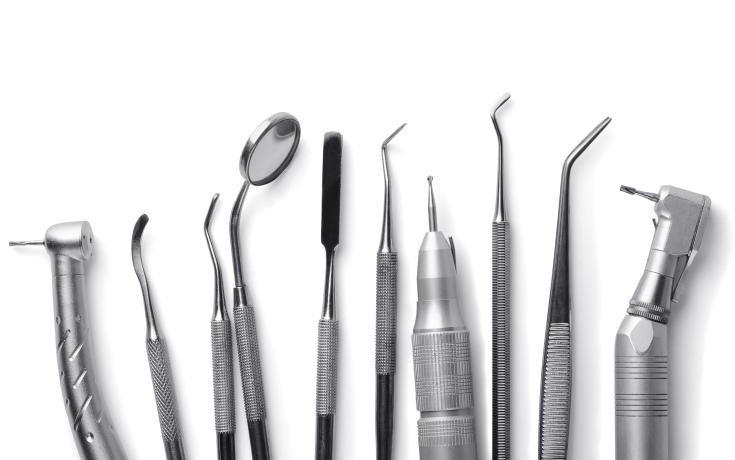
- Deburring, surface smoothing, and sterilisation-surface preparation of dental scalers, curettes, explorers, and periodontal probes
- Finishing of dental rotary instruments including burs, drill heads, and handpiece components
- Surface preparation and post-coating treatment for PVD and DLC application - where wet blasting controls the Ra profile for adhesion prior to coating, and post-coating peening converts tensile to compressive stresses to maximise coating durability
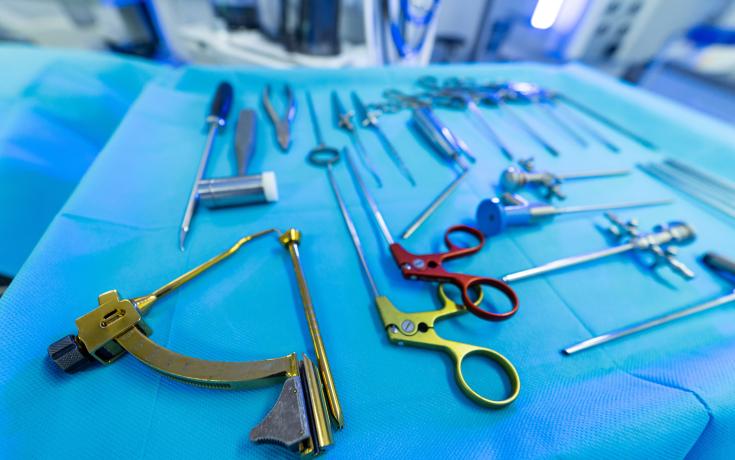
Why Vapormatt
Surgical and dental instrument manufacturers operating within ISO 13485, FDA 21 CFR 820, or EU MDR supply chains must use a finishing process that is controlled, parameterised, validated, and fully reproducible across every production batch. This requirement rules out manual polishing - by definition an inconsistent, operator-dependent process - and creates serious validation challenges for dry blasting, which lacks the process control needed to demonstrate batch-to-batch repeatability. What these regulatory frameworks demand, in practice, is automated machinery capable of delivering quantifiable, auditable output parameters every time.
Vapormatt's automated machines deliver exactly that. Blast pressure, media concentration, media size, nozzle geometry, slurry conditioning, and cycle duration are all defined, held, and logged. The surface outcome is not approximate. It is specified. Every batch of instruments leaves the machine with the correct finish, free of embedded abrasive, free of heat stress to the substrate, and free of residual particulate contamination.
Most finishing equipment suppliers treat wet blasting as one process among many. Vapormatt's sole focus is wet blasting. That focus, sustained across decades of application engineering, is reflected in a patent portfolio covering process control, slurry conditioning, and media filtration that no generalist finishing company can match.
The bottom line
Surface finishing is where medical instrument compliance is secured or compromised. A surface at Ra 1.3µm cannot be reliably sterilised. A manually polished surface cannot be ISO 13485 validated. A dry-blasted surface leaves embedded abrasive that no audit will accept without challenge. Wet blasting at 0.25 to 0.6µm Ra closes all three exposures simultaneously, in a single automated operation, with a documented process output that satisfies regulatory reviewers and quality directors alike. Manufacturers who continue with the old approach carry a compliance liability that grows as regulatory scrutiny on medical device finishing increases under EU MDR and updated FDA guidance.
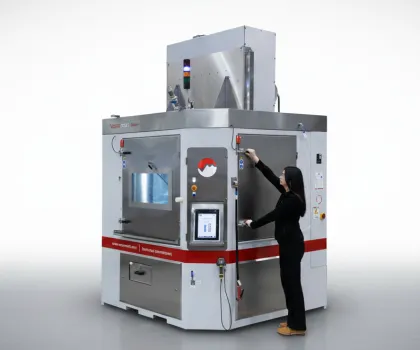
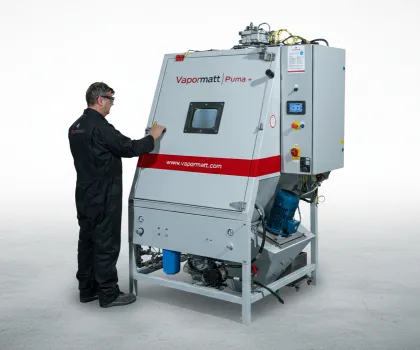
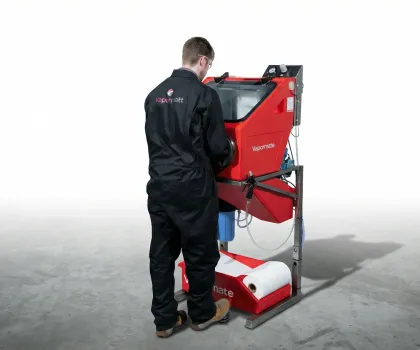
Related machines
FAQs
What surface roughness do surgical and dental instruments need for reliable sterilisation in an autoclave?
The European Hygienic Engineering and Design Group (EHEDG) identifies surfaces above Ra 0.8µm as areas of increased bacterial retention risk. Wet blasting with glass beads consistently produces instrument surfaces between 0.25 and 0.6µm Ra. This is below the EHEDG threshold, within the range that allows full steam penetration during the autoclave cycle, and achievable repeatedly across production volume in a validated automated process.
How does wet blasting satisfy ISO 13485 process validation requirements?
ISO 13485 requires finishing processes to be controlled, documented, and capable of consistent output. The multiple parameters of wet blasting: pressure, media type, concentration, nozzle geometry, and cycle duration are all fixed, logged, and reproducible. This makes it possible to validate under ISO 13485 and FDA 21 CFR 820. Manual polishing and dry blasting produce operator-variable or surface-contaminating outputs that are difficult or impossible to validate to the same standard.
Will wet blasting damage complex instrument geometry such as serrated jaws, box-lock joints, or fine hinge pins?
No. The water carrier cushions media impact and prevents localised stress on fine geometry. Wet blasting is routinely used on thin-section stainless steel instruments, dental rotary components, and articulating joints without dimensional distortion or substrate damage. Media size and blast pressure are defined per instrument profile during process development, not applied as a generic setting.
What instrument materials can be wet blasted?
Wet blasting is compatible with the full range of materials used in medical and dental instrument manufacture: austenitic stainless-steel grades 304 and 316L, titanium alloys, cobalt-chrome, and engineered ceramics. Media selection and process parameters are adjusted per material to deliver the target Ra without altering substrate integrity or creating contamination risk from ferrous media contact.
Can wet blasting replace multiple finishing steps in a single operation?
In many instrument manufacturing workflows, wet blasting consolidates deburring, surface cleaning, scale removal, and sterilisation-surface preparation into a single validated step. Manufacturers currently running sequential deburring, polishing, and cleaning operations typically reduce handling steps, process time, and the number of separate validation activities required under ISO 13485.