Vapor blasting machines: what they deliver and how to choose one

A vapor blasting machine mixes water and abrasive media into a slurry and projects it at a component with compressed air, inside an enclosed cabinet. The water cushions each particle before it reaches the part, so the component is cleaned, degreased and finished in a single pass: a soft, even satin finish, minimal embedded grit and no dust cloud to extract. Vapor blasting machines are also known as wet blasting machines, and Vapormatt has designed and built them in Somerset, UK, since 1978, supplying more than 2,000 to manufacturers in over 50 countries.

Get a vapor blasting machine recommendation

Learn more about vapor blasting

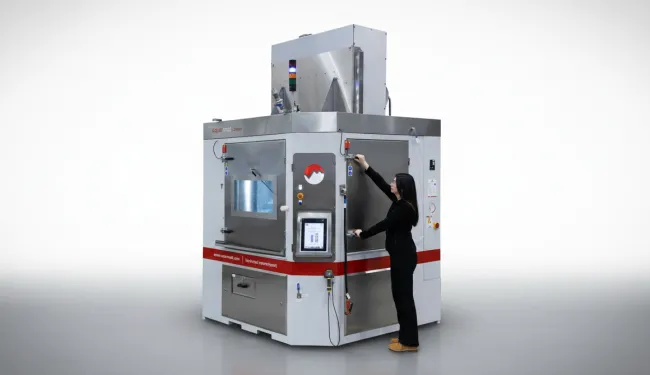
Vapormatt Sabre automatic wet blasting machine
Trusted by
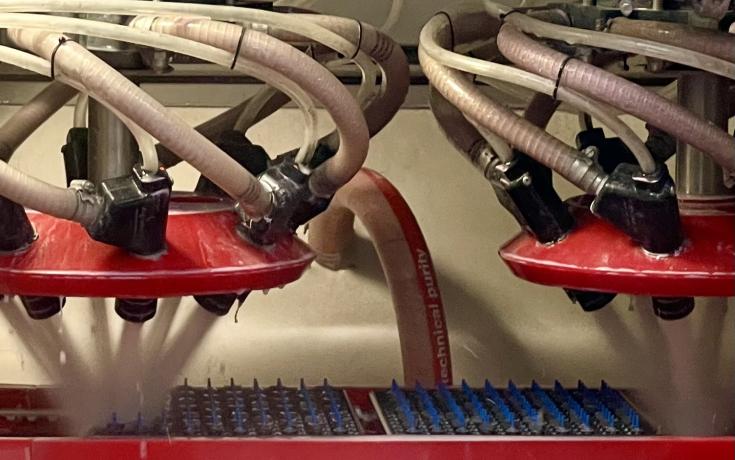
Cutting tool inserts being finished in a Vapormatt Tiger automatic wet blasting machine

What a good vapor blasting machine delivers

  • Closed-loop slurry recirculation, so the media is filtered and reused rather than drained, keeping consumption and running costs down.
  • Slurry concentration and pressure held within tolerance throughout the cycle, so part 10,000 matches part one. Machines that don’t monitor the slurry drift, and the finish drifts with them.
  • A single-pass result: cleaning, degreasing and finishing in one operation rather than several.
  • A build designed for abrasive slurry, with motors and drives positioned to minimise wear, so the machine runs for 20 years or more.
  • Low energy and air use. Vapormatt’s automatic machines typically use less than half the energy of equivalent competitor machines.
  • Proof on your own parts before you buy, through sample trials at Vapormatt’s R&D Centre.

See how Vapormatt engineers that consistency into every machine
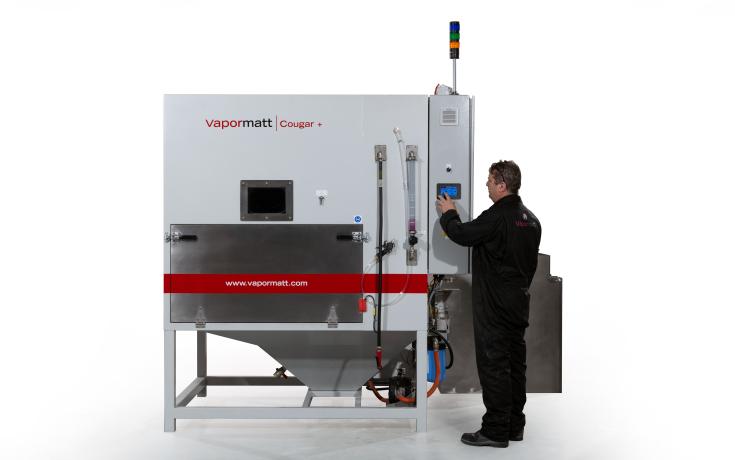
Vapormatt Cougar+ automatic wet blasting machine

Manual and automatic vapor blasting machines

  • Automatic vapor blasting machines - for production environments where the process needs to run the same way, unattended, thousands of times over. Most customers start with the Puma+ or Cougar+; specialist cells include the five-axis Sabre and the in-line Tiger for cutting tool inserts. 
  • Manual vapor blasting machines - for lower volumes, prototyping, or components with variable geometry where an experienced operator is more efficient than automation. The range runs from the compact Vapormate for R&D and small parts to the PumaXL, with a turntable rated to 250kg.

Get a machine recommendation from an applications engineer

Where vapor blasting machines are used

Aerospace coating removal and wet shot peening of jet engine components, cutting tool deburring and edge preparation, industrial cleaning and degreasing ahead of assembly or coating, and paint and coating stripping back to bare substrate. 

Contact us

Tell us your parts, material, volumes and target finish, and a Vapormatt applications engineer will recommend a machine with an indicative budget.

FAQs

What is a vapor blasting machine?

A vapor blasting machine mixes water and abrasive media into a slurry and projects it at a component using compressed air, cleaning, degreasing and finishing the surface in a single pass without dust or embedded grit.

How is a vapor blasting machine different from a sandblasting cabinet?

A sandblasting cabinet fires dry abrasive directly at a part, which can embed grit in the surface, generate dust, and heat thin sections. A vapor blasting machine cushions the abrasive in water before impact, avoiding all three, and finishing the part in one pass rather than several.

Do I need an automatic or a manual vapor blasting machine?

That depends on production volume and part geometry. Automatic machines suit high, repeatable volumes; manual machines suit lower volumes or varied parts where operator control adds value. Our guide to buying a wet blasting machine covers how that decision gets made.

How long does a vapor blasting machine take to pay for itself?

It depends on the level of automation, cabinet size, number of blast guns, part handling, and rinsing and drying. Manual cabinets have the lowest capital cost; automatic machines cost more but lower the cost per part at volume. The payback can be substantial: an automatic Vapormatt Leopard cut GE Aerospace’s total component processing time from 430 hours to 88. Request an indicative budget for your components, or read our wet blasting machine costs and buying guide.