How sharp is your file? And how do you know?
File makers have judged sharpness by feel for two hundred years. Here's why that isn't enough, and what measuring it could look like.
My father, Stewart Ashworth, spent his working life in wet blasting. Of all his stories about the file industry, one has stayed with me.
In the 1960s he watched a quality engineer test files. The engineer wore one particular woollen jumper. He leaned back, laid a file flat against his chest, then slowly straightened up, watching how far he could rise before the file slid off. A sharp file gripped the wool and held on as he came upright. A dull file let go early. That angle was his measure of sharpness.
It sounds eccentric. It was also rather clever. It judged the one thing a file user notices first: how readily the teeth bite.
Learn more about the history of wet blasting
Two hundred years of judging by feel
The jumper was one man's version of a very old idea. In the nineteenth century, the Sheffield file makers checked their work with a 'prover': a bar of steel hardened slightly softer than the file, drawn across the teeth. A good file bit into it. A poor one slid over it.
Much of the industry still works the same way. A wooden block drawn across the grain. A steel test stick that should grab the teeth and leave small flecks of steel behind. An experienced inspector's hand. A file sharpener in California, filmed for a YouTube channel, tries each file on a block of wood after sharpening: 'If they'll file that, then they're good.'
These are good tests in skilled hands, but they share two limits. They give a pass or a fail, not a number. And they depend on the person, the block and the day.
How the standards test file sharpness
Few standards deal with cutting performance at all. The international standard, ISO 234, covers the dimensions of files and rasps and the coarseness of their cut, not their sharpness.
The most complete example I have found is the Indian standard for engineer's files, IS 1931:2000. It sets two tests.
The hand prover test is the Sheffield prover written into a specification. A hardened steel bar, about 25mm by 5mm and 250mm long, is held at about 30° and pressed over the file from point to shoulder, with only enough pressure to make it bite. If it slips over any part of the file, the file is rejected. The prover's hardness is set by file type, from 545 to 675 HV.
The endurance test is something else. A machine files a steel test bar under a set pressure, and after 30,000 strokes the file must have filed away a minimum length of bar.
In other words, the hand prover is a bite test. The endurance test is a material removal test.
Soft or blunt? The prover can't tell
There is a catch in every bite test, from the jumper to the standard. A file whose teeth are too soft and a file whose teeth are hard but blunt both let the prover slide. The Sheffield file makers treated that as a strength, because one test caught both faults. But it means a failed file tells you something is wrong, not what.
So a file's quality really rests on three things, not one: how hard the teeth are, how readily they bite, and how much material they remove over their working life. Hardness is easy to measure, and every file maker does. Bite and MRR are the two that usually aren't.
Bite and material removal are not the same thing
Bite is how readily the edge of each tooth catches on the first stroke. It depends on the condition of the cutting edge itself: how keen it is, and whether anything sits in the way. It is what a customer feels the moment they pick up a new file, and often how they judge the brand.
Material removal rate (MRR) is how much metal the file takes off, stroke after stroke, over thousands of strokes. It depends on tooth form, hardness, how well the chips clear from the gullets, and how the edges wear. It tells you about working life.
A file can do well on one and disappoint on the other. The teeth also bed in: in laboratory tests, the friction between a file and its test material changes over the first runs, so the first strokes and the long run tell different stories. A 30,000-stroke endurance figure says little about how the first stroke feels.
What gets in the way of the bite
So what decides how well a new file bites? Partly the cut itself, and partly what happens to the teeth in the heat of hardening, a part of file making that has changed surprisingly little in two hundred years.
The Sheffield file makers coated the teeth with a paste of charcoal, salt and water, with flour, horn dust or oatmeal, heated the files in a bath of molten lead, then quenched them. Today the bath is more often molten salt, and every maker guards its own recipe, but files are still coated before hardening. Japanese makers traditionally use a paste made from miso; one says the salt in it helps the file cool evenly in the quench. The coating keeps the bath off the teeth and stops the surface of the steel losing carbon, so the tooth tips come out fully hard.
The oldest recipes went further still. When files were made of iron or soft steel, they were packed in charcoal or horn and heated for hours, so the surface absorbed carbon and could then be hardened: the more carbon in the steel, the harder it gets when quenched.
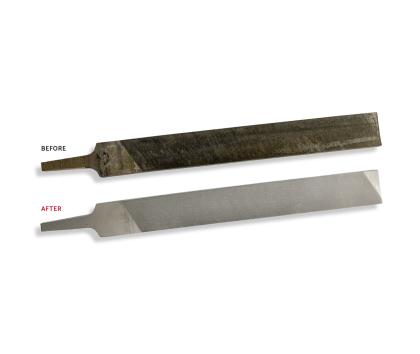
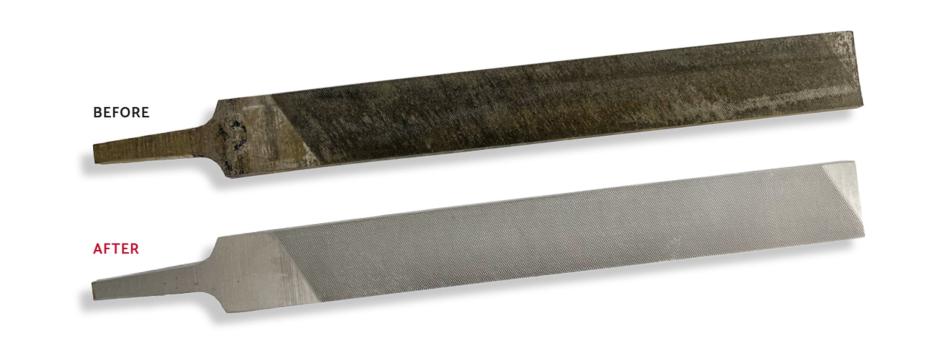
Whatever the recipe, something is left behind after the quench: coating residue, scale and salt or lead, packed into the gullets and lying along the cutting edges. That can be what stands between a well-cut tooth and a good bite.
When sharpening became a separate step
The Sheffield file makers cleaned their files after hardening, but didn't sharpen them. The paste was scoured off with coke dust and a brush; some firms used bristly half coconut shells, which the soap makers gave away. The cutting edge came straight from the chisel.
Blasting to sharpen files appears later, in American patents. In 1906 a Chicago inventor patented a file-sharpening machine that used steam to blast a wet mix of carborundum and ground quartz at the file. In 1959 the Simonds file company patented a high-pressure slurry blast aimed only at the backs of freshly cut teeth, to hone the cutting edge. By 1971, a German documentary filmed at a small file factory near Remscheid showed a worker feeding each file by hand into a wet blasting machine after hardening.
The same kind of machine is still running in California. The sharpener there drives an abrasive slurry with steam and moves each file back and forth under the nozzles by hand. In his words, 'the abrasive blast takes metal from the back of the files and reforms the edge'. He sharpens new files before he sells them, because some brands' new files 'feel dull': the makers, he says, 'used to sharpen them at the factory', and stopped.
That is the bite question in a sentence. A file can be well made and correctly hardened, and still not bite as it should on the first stroke.
Putting numbers on file sharpness
Which brings us back to the jumper. If the bite depends on what happens to the teeth after the quench, a pass or fail test isn't enough to manage it. You need to know how much better, or worse, one file is than another.
This is where our own work is heading. We measure the edge radius of file and rasp teeth, in microns, on a 3D optical microscope: a direct measure of how keen the cutting edge is. And we have been working with engineering consultants at the University of Southampton on a measured cutting test. A wooden pin runs over the file on a reciprocating test rig, which records the friction as the teeth bite and the material removal rate (MRR): the mass of wood the file takes off per stroke, and how that changes as the teeth bed in and wear.
It is early work, with a small number of files, and it is not a standard. But the direction is clear: from the jumper, the prover and the test block to numbers that a file maker can write into a specification, use to control a process, and show to its own customers. Hardness, bite and MRR, each measured, each with a number.
Why this matters to us
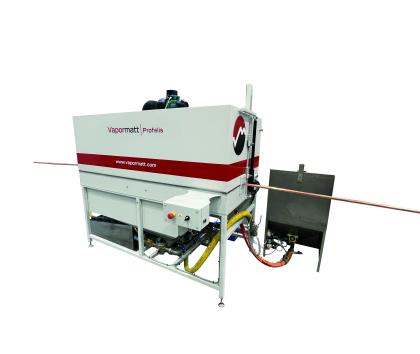
Four generations of my family have built wet blasting machines, and our family's work with file makers goes back to the 1950s. Today, our Profelis FR (File and Rasp) cleans heat scale out of every tooth and sharpens the cutting edge in a single pass, on a conveyor rather than by hand, so every file gets the same treatment. We would rather show what it does in measured results, on your own files, than describe it in adjectives.
Over to you
How do you test sharpness in your factory today? A block, a stick, a prover, a machine, or something of your own? And if you have a jumper story of your own, I would love to hear it.
Robin Ashworth, Managing Director, Vapormatt
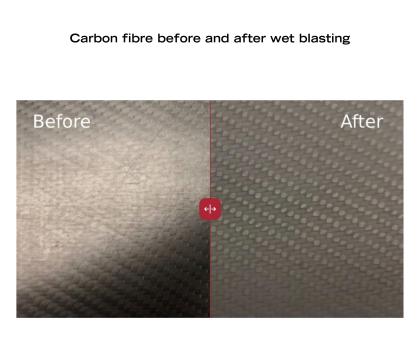
Learn about wet blasting for files and rasps
Discover the Profelis FR automatic wet blasting machine for files and rasps