
Contact us if you would like to discuss the benefits of vapor honing for your components
Vapor honing is wet blasting: a slurry of water and fine abrasive, driven at a part by compressed air, that cleans and finishes a surface without dust, heat or embedded media. The term is often used interchangeably with vapor blasting, particularly for restoring engine and motorcycle parts. In precision manufacturing it means something more specific: wet blasting controlled so tightly that the result (an edge radius, a K-factor, an Ra value) is specified in microns and repeats from part one to part ten thousand.
The name itself comes from the same root as the process: Norman Ashworth called his 1940s invention 'liquid honing' because the water-cushioned abrasive stream behaved less like blasting and more like honing - a controlled, lapping action rather than a series of individual impacts. Vapor honing is that same mechanism, applied wherever the outcome has to be measured in microns rather than judged by eye.
What vapor honing actually does to a surface
In dry blasting, abrasive particles strike a surface at full velocity, with a risk of embedding into it, and remove material unevenly. In vapor honing, the water cushions each particle's impact, changes the angle of contact, and creates a flowing, lapping action across the surface rather than a series of direct hits. The result is a surface that is deburred, edge-honed, and finished in one motion, without the pitting, embedding, or heat distortion that comes from dry processes.
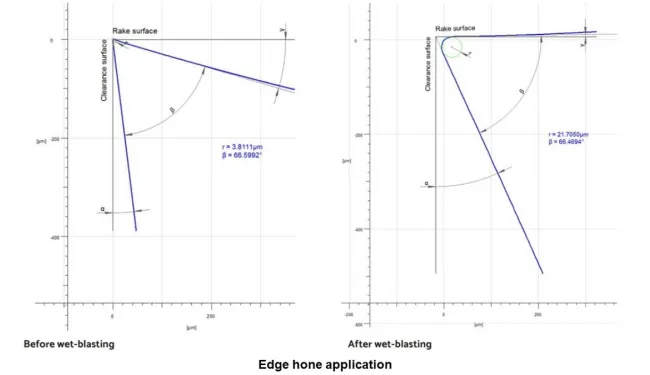
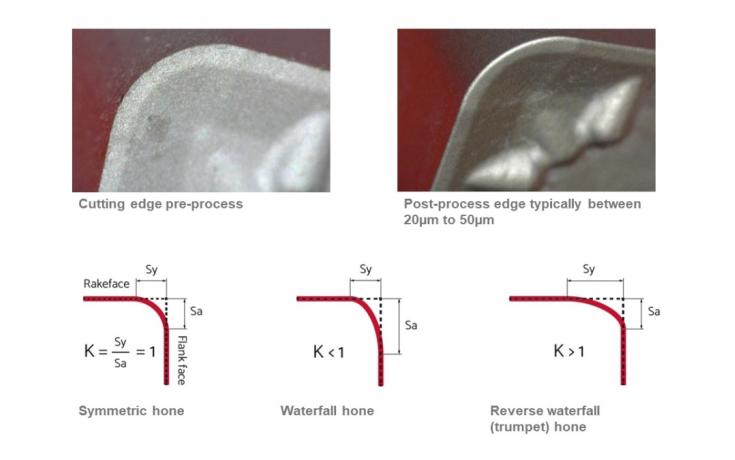
That control is what makes vapor honing suitable for tolerance-critical work: honing a cutting edge to a specific K-factor, breaking a burr without rounding a feature that needs to stay sharp, or holding a repeatable Ra value across thousands of identical parts. K-factor describes the shape of a honed edge: the ratio of the edge rounding on the rake face to that on the flank face. A K-factor of 1 is a symmetrical hone; above or below 1 gives a waterfall or trumpet profile. Ra is the average roughness of a surface profile, measured in microns. On automatic Vapormatt machines, edge hones can be held to within ±2µm tolerance and surface finishes can reach 0.2µm Ra. Those results depend on 15 interacting process variables (media type, size, concentration, air pressure, nozzle geometry, standoff distance and more) being held constant, not left to an operator's feel.
Where vapor honing is used
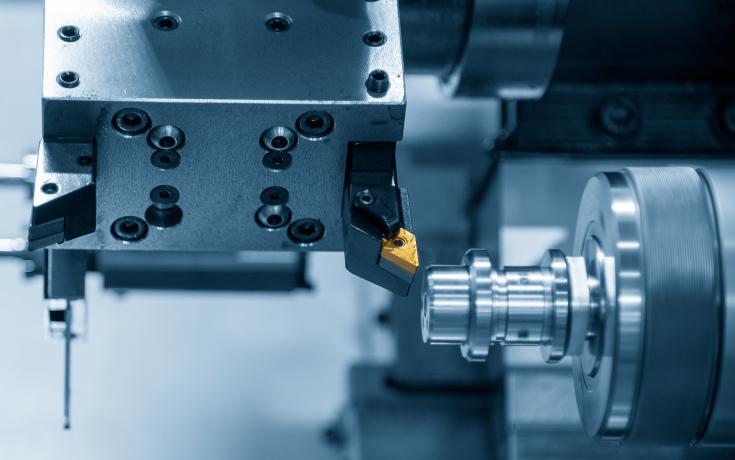
- Cutting tools: edge honing to a precise K-factor
- Precision components: controlled deburring where over-honing a feature is as costly as under-honing it
- Additive manufacturing: smoothing and edge control on printed parts where geometry has to be preserved
- Medical implants: surface roughness held within a defined band for biocompatibility
Why the process has to be precise, not approximated
A vapor honing result is only as repeatable as the machine producing it. Media that breaks down changes its cutting characteristic mid-cycle; slurry that isn't held at a consistent concentration changes the result part to part; air pressure that drifts changes the finish. Vapormatt machines run as closed-loop systems, continuously monitoring and correcting slurry quality and air pressure so a honing 'recipe' set on part one still holds on part ten thousand.
What vapor honing delivers in practice
A customer honing round shank tools reported a 50% improvement in tool performance compared with their previous blasting-only process, rising to 100% when vapor honing was combined with a new coating. A regrinder applying a defined edge hone to resharpened high-performance drills on an automated Oncilla increased tool life by five to seven times. In Vapormatt sample trials on tungsten carbide inserts, the K-factor stayed within specification across every processed insert.
Vapor honing vs other edge preparation methods
Vapor honing isn't the only way to prepare an edge. Here's how it compares with the other common methods for tolerance-critical work.
| Vapor honing | Brush honing | Drag finishing | Dry micro-blasting | |
|---|---|---|---|---|
| How the edge is formed | Water-cushioned abrasive slurry, lapping action | Abrasive-filled nylon brushes | Tool dragged through loose media | Dry abrasive in compressed air |
| Edge radius / K-factor control | Set by pressure, media, angle and dwell; held by closed-loop control | Good on uniform edges; harder on complex geometry | Good on round shank tools | Possible, but more sensitive to drift |
| Micro-chipping risk on carbide | Low: water cushions each impact | Low to moderate | Low | Higher: full-velocity impacts |
| Complex and internal features | Reaches any surface the slurry stream can access | Limited to edges the brush contacts | External surfaces only | Line of sight only |
| Cleans and preps for coating in the same cycle | Yes | No | No | No; dust extraction needed |
| Best suited for | Inserts, round shank tools, bandsaw blades, precision and AM parts | High volumes of simple insert geometries | Round shank tools needing polished flutes | Low-volume or legacy lines |
See the full comparison against dry blasting, drag finishing and chemical etching
FAQs
Is vapor honing the same as wet blasting?
Yes. Vapor honing, vapor blasting and wet blasting are the same process: water and abrasive mixed into a slurry and projected under compressed air. "Vapor honing" is the name most often used when the process is controlled to a measured tolerance, such as an edge radius or Ra value, rather than a visual finish.
What tolerances can vapor honing achieve?
Vapormatt machines hold edge hone tolerances to within ± 2µm and surface roughness values as low as 0.2µm Ra, depending on media selection, pressure, and part geometry.
Can vapor honing be used on hardened materials like carbide?
Yes. Vapor honing is widely used on carbide and other hard tooling materials to hone cutting edges to a defined K-factor without the heat generation or embedding risk of dry processes.
What is vapor honing used for?
Honing cutting tool edges to a defined radius and K-factor, deburring precision components without rounding critical features, smoothing additively manufactured parts, and holding medical implant surfaces within a set roughness band. It also cleans and prepares surfaces for PVD and CVD coating in the same cycle.
What's the difference between vapor honing and vapor blasting?
There's no difference in the equipment or mechanism. "Vapor blasting" is the general term; "vapor honing" describes the same process configured and controlled for precision work, where the result is measured in microns.
Will vapor honing change my part's dimensions?
Only where you intend it to. On cutting tools, material is removed from the cutting edge, not the rake or clearance faces, and gun angle, pressure and fixturing are set to protect geometry from the start.
What media is used for vapor honing?
For edge honing, aluminium oxide between 150 and 320 mesh is typical: coarser for larger radii, finer for tighter edges. Other media suit finishing and peening work.
Is "vapour honing" the same as "vapor honing"?
Yes. "Vapour" is the UK and Commonwealth spelling of the same process.
How do I know if vapor honing will work on my components?
Send us sample components with your target edge radius or Ra. We'll process them and return the measurement data, so you can decide on confirmed figures.