
The technical challenge
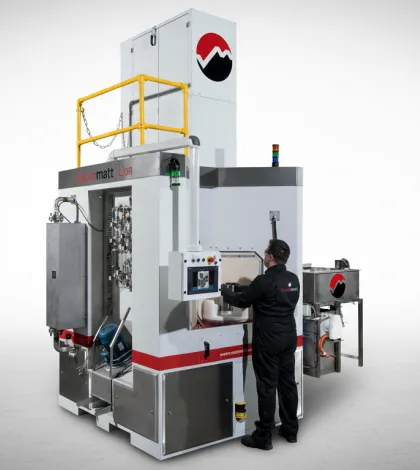
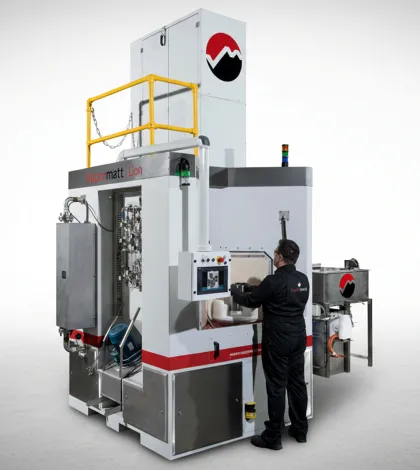
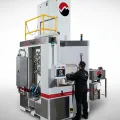
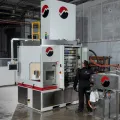
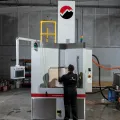
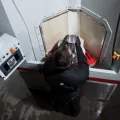
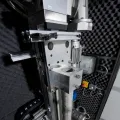
High-volume parts that need multiple finishing stages create the same problem in every operation: handling. Every transfer between blast, rinse and dry adds cycle time, exposes the part to damage, and breaks process traceability. The Lion Rotary was engineered to resolve all three in a single indexed cycle.
Process control and compliance
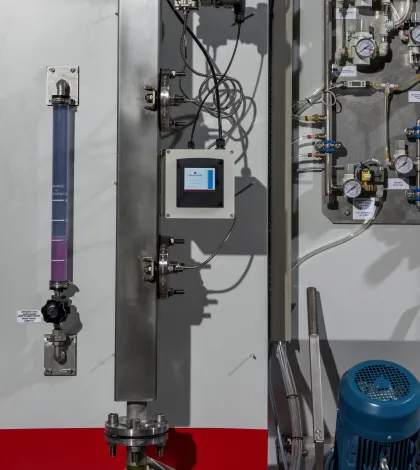
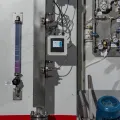
The Lion Rotary processes one part per zone at the same time. Each component’s recipe (blast pressure, oscillation stroke, satellite rotation speed and rinse duration) is stored on the HMI and recalled by component number, or loaded from a batch card with the optional barcode scanner. Hydrocyclone slurry conditioning keeps abrasive media consistent as standard, with the optional patented elutriation tower for tighter repeatability at production volume. After rinsing, components are clean to ISO 8503-2 class 2. A process monitor shows real-time trend lines for grit-water ratio, air flow, actuator movement and media added. Optional MES data logging records every cycle for traceability, and Vapormatt 4.0 adds remote diagnostics and recipe backup.
Why Vapormatt
The Ashworth family invented wet blasting in the late 1940s and founded Vapormatt in 1978. We have spent the decades since engineering machines around the way real production lines actually run.
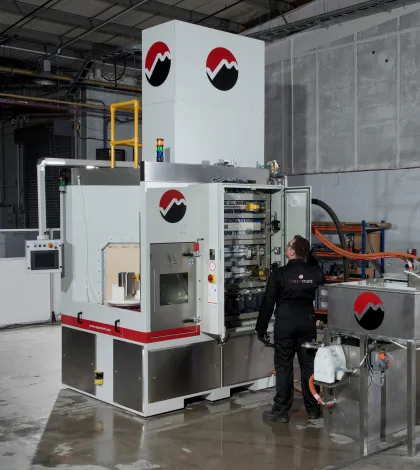
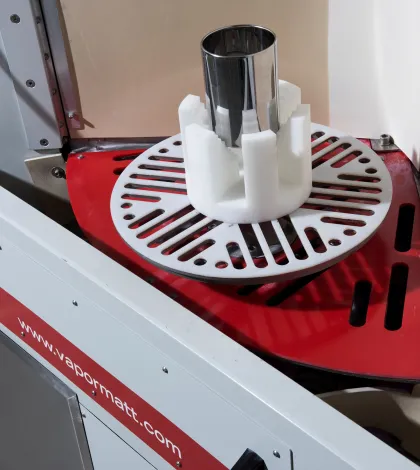
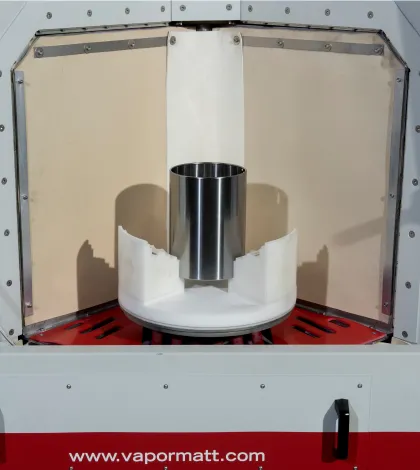
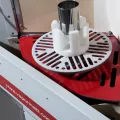
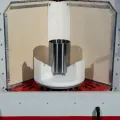
- Four-zone indexed architecture: Load/unload, waiting, blast and rinse zones are separated by fixed baffles, with one part touch per cycle. Blow-off drying at the unload station is standard, with heated air-sock drying optional. It eliminates inter-stage handling, cross-contamination and the cost of running separate machines.
- Production-scale wet finish: Wet blasting delivers controlled surface texture, no media embedment, no thermal effect, and a clean operating environment. Built into a rotary platform designed for repeat-part volume.
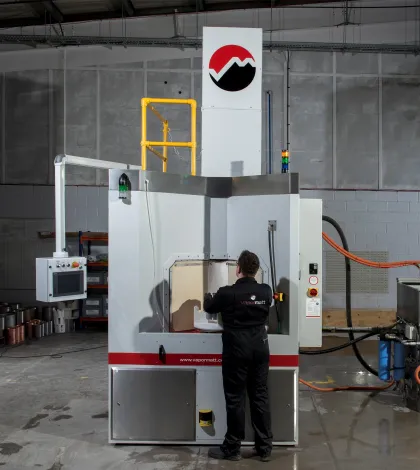
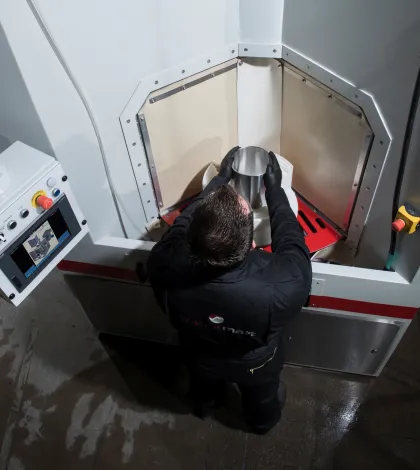
- Built for integration: Parts load by hand, robot or an optional jib crane rated to 450kg (992lb). Provision for occupied-space sensors means a robot can never place two parts in one position. Optional barcode recipe loading and MES data logging connect the machine to your factory systems, so it drops into an automated cell, not a standalone workstation.
The Vapormatt Promise: the machine meets the agreed specification, or we make it right.
The bottom line
Choose the Lion Rotary when parts with a surface of revolution, up to 430mm (17") OD and 91kg (200lb), need blasting, rinsing and drying in one continuous cycle with a single part touch. For heavier parts up to 1,000kg (2,205lb), or batch loads on one turntable, the Cougar+ is the better fit; for compact automation of smaller parts, choose the Puma+. Running blast, rinse and dry as separate steps costs cycle time, handling damage and traceability every shift. Send us your component drawing and we’ll confirm whether your part fits.
Lion Rotary technical specifications
| Parameter | Specification |
|---|---|
| Maximum component OD | 430mm (17") |
| Maximum component length | 559mm (22") |
| Maximum component weight | 91kg (200lb) |
| Component types | Surface of revolution, or components that can be held vertically, mounted at the centre of a satellite |
| Turntable | 4 zones (load/unload, waiting, blast, rinse) separated by baffles; satellites index 90° per step |
| Loading | By hand, crane or robot; optional jib crane rated to 450kg (992lb) |
| Satellite rotation speed | 10–30 rpm, recipe-controlled |
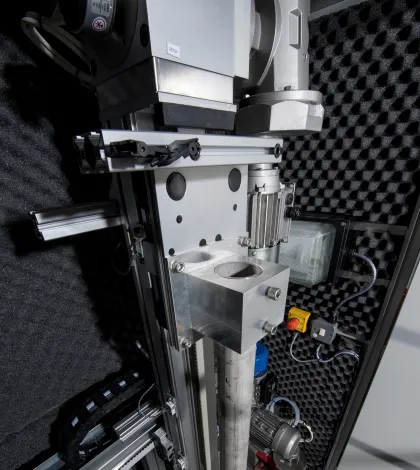
| Oscillation system | Vertical Z-axis, 600mm (23.6") stroke at 0–1500mm/min (standard); Y-axis horizontal adjustment (optional) |
| Blast guns | 2 × Vapormatt Mk3 with 10mm boron carbide nozzles (standard); Mk9 guns, approx. 10% more efficient (optional) |
| Drying | Manual blow-off nozzle (standard); powered drying with heated air sock (optional) |
| Cleanliness after rinse | ISO 8503-2 class 2 |
| Cabinet construction | Welded stainless steel, abrasion-resistant lining |
| Sound level | 80dBA maximum |
| Machine dimensions | 5.53 × 4.45 × 4.21m (18.1 × 14.6 × 13.8') |
| Floor space required (including service door access) | 5.5 × 6.0 × 4.2m (18.0 × 19.7 × 13.8') |
| Power supply | 400/480V 3-phase 50/60Hz, 12kW load |
| Process air | 6–7 bar (90–100 psi), max 2.90 Nm³/min (100 SCFM) |
| Water supply | 2–7 bar (30–100 psi), 13 L/min (2.86 US gpm) intermittent, DN15 (½" BSP) |