How automated wet blasting improves finish quality
Key takeaways: how automated wet blasting improves finish quality
Automated wet blasting eliminates the variability of manual processes by controlling up to 15 interacting process variables in real time.
Closed-loop systems maintain slurry concentration, pressure, and media condition cycle after cycle for consistent surface finishes.
Vapormatt's patented elutriation tower keeps particle size distribution stable throughout production runs without operator intervention.
Recipe-driven process control allows you to document and reproduce exact finishing parameters across shifts, machines, and facilities.
Automated systems reduce processing time by up to 80% compared to manual methods while improving dimensional accuracy and coating adhesion.
What makes surface preparation repeatable?
Surface preparation for coatings, bonding, or further processing depends on achieving the same result every time. A finish that meets specification on Monday needs to meet it on Friday, and on the ten-thousandth cycle. Manual processes cannot guarantee this because they rely on operator skill, fatigue, and judgment.
Automated wet blasting removes human variability from the equation. Machines control the parameters that determine finish quality: slurry concentration, air pressure, nozzle angle, component distance, and process speed. When these variables are held constant, the finish becomes predictable.
This predictability matters most in industries where inspection failures carry serious consequences. Aerospace components, medical implants, and cutting tools all require finishes that fall within tight tolerances. Automation makes those tolerances achievable at production scale.
How automation controls the variables that affect finish quality
Wet blasting involves up to 15 independently adjustable process variables. Each one interacts with the others. Media concentration affects surface profile. Abrasive breakdown affects process times. Slurry pressure affects wear on the machine. Any variable drifting slightly over time produces a measurable change in output.
Automated systems address this by monitoring and adjusting these variables during the production cycle. Sensors track slurry concentration and pressure in real time. Variable speed pump drives compensate for wear. Air flow monitoring detects changes to nozzle geometry before finish quality degrades.
Vapormatt machines use proprietary closed-loop engineering to hold these parameters steady. The result is a finish that stays consistent from the first component to the last, without relying on operator experience or manual checks.
Why media management matters for finishing quality
Abrasive media breaks down during production. As particles fracture, their size distribution shifts, and the surface finish changes with it. Standard filtration methods rely on sieves that block and cannot maintain the tight particle size window that critical applications require.
Vapormatt's patented elutriation tower solves this problem using fluid dynamics rather than screens. Based on Stokes' law, the tower continuously separates broken particles from the working media population. This keeps particle size distribution stable throughout the production run, not just at the start.
Controlled particle size means you get the same surface roughness on every component. For applications like coating preparation or bonding, where a specific Ra value determines adhesion performance, this consistency is essential.
The impact of particle size on surface roughness
Finer particles produce smoother finishes. Coarser particles create more aggressive profiles. When particle size drifts during a production run, so does the finish. You end up with components that look similar but perform differently.
Automated media management removes this variability. The Vapormatt elutriation system holds the media population within specification without operator intervention. This means your process engineer signs off a recipe once, and the machine delivers that recipe reliably.
How slurry delivery affects finish consistency
Inconsistent slurry delivery produces inconsistent results. If nozzles across a machine receive different concentrations or pressures, the blast pattern varies across the component surface. The consequences are uneven surface finish, dimensional variation, and process non-conformances that are difficult to trace.
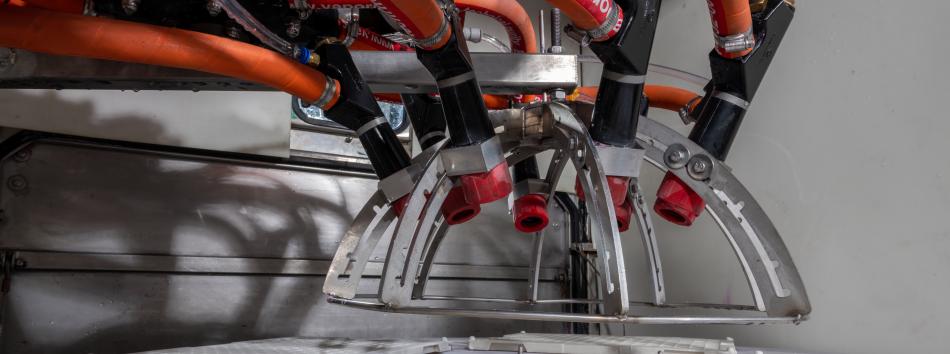
Automated wet blasting machines address this through engineered pipework and real-time monitoring. Vapormatt machines use the proprietary Vapormatt Slurry Pipework System (VSPS), which ensures each nozzle receives a consistent and equal supply. This modular delivery architecture was developed through decades of understanding how particles behave in liquid.
This is why Vapormatt process results hold where less controlled systems drift. The slurry reaches the right place at the right time, every cycle.
Recipe-driven process control for manufacturing repeatability
Recipe-driven control means you define the exact parameters for a finish once and store them in the machine. Air pressure, blast time, nozzle position, media concentration, and component handling are all recorded. When you run that recipe again, the machine reproduces those parameters exactly.
This approach has significant advantages for production environments. New operators can achieve experienced-level results by selecting the correct recipe. Quality teams can audit exactly what parameters were used on any component. Process engineers can compare results across machines and facilities.
For regulated industries, recipe-driven control also supports traceability requirements. Vapormatt 4.0, the company's IIoT platform, logs every process parameter for every cycle. This creates a complete production data record that integrates with your existing manufacturing systems.
Managing performance drift from natural wear
All blasting machines start to wear from the moment you turn them on. Pumps lose efficiency. Nozzles erode. Seals degrade. The question is whether the machine compensates automatically or silently allows output quality to decline.
Automated systems can detect and respond to wear before it affects your finish. Vapormatt machines use variable speed drives that compensate for changes in slurry pressure as pumps wear. Air flow monitoring on each nozzle detects changes to nozzle shape and size, with the machine compensating to prolong nozzle life.
This automatic compensation extends the usable life of consumable components and maintains finish quality between maintenance intervals. You get more consistent results and lower operating costs.
Where automated wet blasting delivers measurable results
The benefits of automation show up in production metrics. One manufacturer reduced compressor hub processing time from three hours to 20 minutes by installing a Vapormatt automatic machine. Another cut total component processing time from 430 hours to 88 hours, an 80% reduction.
These improvements come from two sources: faster cycle times and reduced rework. When the finish is correct the first time, components move through production without inspection failures or secondary processing. Quality improves while throughput increases.
Industries that rely on automated finishing
Aerospace manufacturers use automated wet blasting for shot peening, cleaning, and paint stripping of engine components, wheels, and brakes. The process meets AMS 2432 requirements for peening intensity and coverage verification.
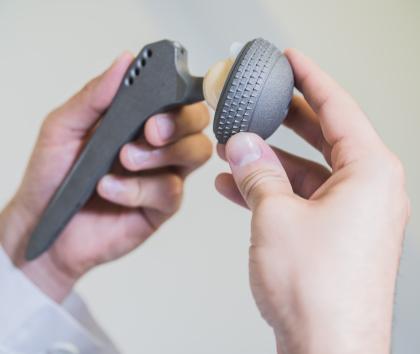
Cutting tool manufacturers use it for edge honing to K-factor specifications, pre-coating preparation, and burr removal. Medical device manufacturers rely on it for creating controlled surface roughness finishes that meet biocompatibility requirements.
In each case, the common requirement is a finish that can be specified, documented, and reproduced reliably.
How automation improves coating adhesion
Coating adhesion depends on surface cleanliness and surface profile. A clean surface with the correct roughness provides mechanical keying for the coating to grip. An inconsistent surface produces adhesion that varies across the component.
Automated wet blasting addresses both factors. The process cleans and profiles the surface in a single operation, removing contaminants while creating a specific Ra value. Because the process is controlled, that Ra value is consistent across every component and every surface area.
For composite bonding applications, where adhesion performance is safety-critical, this consistency is essential. Vapormatt machines achieve surface roughness values as low as 0.2µm and can hold edge hone tolerances to within ±2µm.
The safety advantages of automated wet blasting
Automated wet blasting machines enclose the process, keeping operators separated from the blast zone. Because wet blasting produces no airborne particulate, there is no dust extraction requirement and no explosion risk from airborne abrasive.
This makes automated wet blasting safer than manual dry processes on two counts. First, operators are not exposed to the process itself. Second, the process generates none of the respiratory hazards associated with dry abrasive blasting.
For facilities processing materials like cadmium-containing coatings, the elimination of airborne particulate is particularly valuable. The wet process captures removed material in the slurry, where it can be filtered and disposed of safely.
In conclusion: why automated wet blasting delivers consistent finishing quality
Automated wet blasting improves finish quality by removing the variables that cause inconsistency. Controlled slurry delivery, managed media breakdown, real-time parameter monitoring, and automatic wear compensation work together to hold the process steady.
The result is a finish you can specify and document, then reproduce reliably at production scale. For manufacturing engineers and production leaders who need finishing quality they can count on, automated wet blasting delivers the process control that makes repeatability possible.
FAQs about how automated wet blasting improves finish quality
What surface finishes can automated wet blasting achieve?
Automated wet blasting machines can achieve Ra values as low as 0.2µm and hold edge hone tolerances to within ±2µm. Vapormatt systems deliver these results consistently because closed-loop control maintains slurry concentration, pressure, and media condition throughout production runs.
How does automated wet blasting compare to manual processes for repeatability?
Manual processes rely on operator skill and judgment, which introduces variability between shifts and operators. Vapormatt automated systems control up to 15 process variables in real time, delivering the same finish on the thousandth component as the first without human intervention.
Can automated wet blasting replace multiple surface preparation steps?
Yes. Automated wet blasting combines cleaning, degreasing, deburring, and surface profiling in a single operation. This reduces handling time and eliminates the variability introduced by moving components between separate process lines.
What industries benefit most from automated wet blasting for finish quality?
Aerospace, medical devices, and cutting tool manufacturing rely heavily on automated wet blasting. These industries require finishes that meet tight specifications and can be documented for traceability. Vapormatt machines support these requirements with full cycle logging and process verification.
How does Vapormatt maintain media quality during production?
Vapormatt's patented elutriation tower uses fluid dynamics to continuously separate broken particles from the working media population. This keeps particle size distribution stable throughout production runs, ensuring consistent surface finishes without operator intervention or manual media checks.
What is recipe-driven process control in wet blasting?
Recipe-driven control lets you define and store exact process parameters for a specific finish. Vapormatt machines record air pressure, blast time, media concentration, and all other variables. When you run that recipe, the machine reproduces those parameters exactly, giving new operators the same results as experienced staff.