
Precise
Hit your Ra surface roughness target every time
Clean
No embedded abrasive. No compliance risk
Repeatable
Every implant. Identical result
Validated
Built for regulated manufacturing environments
The surface of an implant is not cosmetic. It determines whether bone integrates or rejects, whether a coating bonds or delaminates, whether a regulatory audit passes or stalls. Get it wrong and you carry the risk: failed osseointegration, embedded abrasive flagged in a biocompatibility assessment, a batch quarantined pending re-validation.
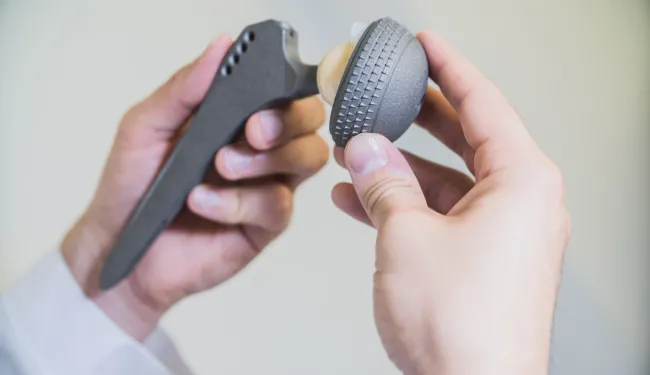
Wet blasting, also called vapour blasting or vapor blasting, propels a slurry of water and fine abrasive at the implant surface. The water cushions every particle, so the surface is textured to a set Ra without abrasive embedding. Vapormatt designs and builds the machines implant manufacturers use to finish hip stems, tibial trays, spinal cages and dental implants for osseointegration and coating adhesion, with every process parameter logged for ASTM F86 and ISO 13485 validation.
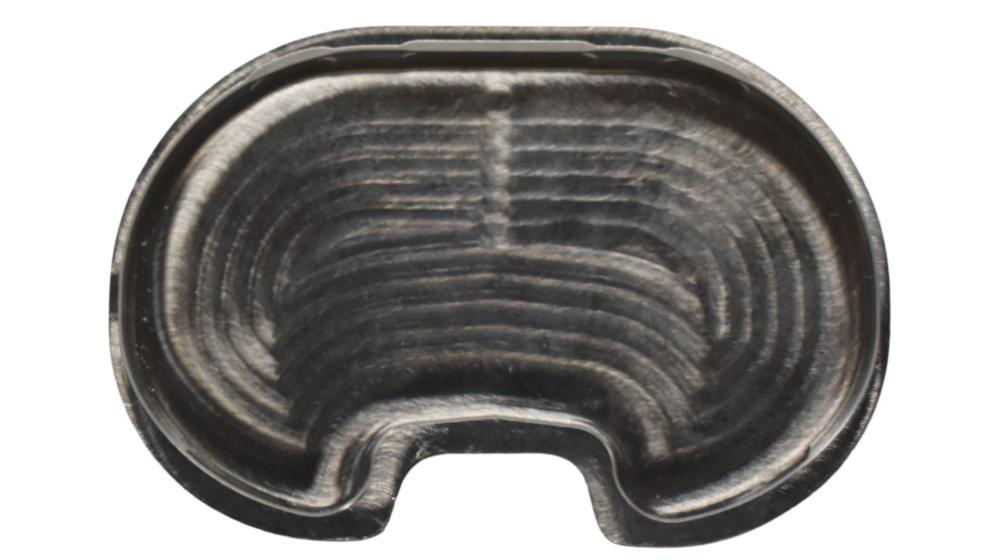
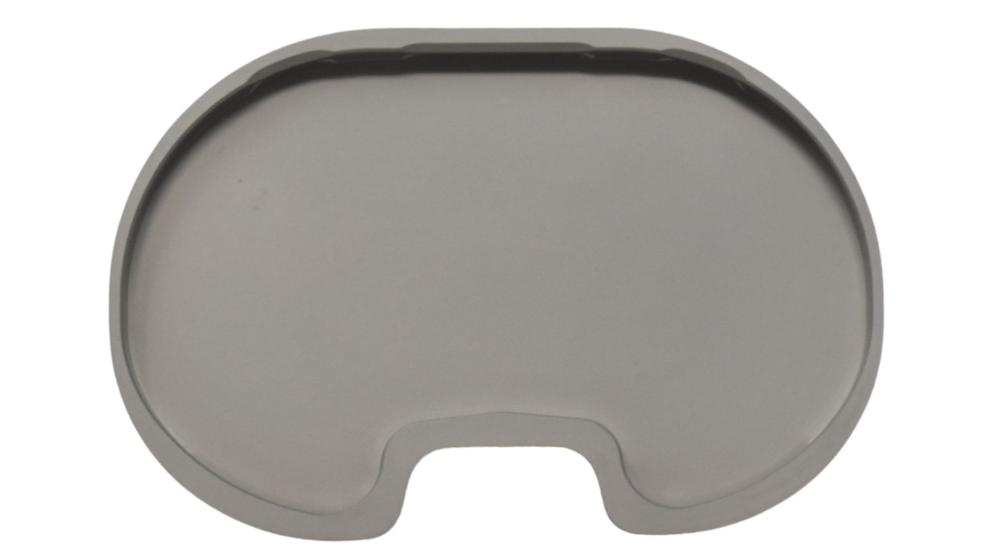
Tibial tray before and after wet blasting
Why the finishing process you use now may be creating compliance risk
Surface finishing in medical implant manufacturing is still dominated by processes that were specified decades ago. Each carries a specific mechanism of failure that becomes harder to defend as regulatory scrutiny increases.
vs. dry blasting: Compressed air drives abrasive particles into titanium and cobalt-chrome surfaces at high velocity. Without water to cushion impact, media embeds. Embedded ceramic or aluminium oxide particles in a surgical implant surface are a biocompatibility risk and a problem under ASTM F86, the standard practice for surface preparation of metallic surgical implants.
vs. drag finishing: More controlled than vibratory finishing and consistent on simple shapes. But every implant design needs its own fixture, and fixture-to-fixture variation shows up as Ra variation that is hard to validate. Porous ingrowth surfaces, internal tapers and undercuts are partly shielded from the media, so zonal Ra specifications cannot be held reliably. In a Vapormatt trial, wet blasting replaced the drag-finishing stage on titanium tibial base plates, removing CNC marks in 15 seconds.
vs. vibratory/tumble finishing: Effective for bulk deburring of simple geometries. Poor on complex three-dimensional implant forms - threaded sections, porous lattice structures, internal channels - where contact is inconsistent and Ra control is statistical rather than engineered. Not suited to the zonal finishing requirements of orthopaedic implants, where the articulation surface and the osseointegration surface demand different Ra values in close proximity.
Find out how wet blasting compares with other finishing processes
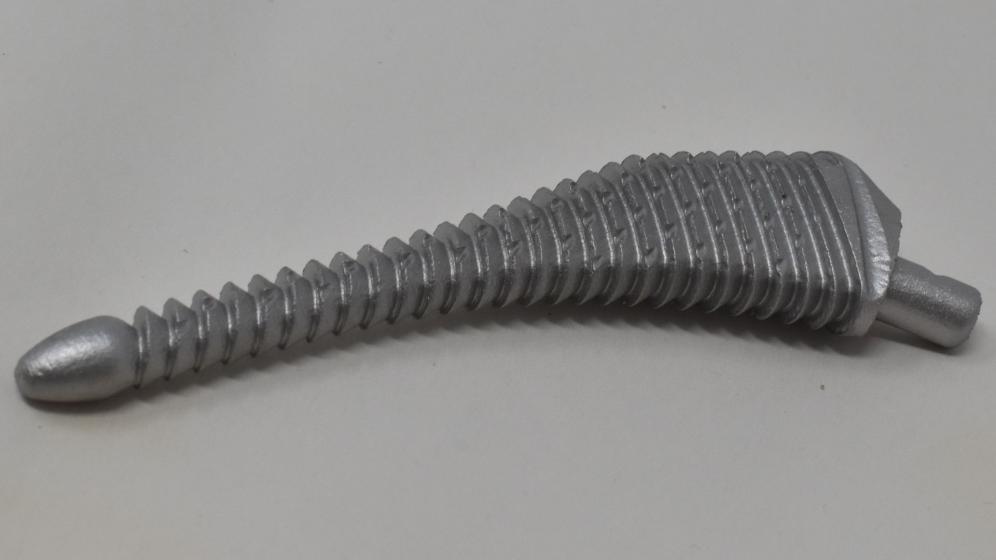
Hip stem before and after wet blasting
The surface specifications that implant performance depends on
Implant surfaces are not uniform. They carry multiple functional zones, each with a precise finishing requirement.
The osseointegration zone - where bone must grow into the implant - performs best with a controlled micro-rough surface. The target Ra for optimal cell adhesion and bone bonding lies between 1.0µm and 4.0µm depending on implant design and coating strategy, with moderately rough surfaces of 1-2µm showing the strongest bone response in published research. Too smooth and osteoblast attachment is poor. Too rough and bacterial colonisation accelerates.
Wet blasting achieves each of these surface conditions in a single validated process. Adjusting slurry pressure, media type, particle size, and dwell time allows a Vapormatt machine to move precisely between these Ra targets - on the same component, on the same shift, batch after batch.
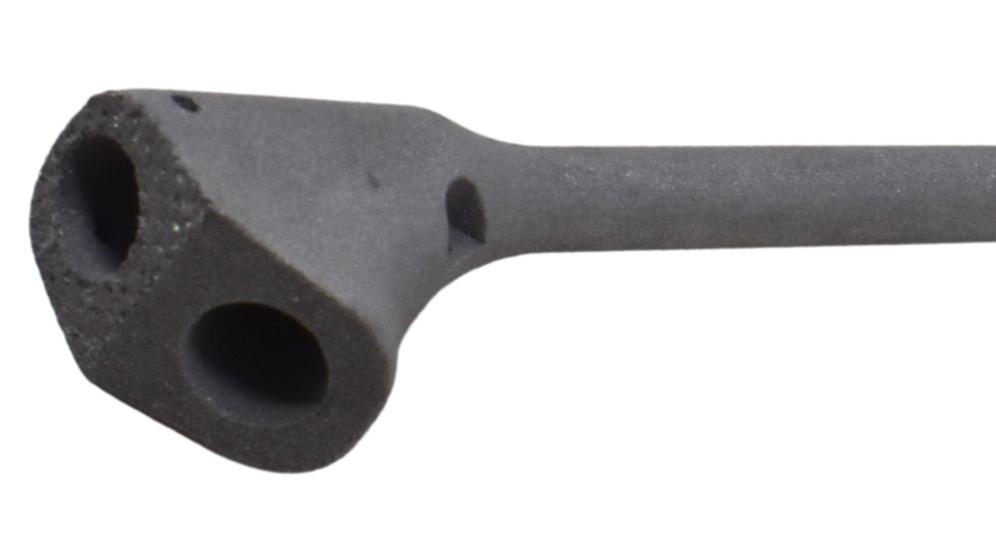
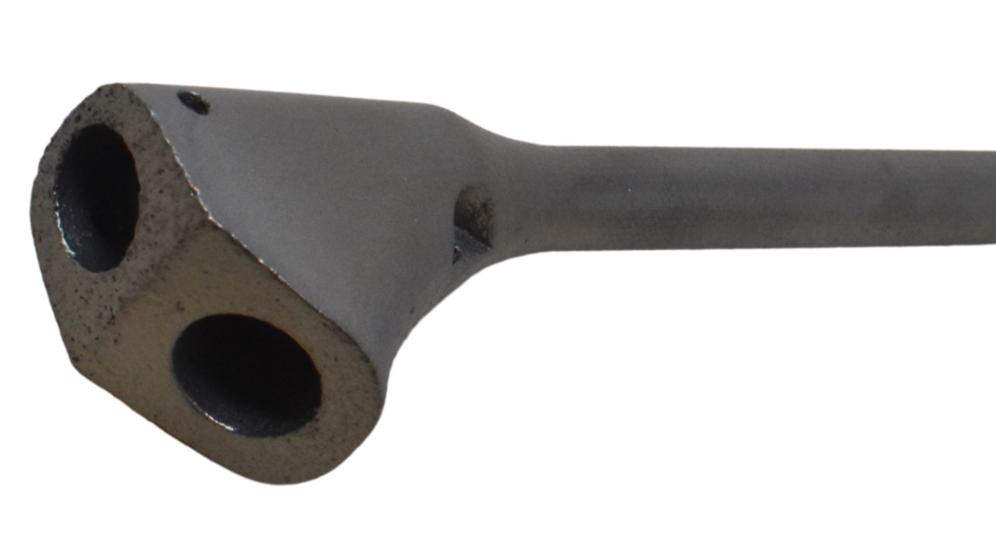
Shoulder stem before and after wet blasting
Wet blasting applications for medical and dental implant manufacturing
Implant manufacturers use Vapormatt machines across the full manufacturing sequence, not as a single finishing step. Applications include:
- Orthopaedic implants: Hip stems, femoral heads, tibial components, acetabular cups, bone plates and screws
- Spinal implants: Interbody fusion cages, pedicle screws, vertebral plates
- Dental implants: Titanium fixture deburring, osseointegration surface preparation, abutment finishing
- Dental prosthetics: Crowns, bridges, and dentures produced via additive manufacturing
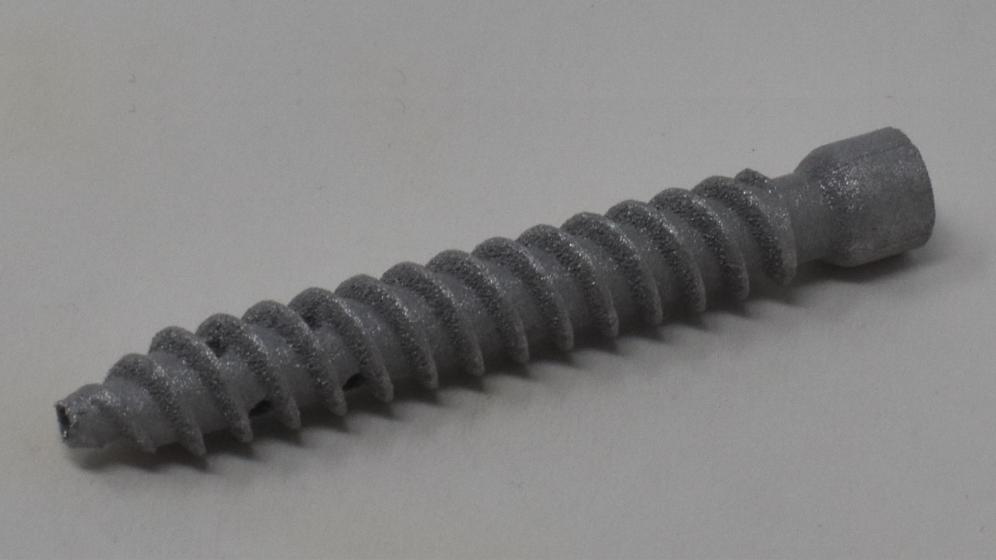
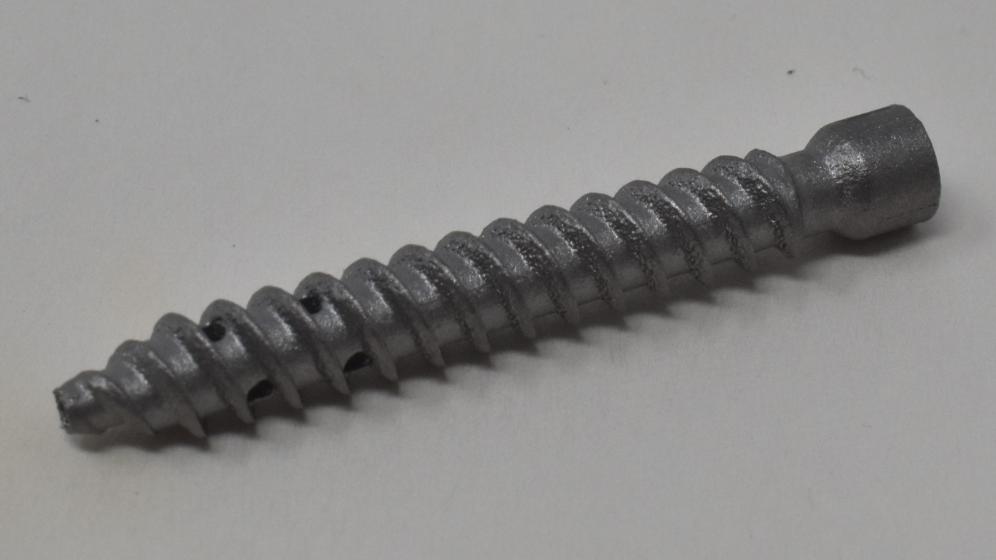
- Additively manufactured implants: Powder removal from internal channels, surface refinement of lattice structures, pre-coat preparation
For dental implants specifically, wet blasting has been shown to produce surfaces that are more hydrophilic than those finished by conventional SLA (sandblasted, large-grit, acid-etched) methods - improving blood wetting, accelerating protein adsorption, and supporting earlier cell attachment in the critical early healing window.
Learn more about biocompatible surfaces created by wet blasting
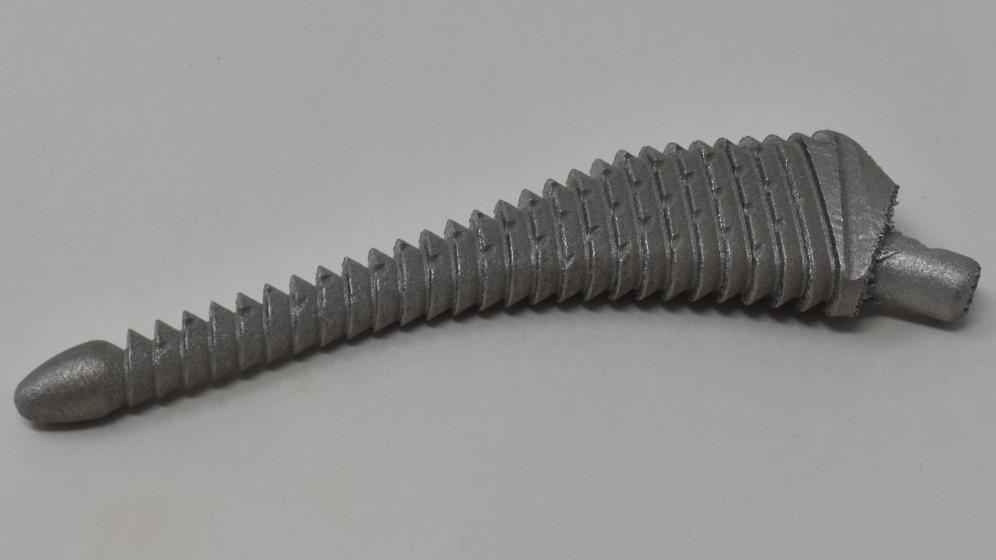
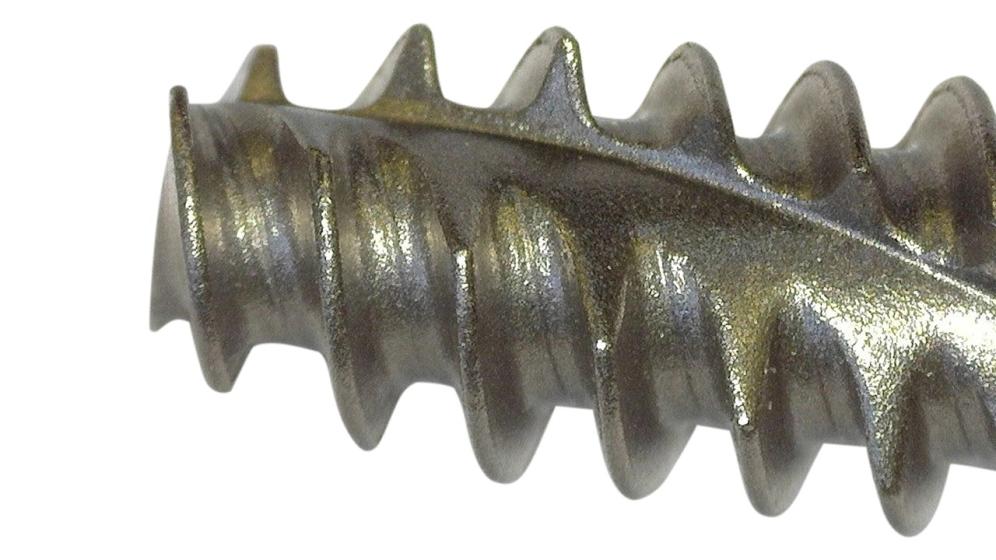
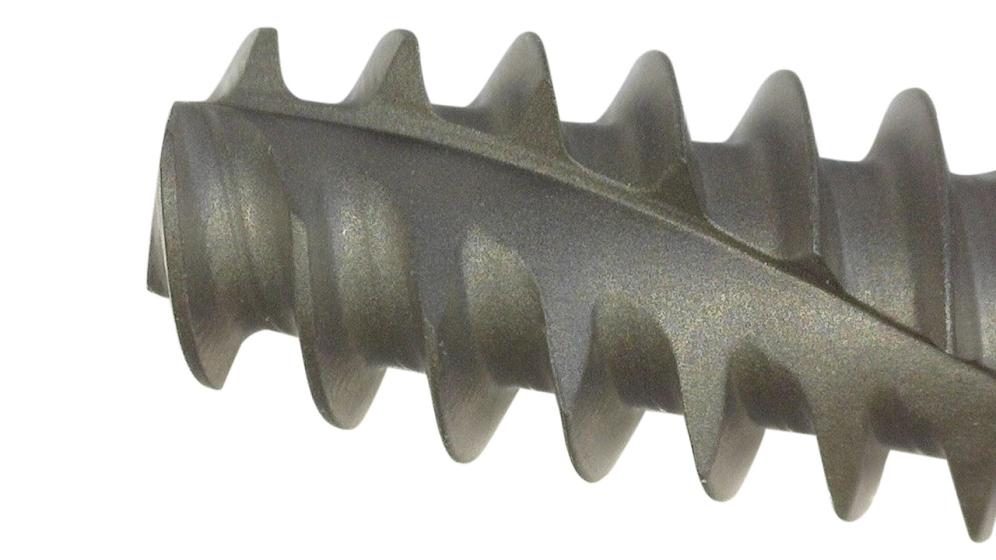
Additive manufactured screw before and after wet blasting
Why Vapormatt
The question a process engineer in a regulated facility needs to answer is not does wet blasting work? It is which supplier can I validate this against, and what happens when I need to re-qualify?
Vapormatt wet blasting machines (also known as vapor blasting machines) are designed for validated manufacturing environments. Process parameters - slurry concentration, pressure, media profile, cycle time, nozzle geometry - are fully controllable and fully recordable. Vapormatt has specialised in wet blasting since 1978, has supplied more than 2,000 machines to over 50 countries, and is still owned and run by the Ashworth family.
Three specific capabilities distinguish Vapormatt from generic wet blasting equipment in this sector:
Biocompatible media compatibility. Vapormatt machines can process implants using calcium-phosphate media such as HIMED's biocompatible grades. This eliminates the contamination risk that ceramic and aluminium oxide media present in implant surface finishing, and the finished surface carries no foreign-material residue that would require justification in a biocompatibility dossier.
Zonal finishing on complex geometries. Multi-nozzle and programmable machine architectures allow different surface zones on a single implant to be finished to different Ra targets in a single automated cycle. No manual re-fixturing. No inter-stage contamination risk.
AM implant capability. Additive manufactured (AM) implants - built by SLS, SLM, or DMLS - arrive from the printer with as-built roughness values that can exceed 30µm Ra and internal channels carrying un-sintered powder. Wet blasting refines the surface and flushes channels simultaneously. The liquid slurry provides a visible indication that a channel is clear - a functional advantage that dry blasting cannot replicate.
Dental implant fixture before and after wet blasting
The bottom line
A medical implant that fails surface finishing validation does not ship. One that passes but carries embedded abrasive or an uncontrolled Ra profile creates downstream liability that no manufacturer wants to carry. Vapormatt machines give implant manufacturers the process control and the finishing range to meet every surface specification - from the osseointegration texture on a titanium dental fixture to the sterilisation-ready Ra on a spinal cage - with consistency that holds across production volumes.
The alternative is to continue with a process that was not designed for this level of scrutiny, and to defend that choice in an audit room.
Related machines
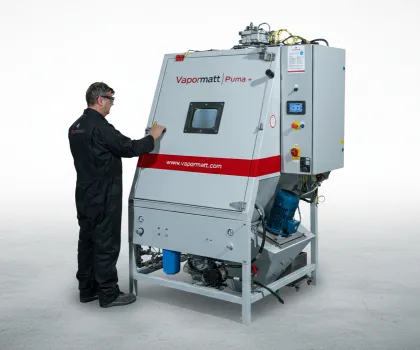
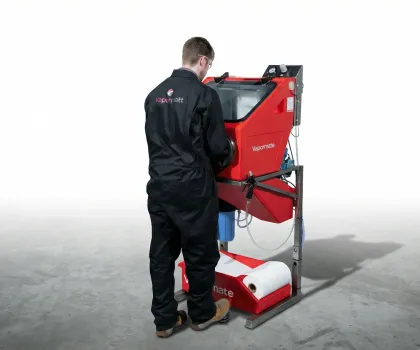
FAQs
How is wet blasting different from grit blasting or sandblasting for implants?
Grit blasting and sandblasting use compressed air to fire dry abrasive at the implant. Wet blasting suspends the abrasive in water, which cushions each particle on impact. Both create the micro-rough surface that osseointegration needs. Wet blasting does it with a much lower risk of abrasive embedding in the titanium, no heat build-up and no combustible titanium dust. The water also flushes debris away, so parts come out of the machine clean and Ra is easier to hold from one part to the next.
Does wet blasting leave abrasive embedded in the implant surface?
Wet blasting greatly reduces the risk. The water layer between the abrasive and the substrate absorbs impact energy, and residue is flushed away during processing rather than driven into the surface. Some implant specifications rule out foreign media altogether. For those, Vapormatt machines can run resorbable calcium phosphate media (also called RBM, resorbable blast media), such as HIMED’s biocompatible grades. Any trace residue is then calcium phosphate rather than alumina, glass or metal.
What Ra values can wet blasting achieve on titanium implants?
In Vapormatt trials, wet blasting produced titanium implant finishes from 0.12µm to 2.73µm Ra. Media grade sets the range and pressure fine-tunes it. The trial results were:
- Threaded titanium dental implants: 0.12 to 1.03µm Ra on one machine, by changing the media grade.
- Titanium tibial base plates: a homogeneous 0.236µm Ra in 15 seconds.
- 3D printed titanium implants: 2.55–2.73µm Ra with calcium phosphate media at 4 bar.
Osseointegration zones are typically targeted at 1.0–4.0µm Ra. Finishes for surgical instruments are covered on our medical and dental instruments page.
Can wet blasting finish different zones of one implant to different Ra values?
Yes. On Vapormatt automatic machines, multiple nozzles and programmed paths apply a different pressure and dwell time to each zone. An osseointegration surface and a smoother adjacent zone can therefore be finished to separate Ra targets in one cycle, without re-fixturing. Vibratory and drag finishing can’t do this: they average the finish across the whole part and leave recesses and undercuts under-processed.
Can wet blasting meet ASTM F86 surface preparation requirements for metallic surgical implants?
Yes. Wet blasting can be used as the surface preparation step under ASTM F86, the standard practice for surface preparation and marking of metallic surgical implants. It removes oxide scale, machining residue and surface contaminants from titanium, cobalt-chrome, stainless steel and tantalum implants without adding embedded material. It is also compatible with the passivation step that usually follows. Compliance is shown through the manufacturer’s own process validation.
Can a wet blasting process for implants be validated under ISO 13485 and FDA 21 CFR 820?
Yes. Clause 7.5.6 of ISO 13485 requires processes to be validated when their output cannot be fully verified by inspection, as with surface cleanliness and embedded particles. On Vapormatt machines, blast pressure, media concentration, media grade, nozzle position and cycle time are set and recorded. That lets the process be locked down through IQ, OQ and PQ and re-qualified when needed. The FDA’s Quality Management System Regulation (21 CFR 820) has incorporated ISO 13485 by reference since February 2026, so the same validation approach applies to FDA-regulated production.
Is wet blasting suitable for additively manufactured (3D printed) implants?
Yes. Wet blasting removes un-sintered powder from lattice structures and internal channels and refines the rough as-built surface in the same step. Slurry flowing out of a channel shows that the channel is clear. In a Vapormatt trial, residual powder was fully removed from 3D printed titanium implants, and the surface was finished to 2.55–2.73µm Ra with calcium phosphate media. The powder stays suspended in water, so no combustible titanium dust cloud forms.
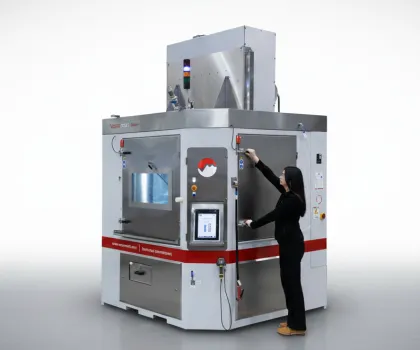
Which Vapormatt machine is used for implant finishing?
It depends on volume and geometry:
- The Vapormate compact manual cabinet suits R&D, process development and low-volume work.
- The Puma manual machine with a barrel attachment batch-processes small parts such as dental implant screws and pins.
- The Puma+ automates medium-volume production, with saved recipes and barrel, radial or vertical configurations.
- The Sabre five-axis CNC cell handles complex, high-value implants such as hip stems and tibial trays.
Can we trial wet blasting on our own implants before buying?
Yes. Send sample implants to Vapormatt’s R&D facility. An applications engineer will process them and report the Ra achieved, the cycle time and the settings used.