
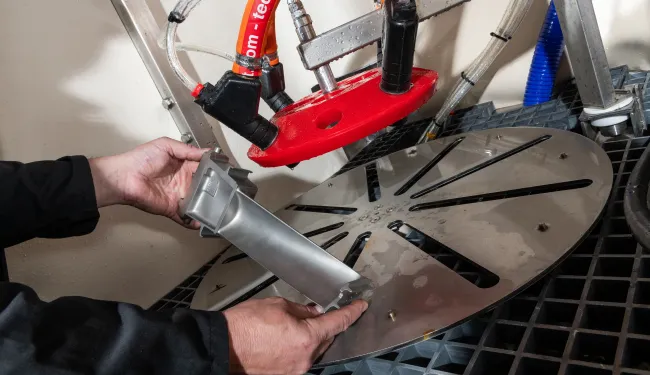
Aqua blasting is another name for wet blasting (also called vapour blasting): abrasive media is mixed with water into a slurry and projected onto a part with compressed air. The water cushions each particle, so it lifts corrosion, old coatings and contamination off alloy and steel parts without cutting into the metal, leaving a clean satin finish with virtually no dust.
Restorers and small workshops use it on engine cases, cylinder heads, wheels and marine hardware. Manufacturers use exactly the same mechanism at production scale for coating removal and surface preparation. What changes between the two isn't the process - it's how tightly the equipment controls it.
Talk to an applications engineer about your aqua blasting requirements
Aqua blasting at a glance
| Aqua blasting | The short answer |
|---|---|
| What else is it called? | Wet blasting, vapour/vapor blasting, liquid honing |
| How does it work? | Media and water are mixed into a slurry and projected with compressed air |
| What does it remove? | Corrosion, oxidation, paint, powder coat, lacquer and contamination |
| What won't it fix? | Pitting, deep scoring or existing damage to the metal |
| Which media should I use? | Glass bead for a satin finish on aluminium; aluminium oxide for coating removal and adhesion profile |
| What finish does it leave? | An even satin sheen, down to 0.2µm Ra |
| Does it create dust? | Virtually none; particles are captured in the water |
| Who invented it? | Norman Ashworth, in the UK, in the late 1940s |
| What machines are available? | Manual cabinets and automatic systems, built in Bridgwater, UK |
What aqua blasting does to the surface
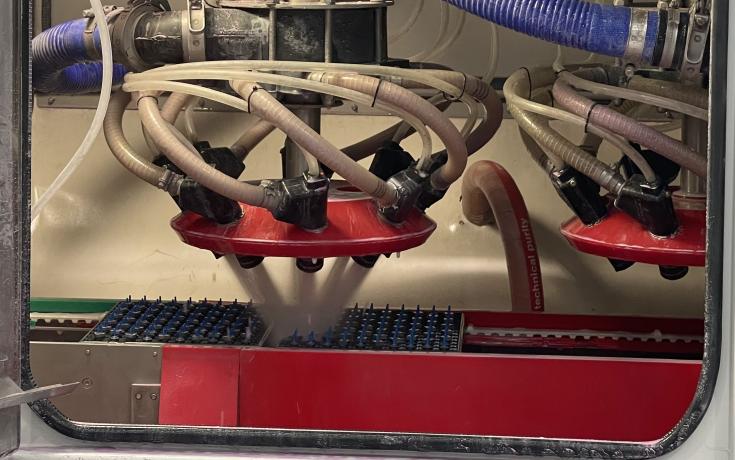
The character of the finish comes from the angle of attack. In a dry process, abrasive arrives at the surface as a stream of individual particles travelling at full velocity, each one striking and rebounding. The result is a cut profile - directional, relatively coarse, and aggressive enough on softer alloys to erode detail.
In aqua blasting, the water film around each particle absorbs part of that energy and deflects the contact across the surface rather than into it. The abrasive laps rather than cuts. On aluminium and magnesium castings in particular, that difference is visible immediately:
- Cast texture survives. Foundry marks, part numbers and original surface texture are still there afterwards, because the process removes what's sitting on the metal rather than a layer of the metal itself.
- Minimal embedded grit. Water flushes abrasive clear as it works, so media doesn't lodge in the surface the way dry abrasive can on soft alloys
- A satin rather than a matt finish. The lapping action leaves an even, slightly reflective sheen rather than the flat, chalky profile dry blasting produces.
- No heat build-up. Water carries heat away continuously, so thin sections, fins and gasket faces aren't put at risk of distortion.
- Virtually no airborne dust. Debris is captured in the water rather than thrown into the air, so no dust extraction system is needed.
What aqua blasting is used on
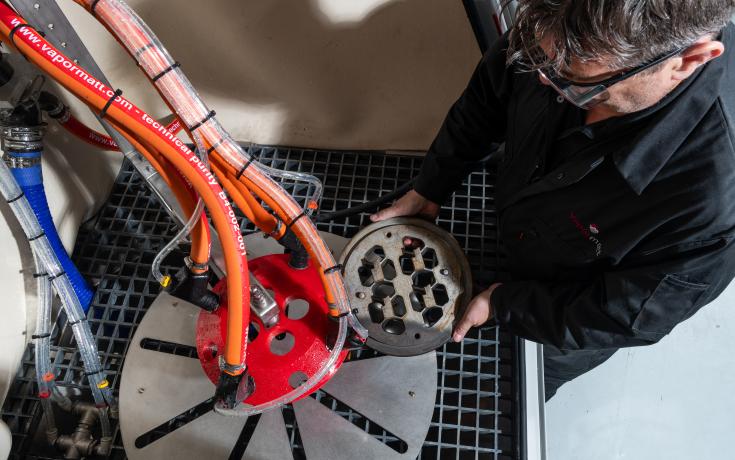
Engine and drivetrain castings - cases, covers, cylinder heads, barrels and sumps, where decades of oil staining, corrosion and exhaust deposits need to come off without touching sealing faces or opening up bores.
Fuel system components - carburettor bodies and throttle assemblies, where the process cleans external corrosion and gummed deposits; as with any blasting process, internal passages should be masked or flushed thoroughly afterwards.
Wheels and suspension parts - alloy wheels, hubs, calipers and brackets stripped of old lacquer and corrosion ready for recoating.
Marine hardware - stainless and bronze fittings, propellers and outdrive components where salt corrosion has to come off but the underlying metal has to stay intact.
Frames, brackets and fasteners - steel components cleaned back to a uniform surface before plating, powder coating or paint.
A note on what the process will and won't do: aqua blasting removes coatings, corrosion, oxidation and contamination. It does not remove metal to correct pitting, deep scoring or previous damage - anything that has eaten into the substrate will still be there afterwards, cleaner but unchanged. It's a cleaning and finishing process, not a repair one.
Media choice decides the finish
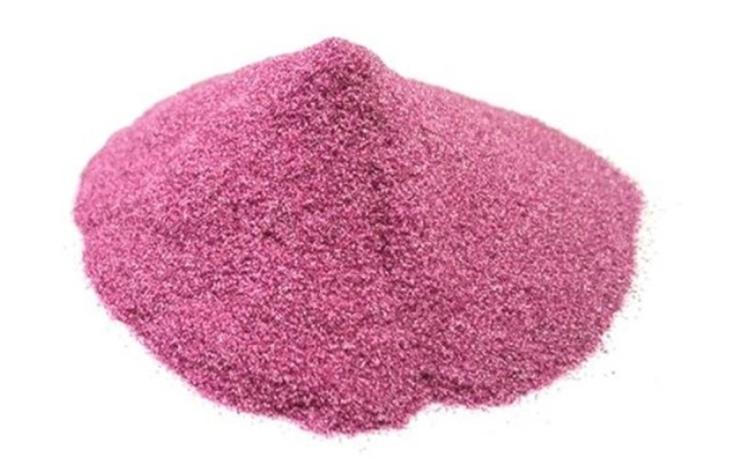
The same machine produces very different results depending on what's suspended in the water. Media selection is the main variable available once the process is set up:
- Glass bead produces the bright, even satin finish most associated with restored castings, and is the usual default for aluminium.
- Aluminium oxide cuts harder and faster, and is used where a coating has to come off or where a surface needs a profile for adhesion rather than an appearance finish.
- Finer grades produce a smoother, more reflective result at the cost of cycle time; coarser grades work faster but leave a more open texture.
Because the water - not compressed air alone - carries the abrasive to the surface, aqua blasting can use finer media than a dry process practically can, which is a large part of why the achievable finish is so much smoother.
Understand how media size, shape and hardness change the result
What changes at production scale
Everything above holds whether the part is a single motorcycle case or the ten-thousandth component off a line. What changes is who is responsible for keeping the result consistent.
On a hand-held setup, that responsibility sits with the operator: media concentration drifts as water is topped up and abrasive breaks down, and the finish drifts with it. The tenth part doesn't quite match the first, and the person holding the gun compensates by feel.
Vapormatt builds machines for the situation where that isn't acceptable - where a surface finish is a specification with a number attached to it rather than a judgement made by eye. Media condition, slurry concentration and air pressure are monitored and corrected continuously, so a process set once holds across a shift, a batch and a production run. It's the same aqua blasting mechanism; the difference is that the machine holds the process rather than the operator.
FAQs
Is aqua blasting the same as wet blasting?
Yes. Aqua blasting is one of several names for the same process, alongside vapor blasting, vapour blasting and liquid honing. In each case, abrasive media and water are mixed into a slurry and projected onto a part with compressed air. "Aqua blasting" is used most often in restoration and workshop settings; wet blasting is the term used in industrial and engineering settings.
Is aqua blasting the same as pressure washing or high-pressure water blasting?
No. Pressure washing, hydro blasting and water jetting use high-pressure water alone, with no abrasive. They can clean or strip a surface but can't finish it. Aqua blasting carries abrasive media in the water at much lower pressure, which is what leaves an even satin finish. It also differs from "dustless blasting", which usually means mobile, trailer-mounted wet abrasive blasting used outdoors to strip paint and rust from vehicles, boats and buildings. Aqua blasting takes place inside an enclosed cabinet that recycles its water and media, which suits precise, repeatable finishing on components.
Is aqua blasting better than sandblasting or bead blasting?
It depends on the job. For castings, soft alloys, thin sections and parts going back into an engine, aqua blasting is usually the better choice. It gives a finer finish, much less media embedment and no heat distortion, with virtually no airborne dust. Sandblasting is often faster and cheaper for heavy rust, mill scale or thick coatings on large steel structures, where the final finish matters less. See the full comparison of vapor blasting, sandblasting and dry bead blasting.
Will aqua blasting damage aluminium castings?
Not with the right media and settings. The water cushions each abrasive particle at the point of contact, so the process lifts corrosion and coatings off the surface without eroding the metal underneath. Cast texture, foundry marks and part numbers survive intact, which is why aqua blasting is preferred over dry blasting for restoration work. Glass bead is the usual choice for aluminium.
Does aqua blasting leave media inside the part?
Very little. The water flushes abrasive clear as it works rather than driving it into the surface, which dry blasting can do on softer alloys. That's the main reason aqua blasting is used on components that go back into an engine or fuel system. As with any blasting process, internal passages such as those in carburettors should be masked beforehand or flushed thoroughly afterwards.
Can aqua blasting strip paint and powder coating?
Yes, and it's one of the most common uses. Coatings come off back to bare metal without the heat, chemical residue or substrate damage associated with other stripping methods. Harder or thicker coatings need a more aggressive media, such as aluminium oxide, than a cosmetic clean would use. Learn more about wet blasting for paint stripping.
What finish does aqua blasting leave?
An even satin sheen, slightly reflective rather than flat, with surface roughness down to 0.2µm Ra. The exact appearance depends on media type and grade. Finer media gives a smoother, brighter result, while coarser media works faster but leaves a more open texture. See how media choice changes the finish.
Will aqua blasting make steel parts rust?
Not if the process is set up correctly. Corrosion inhibitors added to the water prevent flash rust on steel and other ferrous parts. Parts should still be dried promptly after blasting and before plating, powder coating or paint.
Does aqua blasting need dust extraction?
Normally not. Particles are captured in the water, so the process produces virtually no airborne dust. It also typically falls outside the ATEX/DSEAR requirements that apply to dry blasting. Your own DSEAR risk assessment should still confirm this for your materials and site. Read more about health and safety in wet blasting.
Can I see aqua blasting results on my own parts before buying a machine?
Yes. Tell us about your components and the finish you need, then send us samples. Our applications engineers will process them at our R&D Centre and share the results with a recommendation for the right media and machine.