
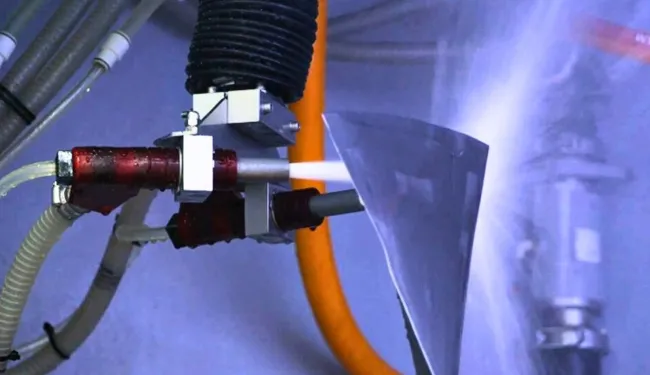
Vapour blasting, also known as wet blasting, vapor blasting, aqua blasting or liquid honing, is a surface finishing process that mixes abrasive media and water into a slurry, then uses compressed air to project it onto a component. "Vapour" is the UK spelling, also used in Ireland, Australia and New Zealand; "vapor" is the US spelling of the same process.
The water cushions each abrasive particle, so it laps across the surface rather than striking into it. This lets vapour blasting clean, degrease, deburr and finish a part in a single pass, leaving a smooth, even finish with minimal media embedment, no heat distortion and far less dust than dry blasting.
Discuss your vapour blasting requirements with our applications engineers
Vapour blasting at a glance
The key facts about vapour blasting, and about the machines Vapormatt builds in the UK.
| Fact | Detail |
|---|---|
| Also known as | Wet blasting, vapor blasting, aqua blasting, liquid honing, slurry blasting |
| How it works | Abrasive media and water are mixed into a slurry and projected onto a component with compressed air |
| What it does | Cleans, degreases, deburrs and finishes parts in a single pass |
| Invented | Late 1940s, UK, by Norman Ashworth |
| Machines built in | Bridgwater, Somerset, UK |
| Machines in service | 2,000+ in 50+ countries |
| Local partners | 22 countries, including Ireland, Australia and New Zealand |
| Typical finish | Down to 0.2µm Ra |
| Typical noise level | 75 dB(A) |
| Key UK regulations | DSEAR, COSHH, Control of Noise at Work Regulations 2005 |

How vapour blasting works
- Abrasive media and water are mixed in the machine's sump to form a slurry.
- A pump delivers the slurry to the blast gun.
- Compressed air accelerates the slurry through the nozzle onto the component.
- The water-cushioned media cleans and finishes the surface.
- The slurry drains back to the sump and is recycled, with broken media separated out to keep the finish consistent.

Why vapour blasting matters for UK and EU compliance
Because vapour blasting generates minimal airborne dust, it sits outside the scope of ATEX compliance requirements that apply to dry blasting processes - there's no combustible dust cloud to manage, no explosion risk to design around, and no extraction system required. That has direct implications under UK and EU health and safety frameworks:
- COSHH (Control of Substances Hazardous to Health): no airborne respirable silica or metal particulate to control, since the process generates none
- HSE guidance on respiratory hazards: wet/vapour blasting was established as the safer industrial alternative specifically because it eliminates the silicosis risk associated with dry abrasive processes
- ATEX: not applicable, as there is no combustible dust atmosphere generated by the process
Built in the UK, supplied and supported globally
Vapormatt is a British manufacturer, still owned and run by the fourth generation of the Ashworth family, with every machine engineered in the same country the process was invented in. Whilst Vapormatt wet blasting machines are manufactured in the UK, support, parts, and service are available globally: Vapormatt supplies and supports vapour blasting machines to aerospace, composite, cutting tool, medical implant, additive, wire and cable manufacturers across multiple continents.
FAQs
What's the difference between vapour blasting and vapor blasting?
No difference in the process - only the spelling. "Vapour" is used across the UK, Ireland, Australia, New Zealand, and much of the Commonwealth; "vapor" is the US spelling. Both refer to the same water-and-abrasive process also known as wet blasting.
Does vapour blasting require ATEX or DSEAR compliance in the UK?
Typically not for dust. In Great Britain, ATEX workplace requirements are applied through DSEAR. Because vapour blasting captures particles in water, it doesn't create the combustible dust cloud that brings dry blasting into scope. Your own DSEAR risk assessment should still confirm this for your materials and site.
Where are Vapormatt vapour blasting machines made?
Vapormatt designs and builds its machines in the UK, from the same country where the process was originally developed in the 1940s, and supplies them to customers internationally.
Is vapour blasting the same as aqua blasting or liquid honing?
Yes. Vapour blasting, aqua blasting, liquid honing, wet blasting and vapor blasting all describe the same process: abrasive media and water mixed into a slurry and projected with compressed air. Norman Ashworth originally called it liquid honing when he developed it in the UK in the late 1940s.
Is vapour blasting noisy?
Vapormatt vapour blasting machines typically run at 75 dB(A), below the 80 dB(A) lower exposure action value in the Control of Noise at Work Regulations 2005. Automatic machines have insulated cabinet walls as standard.