
Talk to an applications engineer about your slurry blasting requirements
Slurry blasting is a wet blasting process in which abrasive media is suspended in water to form a slurry, then projected at a component by compressed air to clean, finish or prepare its surface. In industrial finishing, 'slurry blasting' and 'wet blasting' describe the same process; the name simply puts the focus on the slurry, and on holding it at a steady concentration so the finish stays repeatable.. This page looks specifically at the slurry itself - what's in it, how it's mixed and delivered, and why holding it steady is what separates a controlled process from an inconsistent one.
New to the process? Read the full explanation of how wet blasting works
Slurry blasting at a glance
| Feature | Details |
|---|---|
| What it is | Wet blasting described by its working mixture: abrasive media suspended in water, projected at a component by compressed air |
| Common media | Glass bead, aluminium oxide, ceramic bead, stainless steel shot, plastic (Types II and III) and silicon carbide |
| How concentration is checked | Automatic concentration sensing, or a settle check in the sight glass (a Vapormatt invention) ⚠ |
| How broken media is removed | Patented elutriation tower, which separates broken particles using fluid dynamics rather than sieves ⚠ |
| How it's delivered | Pumped from the sump to the blast gun through the Vapormatt Slurry Pipework System (VSPS) |
| Recycled? | Yes. Every Vapormatt machine runs as a closed loop as standard |
| Also called | Wet blasting, vapour blasting, vapor blasting, liquid honing, wet abrasive blasting, aqua blasting |
What's actually in the slurry
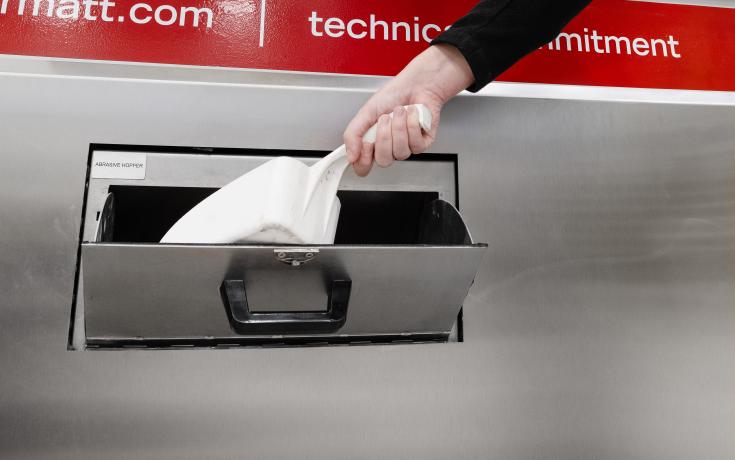
The slurry is a suspension of abrasive media - commonly glass bead, aluminium oxide, or another fine-grade abrasive - in water, held at a concentration measured by volume or weight ratio. Get the ratio wrong and the process drifts: too little abrasive and cycle times stretch out; too much, and nozzles wear faster while the finish turns coarser than intended. Most Vapormatt machines either measure and adjust blast media concentration levels automatically, or feature a 'sight glass' that allows quick and accurate measurement of blast media concentration levels.
How the slurry is mixed and delivered
Wet blasting equipment brings abrasive and water together in one of three ways. Pressure-vessel systems premix the slurry before it reaches the nozzle. Some mobile 'slurry blasters' are dry blast pots that add water at the nozzle to suppress dust on site. Recirculating cabinets, which is how every Vapormatt machine works, mix the slurry in a sump, pump it to the blast gun, accelerate it with compressed air and recover it for reuse. In a Vapormatt machine, delivery runs through the Vapormatt Slurry Pipework System (VSPS). Its pipework is designed around the pressure drop along every metre of hose, so each nozzle receives an equal supply, and variable speed pump drives compensate as the pump wears. Vapormatt holds 12 patents across this process-control architecture.
Why slurry consistency is what separates a controlled process from an inconsistent one
A slurry that's right at the start of a run won't stay right on its own. Four things push it away from specification during production, and each needs its own correction:
- Settling. Heavier abrasive particles drop out of suspension whenever the slurry stops moving. Continuous recirculation keeps the media suspended, so the mixture reaching the gun matches the mixture in the sump.
- Media breakdown. Every impact breaks some particles, and broken media produces a different finish from correctly graded media. Vapormatt's patented elutriation tower removes broken, undersized particles continuously. It uses fluid dynamics rather than sieves, which have a tendency to block and need clearing by hand.
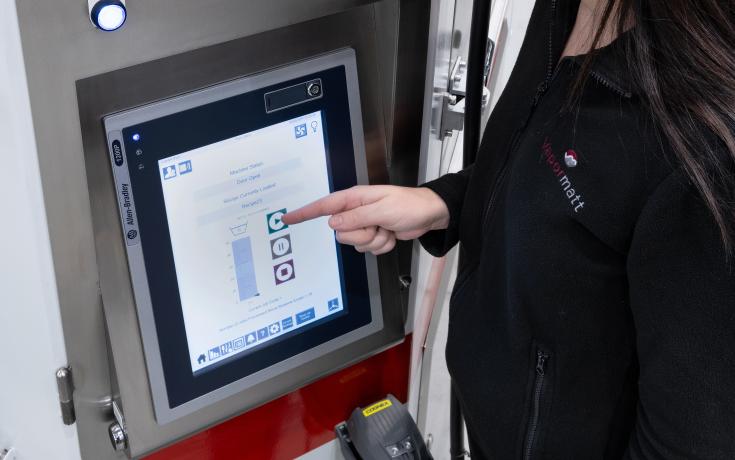
- Water loss and top-ups. Evaporation and topping up with fresh water both change the ratio of abrasive to water. Automatic concentration sensing measures that ratio and corrects it; on machines with a sight glass, a quick settle check shows where it stands.
- Pump and nozzle wear. As pumps and nozzles wear, delivery pressure and flow change. Variable speed pump drives compensate for falling slurry pressure, and air flow monitoring on each nozzle detects wear before the finish is affected.
On all new automatic machines, Vapormatt 4.0 logs every process parameter for every cycle. That gives quality teams a record showing the slurry stayed within specification from the first part of a batch to the last, which is the traceability aerospace and medical device manufacturers need. A machine without these controls leaves the operator to spot and correct drift by eye.
FAQs
Is slurry blasting the same as wet blasting?
Yes. Slurry blasting and wet blasting describe the same process. "Slurry blasting" puts the emphasis on the water-and-abrasive mixture itself, while "wet blasting" is the more general term for the process as a whole.
What's the difference between a slurry blaster and a vapor blaster?
It depends who's using the term. In mobile surface preparation, a "slurry blaster" often means a dry blast pot that adds water at the nozzle to suppress dust on site. In industrial component finishing, slurry blasting, vapor blasting and wet blasting describe the same recirculating process. In that process, abrasive and water are mixed before they reach the gun and recycled continuously. Vapormatt machines work this way.
What's the difference between slurry blasting and wet abrasive blasting?
There's no difference in the underlying process. They're different names for the same water-and-abrasive method, used in different contexts. "Wet abrasive blasting" is the term most often used in technical specifications; "slurry blasting" is used more when the focus is on the mixture itself.
See how to specify wet abrasive blasting
What abrasive media is used in the slurry?
Media choice depends on the substrate and the finish required. Common choices are glass bead, aluminium oxide, ceramic bead, stainless steel shot, plastic media (MIL-P-85891A Types II and III) and silicon carbide. The media has to stay in suspension to be pumped, so Type V acrylic plastic media isn't suitable: it floats in water.
Learn more about wet blast abrasives
How do you check slurry concentration?
On machines fitted with a sight glass, which Vapormatt invented, a sample of slurry settles so the proportion of abrasive can be read at a glance. A layer of fine sediment on top shows the media is breaking down. Vapormatt's automatic machines measure concentration continuously and correct it without operator input.
Does the slurry need to be replaced during a job?
Not during a job, but not indefinitely either. Particles break down with use. Vapormatt's elutriation tower removes broken fines continuously, and water and media are topped up as needed, so a full changeover is only needed periodically. How often depends on the media type and throughput: ceramic beads and stainless steel shot last far longer than glass bead or plastic media. Sieve analysis of the slurry is the most reliable way to decide when to replace it.
Is slurry blasting related to slurry explosives?
No. "Slurry blasting agents," or slurry explosives, are chemical explosives used for rock blasting in mining and quarrying, an entirely different product. Slurry blasting as described on this page is a surface finishing process for manufactured components.
Can you test slurry blasting on my parts?
Yes. Tell us about your components and the finish you need, then send us samples. Our applications engineers will process them at our R&D Centre, share the results and recommend the media, slurry settings and machine to achieve that finish. You'll see what slurry blasting does to your parts before you invest.