
Discuss you wet abrasive blasting requirements with an applications engineer
Wet abrasive blasting is a surface preparation process in which the abrasive reaches the substrate carried in water rather than air alone. Because the water absorbs the impact energy and flushes the abrasive clear as it works, the process removes coatings, corrosion and contamination without the airborne dust, media embedment or heat build-up associated with conventional dry abrasive blasting. It's the term used most often in technical specifications and tender documents; in everyday conversation, the same process is usually called wet blasting. Vapormatt's founder, Norman Ashworth, developed the process in the UK in the late 1940s, and more than 2,000 Vapormatt machines are now in service in over 50 countries.
New to the process? Read the full explanation of how it works
Wet abrasive blasting vs dry abrasive blasting
The two processes solve the same problem - removing coatings, corrosion or contamination and preparing a surface - in fundamentally different ways. Water cushions the abrasive on impact in wet blasting, which changes almost every outcome that matters when writing a specification: dust, media embedment, heat, and the resulting finish.
| Wet abrasive blasting | Dry abrasive blasting | |
|---|---|---|
| Dust | Virtually none – particles are captured in the water | Airborne, requires extraction |
| Media embedment | Minimal – water flushes media clear | Common on softer substrates |
| Heat generation | Low – water carries heat away | Higher, risk of distortion on thin sections |
| Typical finish | Fine, uniform satin – down to 0.2µm Ra | Coarser, more aggressive profile |
| Cleaning and degreasing | Cleans and degreases in the same pass | Separate pre-wash usually needed |
| Adjustable process variables | Up to 15 | Typically 2–3 |
| ATEX / DSEAR dust compliance burden | Minimal – typically falls outside dust-explosion requirements | Significant – extraction and explosion-risk controls needed |
| Best choice when… | Surface quality, dimensional control, cleanliness or operator safety are the priority | Heavy removal of thick rust, mill scale or coatings from large steel structures, or parts that can't tolerate moisture |
See the full comparison with dry blasting, drag finishing and chemical etching
Specifying wet abrasive blasting
A wet abrasive blasting specification typically needs to define:
- Abrasive media type and particle size, chosen for the substrate and the target finish
- Water-to-media ratio in the slurry
- Air pressure at the nozzle
- Standoff distance and dwell time
- Target surface profile or roughness (commonly expressed as Ra)
Many specifications reference recognised surface preparation standards, such as ISO 8501-1 or the SSPC-SP series, to define the required visual cleanliness grade. Confirming which standard a project needs to meet, and agreeing how it will be measured, before equipment is specified avoids rework later.
Specifying wet abrasive blasting
A wet abrasive blasting specification should define the process inputs, the finish required, and how that finish will be verified. The table below sets out what to include.
| Parameter | What the specification should state | Typical value / Vapormatt reference |
|---|---|---|
| Abrasive media type | Media chosen for the substrate and target finish | Glass bead, aluminium oxide, plastic, ceramic or stainless steel – see our abrasive and blast media guide |
| Media particle size | Grade or size range, and the replenishment interval | Finer grades than dry blasting typically allows, because water, not air alone, carries the media; final grade selected during sample trials |
| Water-to-media ratio | Slurry concentration, and how it is held within tolerance | Set for each application during sample trials, then monitored and controlled in real time on Vapormatt closed-loop machines |
| Air pressure at the nozzle | Operating pressure and permitted tolerance | Typically under 10 bar, air-driven |
| Standoff distance and blast angle | Nozzle-to-part distance and angle of incidence | Two of the 15 adjustable wet blasting variables; established during sample trials and built into the machine set-up |
| Dwell or cycle time | Time per part or per pass; gun or fixture speed on automatic machines | Established during sample trials; held by gun speed and cycle control on automatic machines |
| Target surface roughness | Ra value with an upper and lower limit | Down to 0.2µm Ra; edge hone tolerances to ±2µm |
| Roughness measurement method | Instrument, cut-off and evaluation length, number and location of readings | Commonly to ISO 21920-2 (which replaced ISO 4287) or the OEM's own method |
| Surface cleanliness grade | Required visual cleanliness grade (carbon steel coating work) | SSPC-SP 5 / 10 / 6 / 14 / 7 (WAB) – the NACE/SSPC wet abrasive blast cleaning standards |
| Flash-rust control | Whether a corrosion inhibitor is required, and the maximum time before coating | Inhibitors can be added to the process water for ferrous parts |
| Post-blast rinse and drying | Rinse method, water quality and drying method | Confirmed in the written specification agreed with Vapormatt before order |
| Masking | Areas to be protected and the masking method | Defined per component drawing |
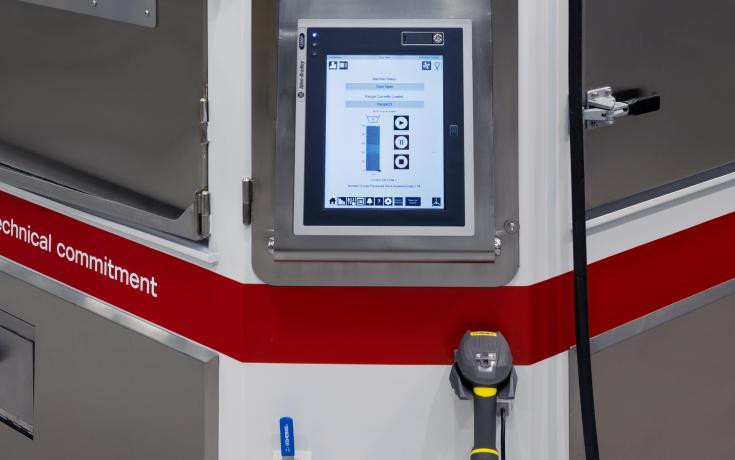
| Process recipe and traceability | Recipe reference, parameter logging and record retention | Recipes stored and recalled via the machine HMI, so each run can be reproduced and documented |
| Peening (where applicable) | Intensity, coverage and monitoring requirements | Vapormatt wet peening systems are built to comply with AMS 2432 |
Where a setting depends on your component, our applications engineers establish it by processing your sample parts at our R&D Centre. Send us your parts and target finish.
Confirm which standard or OEM specification the project must meet, and agree how compliance will be measured, before equipment is specified. This avoids rework later.
Where wet abrasive blasting is used to prepare carbon steel for coating, the dedicated standards are the joint NACE/SSPC wet abrasive blast cleaning (WAB) standards, approved in 2015. These follow the same names and numbers as the familiar dry-blast grades, with a "WAB" suffix: White Metal (SSPC-SP 5 (WAB)/NACE WAB-1), Near-White Metal (SSPC-SP 10 (WAB)/NACE WAB-2), Commercial (SSPC-SP 6 (WAB)/NACE WAB-3), Industrial (SSPC-SP 14 (WAB)/NACE WAB-8) and Brush-Off (SSPC-SP 7 (WAB)/NACE WAB-4). White Metal permits no remaining staining, Near-White allows staining on up to 5% of each unit area, and Commercial up to 33%. Unlike the dry-blast grades, each WAB standard also requires the specification to state the level of flash rust permitted before coating (none, light, moderate or heavy) and whether a corrosion inhibitor may be used; SSPC-VIS 5/NACE VIS 9 provides the visual reference. For precision components such as cutting tools, implants, turbine blades and extrusion dies, the specification is usually written around a target Ra and the OEM's own process specification instead. Either way, confirm which standard applies and agree how compliance will be measured before equipment is specified. This avoids rework later.
Where wet abrasive blasting is specified
- Aerospace MRO (NDT prep, paint stripping, peening to AMS 2432)
- Cutting tools (edge honing, pre-coat prep)
- Medical and dental (controlled Ra)
- Additive manufacturing (depowdering)
- Refurbishment (coating and corrosion removal)
FAQs
Is wet abrasive blasting the same as wet blasting?
Yes. "Wet abrasive blasting" and "wet blasting" describe the same process: water and abrasive media mixed into a slurry and projected onto a component by compressed air. "Wet abrasive blasting" is the fuller, more formal term, generally used in specifications and tender documents.
The process is also known as vapour blasting (vapor blasting in the US), slurry blasting, low-pressure hydro-abrasive blasting and liquid honing, the name Norman Ashworth gave it when he developed it in the late 1940s.
Is wet abrasive blasting the same as dustless blasting?
They work on the same principle, but they're used for different jobs. "Dustless blasting" usually refers to mobile wet abrasive blasting, where water and abrasive are sprayed from a trailer-mounted unit to strip paint and rust from vehicles, boats and buildings on site. It is built for fast, heavy removal.
Industrial wet abrasive blasting takes place in an enclosed machine that recycles its water and media. It is designed for manufactured components where the finish has to be precise and repeatable, part after part. Vapormatt builds enclosed industrial machines for this second type of work.
What's the difference between wet abrasive blasting and dry abrasive blasting?
Wet abrasive blasting suspends the abrasive in water before it reaches the surface. This captures dust at source, minimises media embedment, carries heat away, and cleans and degreases the part in the same pass. Dry abrasive blasting propels the abrasive with compressed air alone. It generates airborne dust that needs extraction and carries a higher risk of media embedment and surface damage on soft or delicate substrates.
Dry blasting is often faster and more economical for heavy material removal where the final finish matters less, such as stripping thick rust, mill scale or heavy coatings from large steel structures. It can also suit parts that can't tolerate moisture. Where surface quality, dimensional control, cleanliness or operator safety are the priority, wet abrasive blasting has the clear advantage.
See the full comparison with dry blasting and other finishing processes
What abrasive media can be used in wet abrasive blasting?
Media choice depends on the substrate and the finish required. It commonly includes glass bead, aluminium oxide, plastic, ceramic and stainless steel. The size, shape and hardness of the media all influence the result.
Because water, not compressed air alone, carries the media to the surface, it is practical to use finer grades than dry blasting typically allows.
How do you specify wet abrasive blasting in a tender or procurement document?
Most specifications define:
- the abrasive type and grade
- the target surface roughness (Ra) or cleanliness grade
- the process parameters that need to stay within tolerance across a production run, such as pressure, standoff distance and cycle time
- how compliance will be measured.
Where carbon steel is being prepared for coating, cleanliness is specified against the joint NACE/SSPC wet abrasive blast cleaning (WAB) standards, such as SSPC-SP 10 (WAB)/NACE WAB-2 Near-White Metal. These also require the specification to state the permitted level of flash rust and whether an inhibitor may be used. For precision components, the specification is usually written around a target Ra and the OEM's own process specification instead.
What pressure is used in wet abrasive blasting?
Industrial wet abrasive blasting typically runs at under 10 bar, with compressed air accelerating the slurry onto the component. This is very different from ultra-high-pressure water jetting, which often runs at 800 to 3,000+ bar and is sometimes also called hydro blasting.
The right pressure for a job depends on the substrate, the media and the finish required. It is established during sample trials and then held within tolerance: on Vapormatt closed-loop machines, air pressure is monitored and controlled in real time.
Low-pressure vs high-pressure hydro-abrasive blasting explained
What surface roughness (Ra) can I specify?
Vapormatt machines achieve surface roughness values as low as 0.2µm Ra and hold edge hone tolerances to within ±2µm. The value achievable on your part depends on the substrate, the media and the process parameters.
A robust specification states the target Ra with an upper and lower limit, and defines how it will be measured: the instrument, the cut-off and evaluation length, and the number and location of readings (for example, to ISO 21920-2).
Have a target Ra in mind? Tell us and we'll tell you if we can hit it
Does wet abrasive blasting cause flash rust?
It can on carbon and low-alloy steels, where flash rust can develop within minutes of wet blasting as the water dries. Adding a corrosion inhibitor to the process water prevents it. Aluminium, titanium and other non-ferrous metals don't rust.
Where steel is being prepared for coating to the WAB standards, the specification should state the level of flash rust permitted before coating (none, light, moderate or heavy) and whether an inhibitor may be used. SSPC-VIS 5/NACE VIS 9 provides the visual reference for each level.
Can you prove the specification on my parts before I buy?
Yes. Tell us about your components and the finish you need, then send us samples. Our applications engineers will process them at our R&D Centre and share the results, along with a recommendation for the right process and machine. Once the process is proven, the specification is agreed with you in writing before you order, so you know exactly what wet abrasive blasting will achieve on your parts before you invest.