What is spallation in surface coatings and how can wet blasting help?
Spallation refers to the phenomenon where a surface coating, such as a layer of paint, thermal barrier coating, or protective film, breaks off, peels, or delaminates from the substrate. This typically occurs due to mechanical stress, thermal cycling, corrosion, or the presence of defects in the bond between the coating and the substrate. Spallation can compromise the coating's performance, leading to premature failure and exposure of the underlying material to environmental or operational hazards.
Common causes of spallation include:
• Residual stress in the coating or substrate
• Thermal expansion mismatch between the substrate and the coating
• Surface contaminants that weaken adhesion
• Mechanical impacts or abrasive wear
• Poor surface preparation before applying the coating
How wet blasting helps improve coating adhesion...
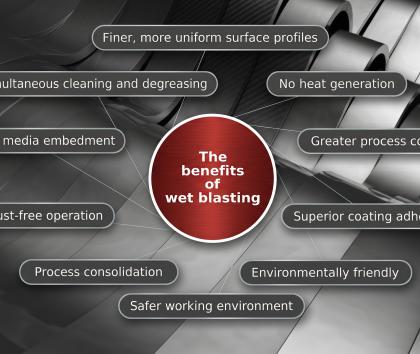
Enhanced surface cleanliness - Wet blasting effectively removes contaminants, such as oils, grease, rust, and old coatings, that can interfere with the adhesion of the new coating.
Surface roughening - The abrasive particles in wet blasting create a controlled roughness on the substrate, known as a ‘surface profile.’ This roughened surface increases the surface area available for the coating to adhere, improving mechanical bonding.
Reduced residual stress - Wet blasting uses water to cushion the impact of abrasive particles, which reduces microcracking and residual stresses that could later contribute to spallation.
Minimised heat damage - The water in wet blasting dissipates heat generated by the abrasive process, preventing thermal damage to the substrate. This is especially important for materials sensitive to heat like aluminium or thin surfaces.
Deburring and edge rounding - Wet blasting smooths out sharp edges and removes burrs, which are common initiation points for coating failure and spallation. This contributes to uniform coating thickness and improved adhesion.
Corrosion resistance enhancement - Wet blasting can improve the surface's corrosion resistance by cleaning it thoroughly and inducing compressive stress, which helps delay crack propagation.
Environmental Benefits - The water used in the process reduces dust and contamination during blasting, creating a cleaner and safer work environment compared to dry blasting. This reduces the risk of introducing airborne contaminants that could compromise coating adhesion.
Using wet blasting as part of the surface preparation process ensures that the substrate is not only clean but also mechanically conditioned for optimal coating performance. This leads to improved durability and resistance to spallation under various operating conditions, especially in high-stress environments like aerospace, automotive, and industrial settings.