Dry blasting, drag finishing, brush finishing, vibratory finishing, chemical etching and wet blasting all have their place. Here's where each one fits.
Dry blasting
- Effective for heavy material removal, but finishes vary on complex shapes and media often embeds in soft metals. Dust extraction is essential.
Drag finishing
- Excellent for high-gloss polishing of fixtured components, but it can't reach internal passages.
Brush finishing
- Proven for deburring flat and rotary parts, but limited on complex 3D geometries.
Vibratory and tumble finishing
- Good for bulk deburring of robust parts, with limited control over individual components.
Chemical etching
- Precise on flat surfaces, but requires chemical storage, handling and disposal.
Wet blasting
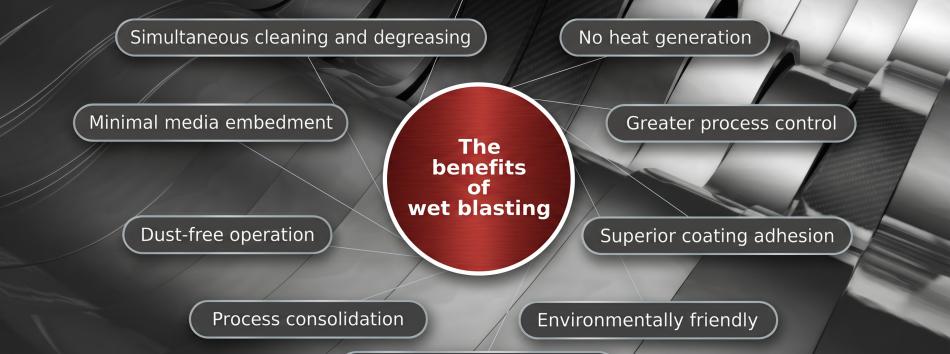
- Uniform finishes across complex geometries and internal passages, with 15 adjustable parameters compared with two to three for dry blasting. No dust, no heat, minimal media embedment, and cleaning, degreasing and surface preparation in one cycle.
Where surface quality, repeatability and safety matter most, wet blasting holds a structural advantage, with running costs among the lowest of any process.