
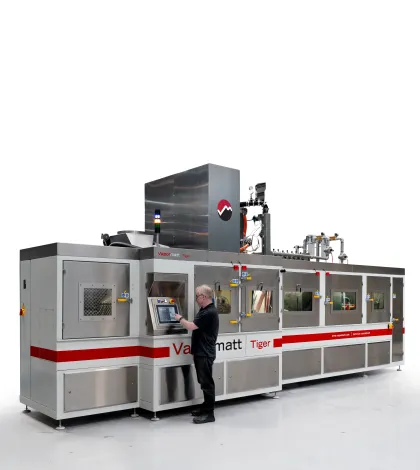
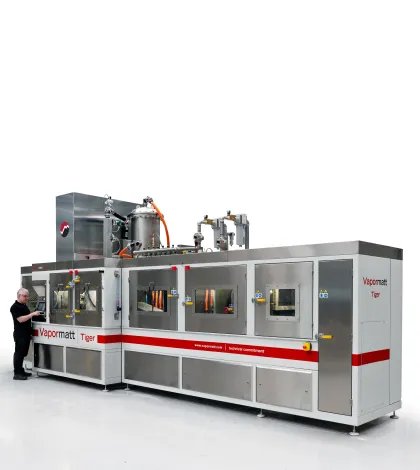
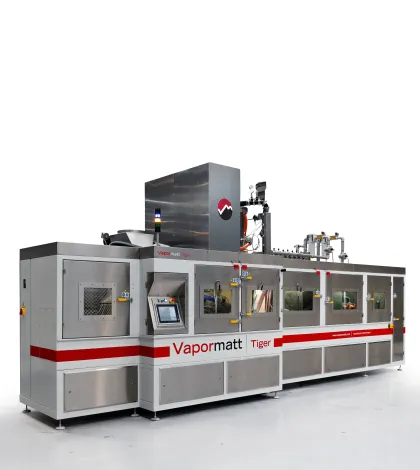
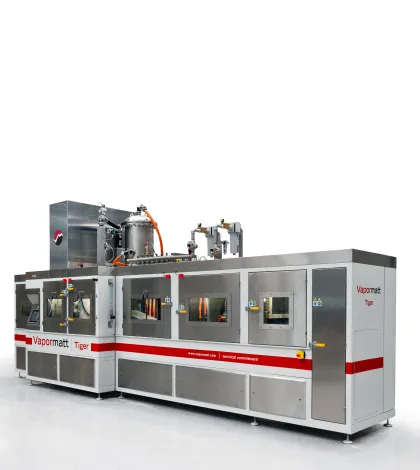




The technical challenge
By the time an insert reaches wet blasting it carries the accumulated cost of raw material, sintering, grinding, and geometry preparation. A cobalt surface that undermines coating adhesion, an edge hone radius outside tolerance, or staining from inadequate post-blast drying does not produce a marginal part. It produces scrap at the point of maximum embedded value, one process step before coating completes it. With carbide now a strategic material, the cost of that failure has permanently increased. The Tiger was engineered to eliminate it.
Process control and compliance
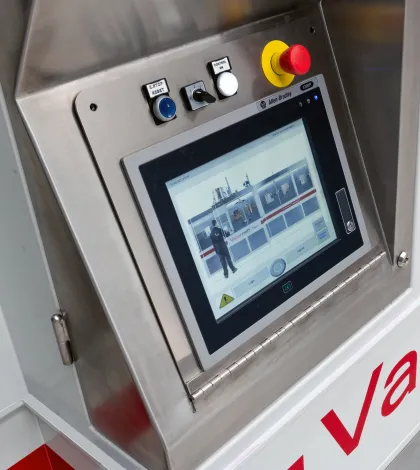
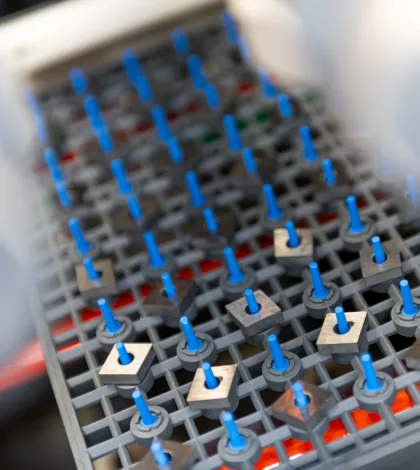
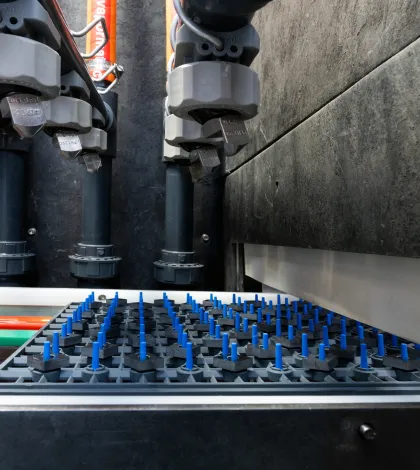
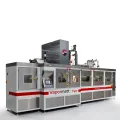
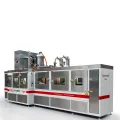
The Tiger’s CNC servo-driven blast gantry traverses the Y axis (700mm stroke, ±0.5mm accuracy) while pallets advance in the X axis, so every insert on every pallet receives the same blast geometry and dwell time. Nozzle height and angle are set independently on each gun crown to reach complex insert geometries. Closed-loop slurry pressure control compensates for nozzle and hose wear, up to 999 recipes are stored and recalled by batch, and every cycle is covered by post-process reporting. Optional RFID pallet tracking, barcode recipe loading, per-gun airflow monitoring and MES integration take traceability down to the individual pallet, supporting ISO 9001 and equivalent quality systems.
Why Vapormatt
Vapormatt built the first automated edge honing machines for cutting tool inserts in the 1980s and holds the patent for K-factor edge control by wet blasting (GB2590936B). We have built only wet blasting machines since 1978, supplied more than 2,000 of them to over 50 countries, and co-developed insert finishing technology with Sandvik.
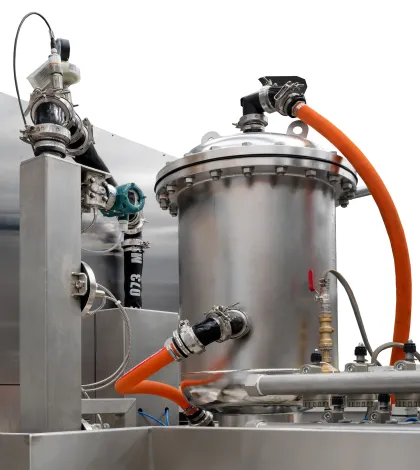
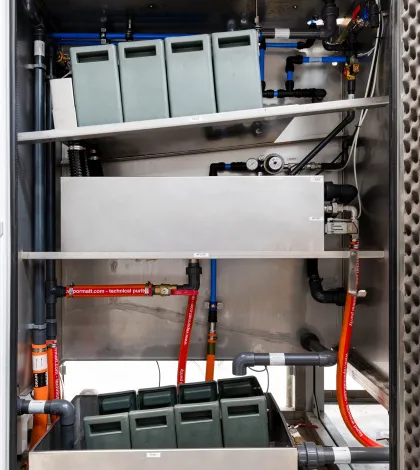
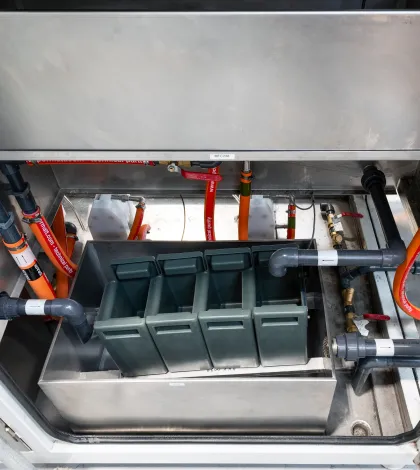
- Patented elutriation tower (recommended for edge honing): Continuously removes broken-down abrasive finer than the selected particle size from the slurry, keeping media grading consistent so edge hone radius stays reproducible across long production runs.
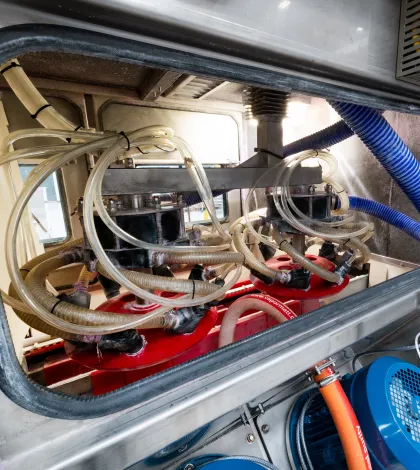
- Integrated washing and hot-air drying: Inserts are rinsed, optionally ultrasonically washed, given a final DI water rinse and dried with air from above and below, which lifts them in their pockets so no surface stays wet. That prevents the staining, corrosion and cobalt leaching that occur when parts wait between blasting and a separate wash line.
- Two separately controlled gun crowns: Each 8-gun crown is fitted at 45°, 55°, 60° or 80°, or as a manually adjustable 45°/80° crown, with its own recipe, nozzle height and angle. Pallets can be processed with two different blast recipes in sequence, for example an edge hone followed by a polishing pass.
- Formal acceptance testing: Every Tiger undergoes Factory Acceptance Testing at our facility and Site Acceptance Testing after commissioning. The machine meets its agreed specification before you commit production to it.
Learn about the patented and proprietary technology underpins the Tiger's performance
The Vapormatt Promise: the machine meets the agreed specification, or we make it right.
The bottom line
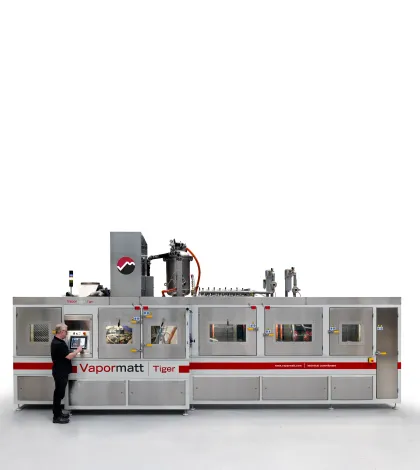
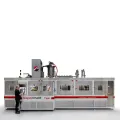
Carbide costs have permanently shifted, so every pallet held in tolerance protects margin. The Tiger combines edge honing, pre-coating preparation and post-coating finishing with washing and drying in one validated in-line process, in a 7.7m line drawing 47kW. If you need two fully independent blast chambers, to run two processes at once or double the output of one, the dual-chamber Tiger+ is the larger alternative.
Technical specifications
| Parameter | Specification |
|---|---|
| Installed dimensions | 7.7m × 1.72m × 3.3m (303" × 68" × 130") |
| Blast gun configuration | 16 × Mk3 Vapormatt blast guns with boron carbide nozzles (standard) |
| Gun crown options | 60°, 55°, 45°, 80°, or manually adjustable 45°/80°; two independently controlled gun crowns |
| CNC gantry Y-axis | 700mm (27.5") stroke; max speed 200mm/s; accuracy ±0.5mm |
| Auto-load capacity | Up to 20 pallets; 40kg (88.2 lb) maximum load |
| Process stages | Wet blast 1, wet blast 2, pre-rinse, drag rinse, ultrasonic dunk (optional), final DI rinse, hot-air dry |
| Electrical supply | 400/480V, 3-phase, 50/60Hz; 47kW load (100A at 400V, 50Hz) |
| Process air supply | 6–7 bar (90–100 psi); max 11.2 Nm³/min at 4 bar (58 psi) |
| Automation options | RFID readers, barcode scanners, gantry robot pallet transfer, infeed/outfeed roller conveyor, flipping unit, AGV-compatible cart docking |
| Construction | Corrosion-resistant high-grade stainless steel cabinet; secondary containment on all process tanks and pipework |
| Throughput | Minimum 16 pallets/hour with gantry robot pallet transfer (one pallet every 3 min 45 s after the first) |
| Edge honing capability | Edge radii up to 70µm (2.8 thou), held to ±5µm (0.2 thou) or ±10%, whichever is larger |
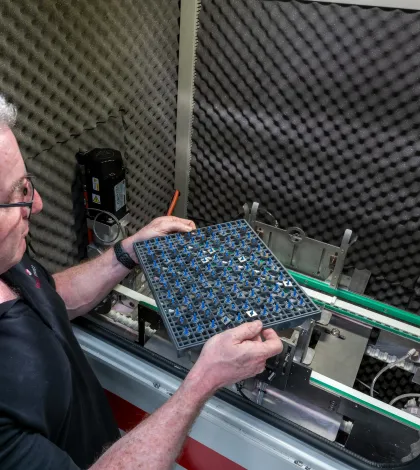
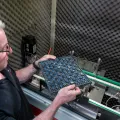
| Compatible pallets | Wendt 296 × 246mm (12" × 10"); Manz 383 × 281.3mm (15" × 11") |
| Blast media | Aluminium oxide, FEPA 60 to FEPA 320 |
| Recipes | Up to 999 stored blast recipes, with post-process reporting |
| Slurry conditioning | Continuous abrasive filtration (standard); patented elutriation tower (optional, recommended for edge honing) |
| Noise level | Specifiable to 75 dBA |
Full technical specifications are available in the downloadable Tiger machine brochure