
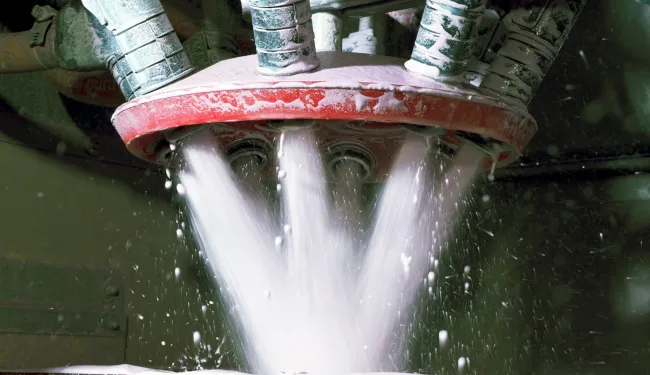
Hydro-abrasive blasting is another name for wet blasting: fine abrasive media is mixed with water into a slurry and projected by compressed air, typically below 10 bar, to clean, deburr, finish or prepare components with virtually no airborne dust. It is often confused with hydro blasting and UHP water jetting, which use water at hundreds or thousands of bar to strip or demolish.
How hydro-abrasive blasting carries fine abrasive to the surface in a water stream driven by compressed air, typically at under 10 bar. This is the process more commonly known as wet blasting, vapor blasting or liquid honing - it cleans, finishes, deburrs and prepares surfaces for coating with minimal media embedment and virtually no airborne dust.
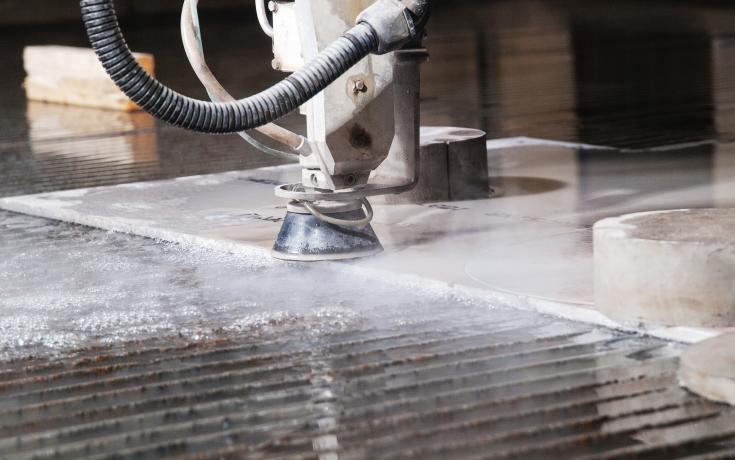
What it's often confused with. Hydro blasting, also called UHP water jetting or hydrodemolition, uses water alone at roughly 300–4,000 bar to strip coatings, clean pipes and remove concrete. Abrasive waterjet cutting adds garnet to a water jet at even higher pressure to cut through metal, stone and glass. Both rely on raw hydraulic force rather than a cushioned abrasive flow, and neither is designed to protect fine tolerances.
We don't make UHP jetting or waterjet cutting equipment. But if the parts you're stripping, descaling or cleaning can be processed in an enclosed machine, wet blasting will usually give a better, safer result than high-pressure jetting.
Discuss your component finishing requirements with our applications engineers
How to tell which one an application needs
The quickest way to tell is pressure and purpose: under 10 bar to finish a component means hydro-abrasive (wet) blasting; hundreds of bar or more to strip structures or cut material means UHP jetting or waterjet cutting.
| Hydro-abrasive blasting (wet blasting) | Hydro blasting / UHP water jetting | Abrasive waterjet cutting | |
|---|---|---|---|
| Pressure | Typically under 10 bar, air-driven | Roughly 300 – 4,000 bar | Typically 3,000 – 6,000 bar |
| Medium | Water and abrasive slurry | Water only | Water with garnet abrasive |
| Mechanism | Cushioned abrasive slurry, controlled flow | Focused hydraulic force | Focused abrasive jet that cuts through material |
| Typical use | Cleaning, deburring, edge honing, coating prep, peening, descaling | Concrete removal, pipe and tank cleaning, coating stripping on structures | Cutting metal, stone, glass and composites |
| Surface effect | Controlled finish down to 0.2 µm Ra, minimal media embedment, no heat distortion | Aggressive removal | Cuts through the material |
| Dust / ATEX | Virtually no airborne dust; typically outside ATEX/DSEAR requirements | No dust, but high-pressure injection injury risk | No dust, but high-pressure injection risk and spent abrasive to handle |
If the goal is a precision, repeatable finish on a manufactured component - a cutting tool, an implant, a turbine blade, an extrusion die - that's low-pressure hydro-abrasive blasting, a process pioneered by the Ashworth family in the UK in the late 1940s, and the one Vapormatt has built machines for since 1978..
Which process should I use?
Hydro-abrasive (wet) blasting is usually the right choice if:
the part is a manufactured component rather than a structure
dimensions, edges or surface roughness must stay within tolerance
the substrate is aluminium, titanium, carbide, a composite or another material that dry or high-pressure methods could damage
operators must be protected from dust
UHP jetting or waterjet cutting is usually the right choice if:
you are removing concrete or working on a structure on site
you are clearing pipes, tanks or heat exchangers
you need to cut through material rather than finish it
Why the low-pressure process suits manufactured components
Because the abrasive is cushioned by water rather than driven by raw pressure, low-pressure hydro-abrasive blasting can be dialled to remove exactly what's needed - a coating, a burr, a contaminant - without altering the underlying geometry or inducing heat distortion. That's the opposite goal to high-pressure jetting, which is built to remove material fast and doesn't need to protect fine tolerances. In practice, Vapormatt machines achieve surface roughness as low as 0.2 µm Ra and hold edge hone tolerances within ±2 µm.
FAQs
Is hydro-abrasive blasting the same as wet blasting?
Yes. Hydro-abrasive blasting is another name for wet blasting: abrasive media carried in water and projected by compressed air at low pressure. Some suppliers use the term loosely for high-pressure abrasive water jetting, so it's worth confirming the pressure and purpose before specifying equipment.
Is hydro-abrasive blasting the same as hydro blasting?
"Hydro blasting" more commonly refers to the high-pressure, water-only or water-jet process used for demolition and heavy descaling, rather than the low-pressure abrasive slurry process.
Which process should I use for coating removal on a precision part?
Low-pressure hydro-abrasive blasting (wet blasting) - it removes coating without embedding media or distorting the substrate, which high-pressure jetting is not designed to protect against.
What pressure does hydro-abrasive blasting use?
Typically under 10 bar, supplied by compressed air. That's far lower than hydro blasting or UHP water jetting, which run at roughly 300–4,000 bar.
Is hydro-abrasive blasting the same as waterjet cutting?
No. Abrasive waterjet cutting uses a high-pressure jet with garnet to cut through material. Hydro-abrasive blasting uses a low-pressure slurry to clean and finish the surface without changing the part's geometry.
Does hydro-abrasive blasting need dust extraction?
No. The water captures particles at source, so there is virtually no airborne dust and the process typically falls outside the ATEX/DSEAR requirements that apply to dry blasting. A COSHH assessment is still needed for the media and any coatings removed.
Can hydro-abrasive blasting remove paint and rust from components?
Yes. It strips paint, coatings, scale and corrosion from components, and with the right media it leaves a surface ready for recoating. It removes what sits on the metal, not damage such as pitting.
Is "hydro blasting" ever used to mean wet blasting?
Yes, in some markets, particularly Australia, "hydro blasting" is used for vapour or wet blasting. Elsewhere it usually means high-pressure water-only jetting, so check the pressure a supplier is quoting.
Can you trial hydro-abrasive blasting on my parts?
Yes. Send us samples and our applications engineers will process them at our R&D Centre, then share the results with a recommendation for the right process and machine.