
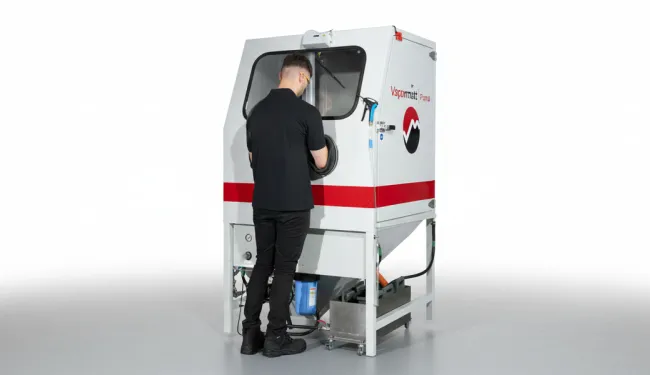
Yes. Wet blasting (also called vapor blasting) is one of the safest forms of abrasive blasting. The abrasive is carried in water, so dust is captured at source. Vapormatt machines run at around 75 dB(A). Automating the process removes the hand-arm vibration risk of holding parts. You still need a COSHH assessment, Legionella controls and safe slurry disposal.
Norman Ashworth developed wet blasting in the late 1940s for jet engine turbine blades. When the Blasting (Castings and Other Articles) Special Regulations 1949 banned silica sand in blasting to stop silicosis, it became British industry’s safer alternative. That ban still stands today under COSHH.
Read the history of wet blasting
That advantage is demonstrable across three areas every production manager and EHS lead needs to assess.
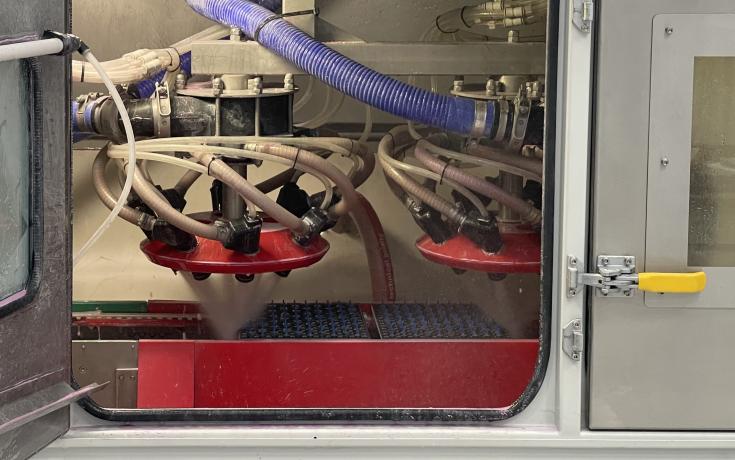
Dust and airborne hazards: dry blasting creates them, wet blasting suppresses them
In dry blasting, the abrasive jet is propelled through air. Everything it dislodges, paint particles, surface oxides, substrate debris, becomes airborne. Where coatings contain cadmium compounds or hexavalent chromium (found in chromate primers), both classified as Group 1 carcinogens by the International Agency for Research on Cancer, that dust is not a nuisance. It is a lung cancer risk.
The HSE estimates around 12,000 deaths per year in the UK are linked to past occupational exposure to dust and chemicals at work (HSE work-related ill health statistics).
In wet blasting, abrasive is delivered in a water slurry. Particles removed from the component surface are captured in the water phase, not ejected into the air. Dust suppression is not an add-on or a mitigation. It is built into the mechanism of the process. It also removes the combustible dust cloud, so enclosed wet blasting typically falls outside the ATEX/DSEAR requirements that apply to dry blasting.
This applies to enclosed cabinet wet blasting, where the operator stands outside the blast zone. Open-air wet abrasive blasting, sometimes sold as “dustless blasting”, suppresses dust but does not contain it, so operators of those systems usually still need respiratory protection. Whichever process you use, you must still carry out a COSHH assessment covering the materials being processed. What changes is the starting risk level, and it changes significantly.
Noise: how loud is wet blasting, and why most suppliers won’t say
The Control of Noise at Work Regulations 2005 set action values based on an operator’s daily personal noise exposure: the A-weighted sound level, which reflects how human hearing perceives sound, averaged over an eight-hour day. At 80 dB(A) employers must assess the risk and make hearing protection available. At 85 dB(A) hearing protection becomes mandatory and hearing protection zones must be marked. 87 dB(A) is the legal limit.
Vapormatt machines typically operate at 75 dB(A), below the threshold at which protection programmes are triggered. We publish that figure because we are confident in it.
Most blasting machine suppliers do not publish noise data at all. When a supplier cannot tell you how loud their machine is, it is worth asking why.
Noise-induced hearing loss is permanent. It is also entirely preventable when the right engineering decisions are made at the design stage, which is precisely where triple insulation, neoprene lining, and triple-glazed cabinet glass make their contribution.
Hand-arm vibration (HAVS): where most operators have an unmanaged risk
The Control of Vibration at Work Regulations 2005 set a daily exposure action value of 2.5 m/s² A(8) and an exposure limit value of 5 m/s² A(8). A(8) means the vibration level transmitted to an operator’s hands, measured and averaged across an eight-hour working day.
Above the action value, employers must put controls and health surveillance in place. The limit value must not be exceeded. The HSE estimates nearly 2 million people in the UK are currently at risk of hand-arm vibration syndrome (HAVS), a permanent and irreversible condition with no cure (HSE hand-arm vibration guidance).
In manual wet blasting, the vibration risk is widely misunderstood. The primary source is not the gun. It is the component being blasted. When an operator holds a part by hand while blasting it, vibration transmits directly from the component into the hand. Most risk assessments focus on the gun and miss this entirely.
This is not a hypothetical risk, and we know it well because the machines involved were ours. In 2013, the HSE prosecuted Rolls-Royce after a worker in its Derby foundry developed permanent bilateral carpal tunnel syndrome. For up to nine hours a day, he had held turbine blades by hand while blasting them in manual Vapormatt cabinets. The HSE found the vibration risk had not been properly assessed or controlled. Rolls-Royce was fined £60,000 and ordered to pay £18,168 in costs. The cause was not the wet blasting process but the method: holding the component by hand. In 2012, before the case reached court, Rolls-Royce replaced the manual cabinets with an automated Vapormatt wet blasting system, which takes the operator’s hands out of the process entirely.
Some manual blasting cabinets on the market are sold with gun-holding brackets, freeing the operator's hand to hold the component instead. That configuration does not reduce vibration exposure. It redirects it to the most dangerous source.
How Vapormatt machines are built: safety beyond the minimum
Compliance with machinery safety law is the floor, not the ceiling. In the UK that law is the Supply of Machinery (Safety) Regulations 2008. In the EU it is the Machinery Directive 2006/42/EC, which the Machinery Regulation (EU) 2023/1230 replaces from January 2027. Some manufacturers outside the UK and EU fall below even this floor. Our machines are designed above it, because the consequences of getting it wrong are permanent.
Every design decision below reflects a deliberate choice to go further than regulations require.
Dual-channel safety switches on manual machines
Standard safety circuits use a single channel. Our manual wet blasting machines use dual-channel switching, building in redundancy that goes beyond the minimum regulatory requirements. If one channel fails, the second holds. Operators are protected even if a component fails.
Premium hardware
Every Vapormatt machine is built with control and operator safety systems using hardware that carries the highest industry approvals available, often certified to standards above those the regulations require. We don't specify components that merely pass. We specify components that lead.
Operating position relative to loading positions
Where the control panel sits relative to where an operator loads and unloads a machine matters. Positioning the HMI so that an operator cannot activate the machine whilst in an unsafe position is a design choice. It is not mandated. We make it on every machine.
Insulated, automatic machines
Our automatic wet blasting machines have insulated cabinet walls as standard, contributing to the 75 dB(A) operating level we publish. The engineering that produces a quieter machine reflects the same commitment to operator environment that runs through every other design decision on this page.
Safety glass
All of our automated cabinet windows are made of safety glass and cannot shatter or splinter under impact. This protects operators from fragment risk during processing and further reduces noise transmission from the cabinet interior.
Easy-pull pump removal with assisted lift
Pumps are designed for single-person removal without draining the sump, using an assisted lift mechanism. Maintenance tasks that on other machines require two people, or create manual handling risks, are handled safely by one.
Filtration tanks and buckets designed to safe working weights
Filtration tanks are set at a safe working height. Waste collection buckets are sized so that a fully loaded bucket remains within standard manual handling limits for a single operator. The weight a person is expected to lift is specified at the design stage, not left to chance.
These are not features that appear in a specification table. They are the difference between a machine that is compliant and a machine that is safe.
FAQs
Which health and safety regulations apply to wet blasting?
In the UK, the main regulations are:
- COSHH, which covers hazardous substances, including the ban on silica sand in blasting.
- The Control of Noise at Work Regulations 2005, with action values of 80 and 85 dB(A).
- The Control of Vibration at Work Regulations 2005, with a 2.5 m/s² action value and a 5 m/s² limit.
- PUWER 1998.
- HSE ACOP L8 for Legionella.
In the EU, the equivalents are Directive 2003/10/EC (noise) and Directive 2002/44/EC (vibration). In the US, OSHA’s noise standard applies (29 CFR 1910.95: 85 dBA action level, 90 dBA limit), along with its respirable crystalline silica standard (29 CFR 1910.1053).
Does wet blasting require a COSHH assessment?
Yes. Even though wet blasting suppresses airborne dust, a COSHH (Control of Substances Hazardous to Health) assessment is still a legal requirement. The assessment must cover the abrasive media being used, any coatings or contaminants being removed from components (such as chromium or cadmium compounds), and the wastewater and slurry produced by the process. The wet phase captures hazardous particles rather than releasing them into the air, but those particles must still be managed, stored, and disposed of safely and in accordance with environmental regulations.
Do you need a respirator for wet blasting?
In an enclosed wet blasting cabinet, the operator works outside the blast zone and dust is captured in water. Respiratory protection is not normally needed for the blasting itself, and your COSHH assessment will confirm this. Open-air wet abrasive blasting, sometimes called “dustless blasting”, is different. Dust is suppressed but not contained, so operators usually need respirators.
Can wet blasting cause hand-arm vibration syndrome (HAVS)?
Yes, if operators hold components by hand while blasting them. In a manual cabinet, vibration passes from the component into the operator’s hands, a source often missed by risk assessments that focus only on the gun. Employers must assess exposure against the 2.5 m/s² A(8) action value. The most effective control is to take the operator’s hands out of the process, using fixturing or an automatic wet blasting machine. Our HAVS white paper covers the technical detail.
Is sandblasting with silica banned in the UK?
Yes. In Great Britain, COSHH prohibits using sand, or any other substance containing free silica, as an abrasive for blasting. The ban dates back to the Blasting (Castings and Other Articles) Special Regulations 1949, introduced to stop silicosis. That is when wet blasting with non-silica media became British industry’s safer alternative.
Is wet blasting safe to use with components that have previously been coated with hazardous materials such as lead paint or chromate primers?
Wet blasting can be used on components with hazardous coatings, but it requires careful risk management. Because the process captures removed particles in the water slurry rather than releasing them as airborne dust, it is generally considered a lower-risk method for stripping hazardous coatings than dry blasting. However, employers must carry out a thorough COSHH assessment before processing such components, ensure the resulting slurry and wastewater are treated as hazardous waste, and confirm that their filtration and waste handling systems are appropriate for the specific contaminants involved. Operators should be informed of the hazards present and provided with suitable PPE.
Does wet blasting equipment require chemical treatment to prevent Legionella?
Yes. Wet blasting systems recirculate warm water containing swarf, rust, and organic debris, conditions in which Legionella bacteria can multiply rapidly. A biocide treatment programme, regular sump cleaning, and a documented Legionella risk assessment are all required under the HSE’s Approved Code of Practice L8. If your current process does not include these controls, it is not compliant.
What training should wet blasting operators receive before using blasting equipment?
Operators should receive documented training that covers safe machine operation, correct loading and unloading procedures, how to hold components to minimise hand-arm vibration exposure, emergency stop procedures, PPE requirements, and what to do in the event of a slurry leak or equipment fault. Refresher training should be provided periodically and whenever processes or equipment change. Employers have a duty under the Health and Safety at Work etc. Act 1974 to ensure workers are competent and properly trained for the tasks they perform.
How often should wet blasting equipment be inspected and maintained to remain compliant?
Regular inspection and preventive maintenance are essential both for operator safety and regulatory compliance. Employers should follow the manufacturer’s recommended maintenance schedule, carry out routine checks on safety interlocks, door seals, and filtration systems, and keep written records of all inspections and servicing. Under PUWER (Provision and Use of Work Equipment Regulations 1998), work equipment must be maintained in good repair and inspected at suitable intervals. Any faults affecting safety systems should be reported and rectified before the machine is returned to use. Vapormatt’s service team maintains and repairs both Vapormatt machines and other manufacturers’ wet blasting equipment.