
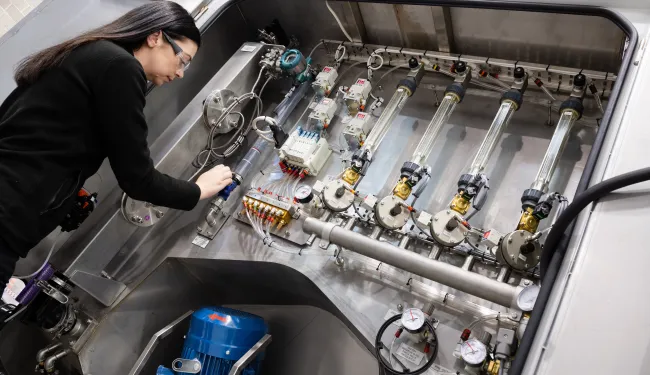
Wet blasting process control is the continuous monitoring and automatic correction of the variables that set a wet blast finish (media size, slurry concentration and pressure, air flow and part handling), so a recipe signed off at cycle one produces the same result at cycle 10,000.
Key wet blasting process control facts
| Control area | How Vapormatt delivers it |
|---|---|
| Variables controlled | Up to 15 interacting process variables |
| Media control | Patented elutriation tower (high-volume automatic machines) and non-blocking overflow (bubble) valve continuously remove broken media |
| Slurry delivery | Vapormatt Slurry Pipework System (VSPS) gives every nozzle an equal, consistent supply |
| Wear compensation | Variable-speed pump drives and airflow monitoring on each nozzle |
| Process data | Vapormatt 4.0 IIoT platform, fitted to all new automatic machines with the first year's subscription included |
| Proven finish | Ra as low as 0.2µm; edge hone tolerance within ±2µm |
| Aerospace standard | AMS 2432 compliant with full cycle logging (Leopard and Leopard Cub) |
| Process validation | Alicona surface measurement, particle size analysis and profilometry in Vapormatt's R&D laboratory |
| Retrofit | Available for Vapormatt machines and other manufacturers' machines (Vapormatt Inside) |
Process assurance in wet blasting: how specification holds at production scale
Your process engineer has signed off the recipe. Results are proven on samples. The specification is documented. The question that remains is the one that rarely gets a direct answer: will this machine deliver the same result at cycle 10,000 as it did at cycle one?
Most wet blasting suppliers will tell you their process is repeatable. Few show you the engineering that makes it so. A machine that can be set consistently is not the same as a machine that holds itself consistently under production conditions, across shifts and across months, without relying on operator experience or extensive manual checks.
Vapormatt machines are built to answer that question with hardware. This page explains the engineering behind it.
What causes wet blasting results to drift?
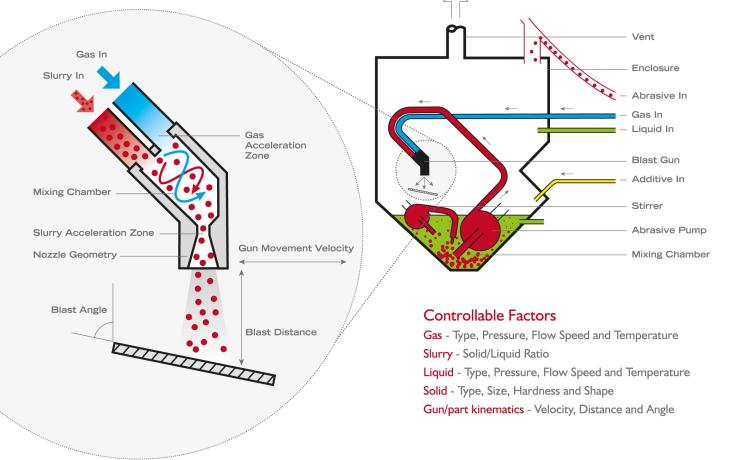
Wet blasting involves up to 15 independently adjustable process variables. Each one interacts with the others. Media concentration affects surface profile. Abrasive breakdown affects the process times. Slurry pressure affects the wear on the machine. Nozzle diameters affect running costs. Any variable drifting slightly, over time, produces a measurable change in the output.
Some machines give you the parameters to set. But setting them correctly at the start of a production run is not the same as holding them throughout. In tightly controlled applications such as peening and edge honing, on safety-critical components such as medical implants and jet engine parts, and in nuclear decontamination, that distinction is not a quality preference. It is the difference between a component that meets specification and one that does not.
Claiming repeatability is straightforward.
Engineering repeatability requires solving three specific problems: control of the abrasive media, consistent delivery of the slurry, and managing drift when machines wear. Most suppliers don't monitor and automatically adjust for these.
If you can measure it, you can control it
Using control as a guiding principle, Vapormatt engineers control into every machine. The result is a connected set of proprietary systems, each designed to remove a specific source of variability from the production cycle.
How do Vapormatt machines control media breakdown during production?
Abrasive media breaks down every time it strikes a component. As broken particles build up in the slurry, the particle size distribution shifts, and the surface finish shifts with it. The result is parts that look the same but measure differently.
Sieve-based filtration can't solve this in production. Screens block, need manual clearing, and can't hold the narrow size window that critical applications such as edge honing and shot peening require.
Vapormatt machines remove broken media continuously while they run, using two patented separation systems.
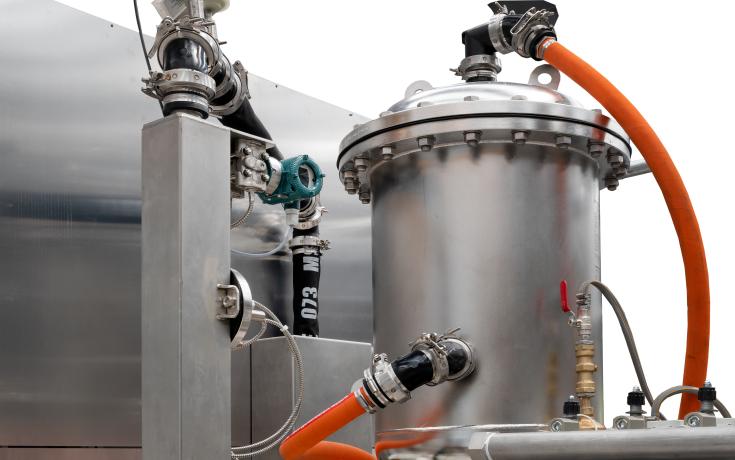
Non-blocking overflow (bubble) valve. Used across general wet blasting applications, this valve lets only broken, undersized media leave through the overflow. Spent particles are removed automatically, without operator intervention and without the blockages that affect screens.
Elutriation tower. On high-volume automatic machines running critical processes, the elutriation tower provides finer separation. Instead of a screen, it uses a controlled upward flow of liquid. Following Stokes' law, small broken particles settle more slowly than correctly sized ones, so they are carried out of the circuit while working media returns to the blast. This keeps the particle size distribution stable for the whole production run, not just at the start.
The result is media that stays within its working size range from the first component to the last. The recipe your process engineer signed off is the recipe the machine continues to deliver.
How is slurry delivered consistently to every nozzle?
Inconsistent slurry delivery produces inconsistent results. If nozzles across a machine receive different concentrations or pressures, the blast pattern varies across the component surface. The consequences are uneven surface finish, dimensional variation, and process non-conformances that are difficult to trace.
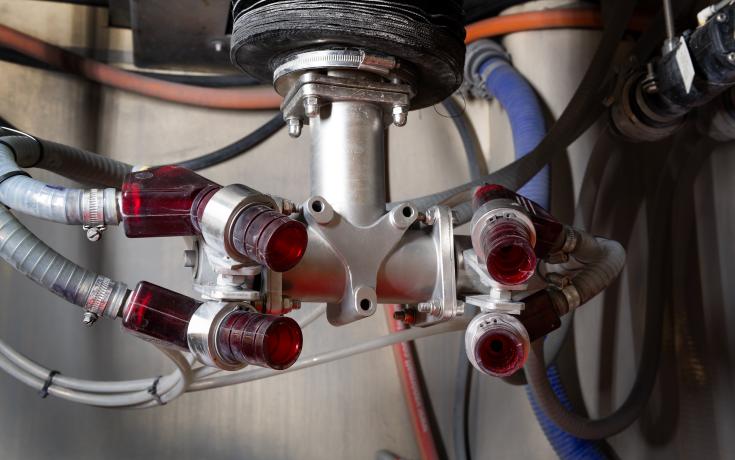
Vapormatt machines use proprietary sensing to monitor and respond to changes in the key delivery variables continuously. Pipework is designed with a precise understanding of how slurry pressure drops with every metre of hose, ensuring each nozzle receives a consistent and equal supply. This is the Vapormatt Slurry Pipework System (VSPS). Behind this is a complete delivery architecture specified and validated in Vapormatt's R&D facility, built on decades of understanding how particles behave in liquid and how to move them consistently around a system. That validation uses Alicona surface measurement, particle size analysis and profilometry, so what reaches your machine is proven, not estimated.
This is why Vapormatt process results hold where less controlled systems drift.
How does recipe-driven control make a finish repeatable?
Media control, slurry delivery and wear compensation keep the machine stable. Recipes make sure it runs the right process every time.
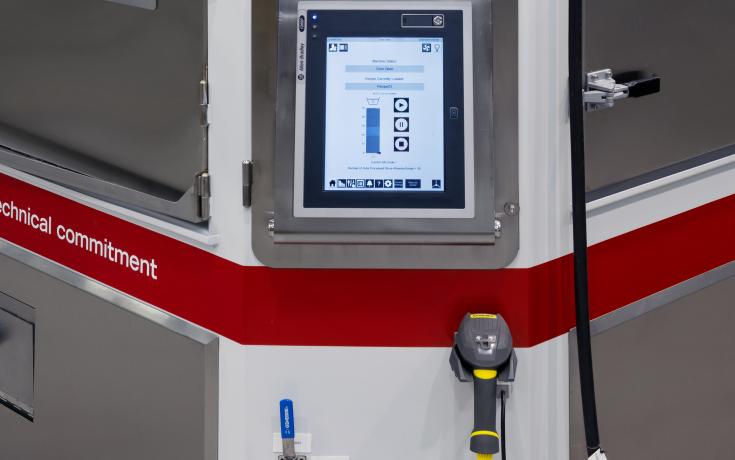
A recipe is the complete set of process parameters for a specific finish on a specific component. That includes air pressure, slurry pressure, blast time, blast angle and range, gun speed and component handling. Once your process engineer has signed off a recipe, it's stored on the machine's HMI and recalled whenever that component runs again. On machines fitted with barcode scanning, the operator scans the part or fixture and the correct recipe loads automatically.
Recipe-driven control changes three things in production:
- Operators choose a recipe, not settings. Results no longer depend on who is running the shift or how experienced they are.
- Quality teams work from an approved, documented process. Every component has a defined set of parameters, supporting the traceability that aerospace and medical OEM specifications require.
- Process engineers can standardise. An approved recipe can be run on another machine of the same model, so results can be compared like for like.
Most recipes start in our R&D Centre. When you send us sample components, our applications engineers develop and prove the process on your parts, then configure it into your machine before delivery. Production starts with a recipe that already works.
Proven where the consequences of drift are most severe
Vapormatt machines are used in some of the most tightly controlled manufacturing environments in the world. In these industries, repeatability has to be demonstrated, not promised.
- Aerospace: Leopard and Leopard Cub machines comply with AMS 2432, the aerospace specification for computer-monitored shot peening, with full cycle logging.
- Cutting tools: Edge hone tolerances are held within ±2µm, and Vapormatt's patented edge honing method delivers controlled, repeatable K-factors on solid carbide tools at production volume.
- Medical devices: Controlled surface roughness finishes support implant biocompatibility and sterilisation.
The results show up in production. One manufacturer cut compressor hub processing time from three hours to 20 minutes after installing a Vapormatt automatic machine. Another reduced total component processing time from 430 hours to 88 hours.
The control systems described on this page are built on Vapormatt patents. These include the vortex pump, the non-blocking overflow valve, the shallow sump media return system, the elutriation tower and micro nozzle technology. Each patent is the documented record of a specific engineering problem solved.
How do Vapormatt machines compensate for wear?
All blasting machines start to wear from the moment you turn them on. The question is whether the machine compensates automatically or silently allows output quality to degrade.
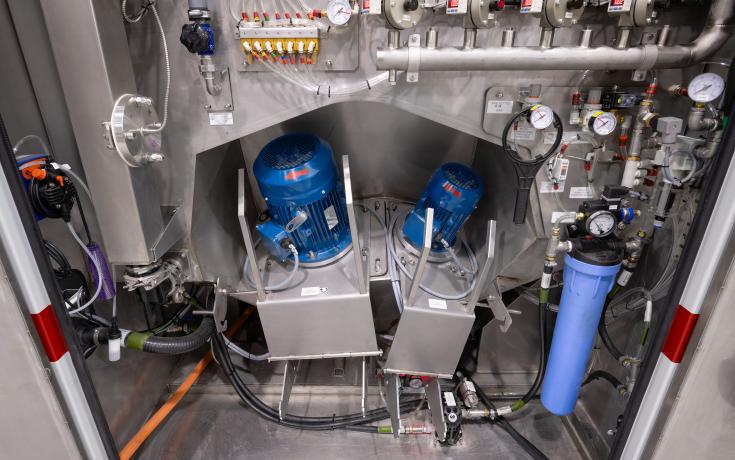
As pumps wear, Vapormatt's variable-speed drives compensate for changes in slurry pressure, increasing the usable life of the pump. Airflow monitoring on each nozzle detects changes in nozzle shape and size, and the machine compensates to prolong nozzle life before the finish degrades or running costs increase.
Vapormatt 4.0, our IIoT platform, is fitted to all new automatic machines, with the first year's subscription included. It continuously monitors drive performance, speed and positioning, flagging degradation before it creates unplanned downtime. Vapormatt 4.0 can also be integrated with your manufacturing systems; ask us what's possible for your site.
Longevity is engineered at the design stage too. Boron carbide blast nozzles, stainless steel cabinets, abrasion-resistant materials and an optimised cabinet design that avoids corners, sharp edges and blocking points all reduce the frequency and disruption of maintenance.
The bottom line
Most wet blasting suppliers claim a repeatable process. Vapormatt backs that claim with patented engineering and decades of know-how built into every machine. Media is managed continuously, slurry is delivered to specification, and wear is detected and compensated for automatically.
Buying a wet blasting machine means accepting whatever level of process control the manufacturer has chosen to invest in. Vapormatt has made that investment.
FAQs
How does a Vapormatt machine maintain consistent surface finish across a long production run?
By controlling the three main causes of drift continuously during production. The elutriation tower and the non-blocking overflow (bubble) valve manage media breakdown by removing broken media while the machine runs. The Vapormatt Slurry Pipework System (VSPS) delivers slurry evenly to every nozzle, with proprietary sensing responding to changes in concentration and pressure. Variable-speed pump drives and airflow monitoring on each nozzle compensate for wear automatically. The system corrects itself rather than waiting for a scheduled check or operator intervention.
What makes Vapormatt's process control different from other wet blasting suppliers?
The difference is in hardware, not claims. Every Vapormatt machine runs as a closed-loop system as standard. Vapormatt automatic machines add elutriation towers, bubble valves, concentration measurement, variable-speed pump drives and airflow monitoring, with the exact specification depending on the model and application. Together they address the three main causes of process drift: media breakdown, slurry delivery variation and wear-induced change over time.
What are the signs a wet blasting process is drifting?
Common signs include:
- surface roughness (Ra) creeping towards the edge of tolerance
- longer cycle times to achieve the same finish
- rising media consumption
- an uneven finish across a batch or across a single component
- nozzles or pumps needing replacement more often
The cause is usually one of three things: media breakdown, uneven slurry delivery or machine wear.
What is recipe-driven process control in wet blasting?
A recipe is the complete set of process parameters for a specific finish on a specific component. That includes air and slurry pressure, blast time, blast angle and range, gun speed and component handling. Once approved, the recipe is stored on the machine and recalled every time that component runs. The finish then depends on the recipe rather than on which operator is running the shift.
Is wet blasting process data compatible with quality management systems?
Yes. Vapormatt 4.0 is fitted to all new automatic machines. It gives authorised users access to machine status, maintenance history and production information, with separate access levels for production, quality and management teams. Approved recipes give quality teams a defined, documented set of parameters for every component. For aerospace peening, Leopard and Leopard Cub machines comply with AMS 2432 with full cycle logging. If you need to connect machine data to your existing quality or ERP systems, talk to us about your setup.
What is the elutriation tower and why does it matter?
It is a patented particle separation system that continuously removes broken, undersized media from the blast circuit during production. Broken media produces a different surface finish to correctly graded media. The elutriation tower holds the media population within specification without sieves, which block and require manual clearing. It is used on high-volume automatic machines running critical processes such as edge honing and shot peening, where even gradual drift in particle size would change the finish.
Can these control systems be retrofitted to existing machines?
Yes, including machines built by other manufacturers. Vapormatt offers two upgrade routes:
- Vapormatt Upgrade for existing Vapormatt machines.
- Vapormatt Inside for other suppliers' machines. It fits original Vapormatt components, and in many cases a complete new wet blasting system, into the existing cabinet.
Both routes start with an on-site inspection and a fixed-price proposal covering parts and labour, and all work carries a 12-month guarantee. Vapormatt 4.0 can also be retrofitted to existing machines. This lets you raise process control on equipment you already own without replacing it.
What is a closed-loop wet blasting system?
A closed-loop wet blasting system recycles its water and abrasive media continuously, rather than discharging them after use. Slurry quality and air pressure are monitored and controlled while the machine runs, so a recipe can be established once and reproduced cycle after cycle. Every Vapormatt machine runs as a closed-loop system as standard.
How does slurry concentration affect a wet blasting finish?
Slurry concentration determines how much abrasive strikes the surface in a given time, which affects the surface profile, the cycle time and how consistent the finish is across a batch. If concentration drifts during a run, the finish drifts with it. Vapormatt machines measure concentration and respond to changes continuously, so the slurry reaching the nozzles matches the approved recipe.
How does nozzle wear affect wet blasting results?
Abrasive slurry gradually erodes the inside of a blast nozzle. As the bore wears, its size and shape change, which alters the blast pattern and increases air consumption and running costs. Vapormatt uses boron carbide nozzles to slow this wear. Airflow monitoring on each nozzle detects the change, and the machine compensates to prolong nozzle life before the finish is affected.
Does better process control reduce wet blasting running costs?
Yes. Automatic wear compensation extends the life of pumps and nozzles, reducing replacement parts and maintenance interventions. Holding the finish within tolerance reduces rework and scrap. Vapormatt 4.0 flags degradation before it causes unplanned downtime. For applications that suit it, Vapormatt's patented micro nozzle technology reduces compressed air consumption by at least 60%.