
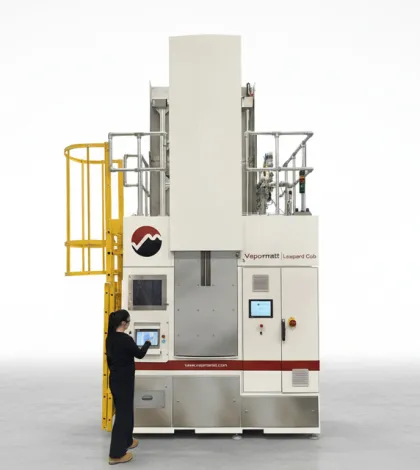
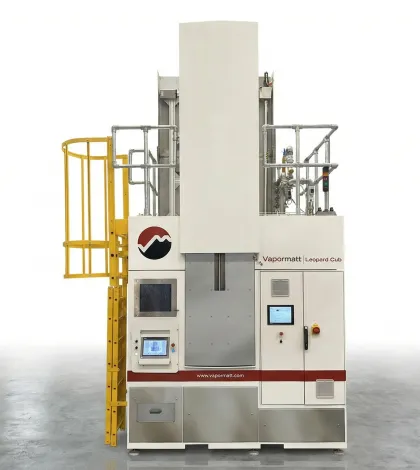
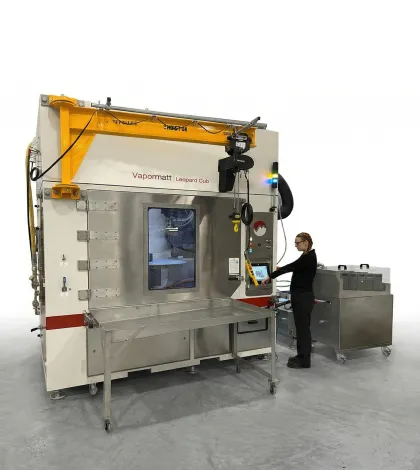
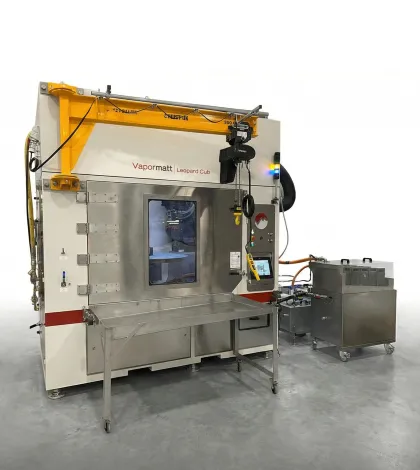
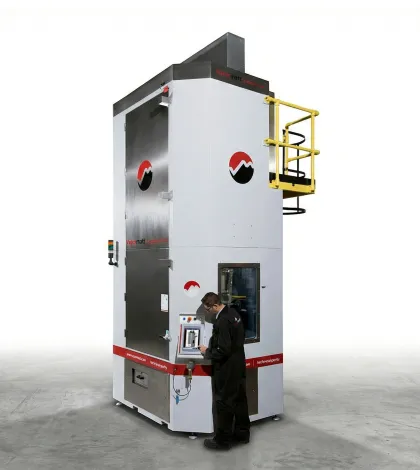
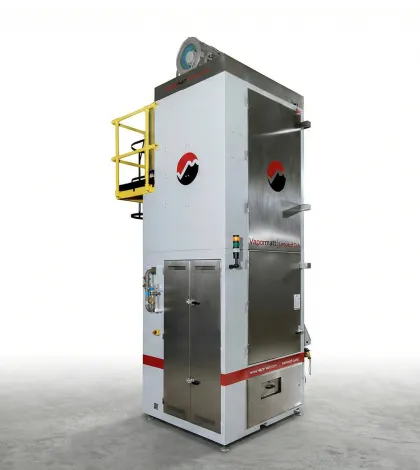
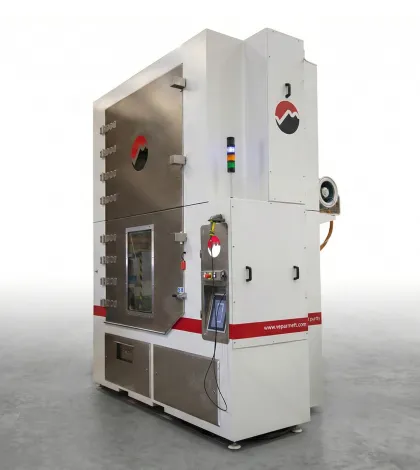
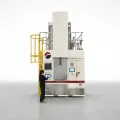
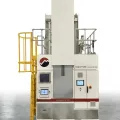
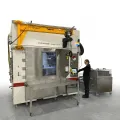
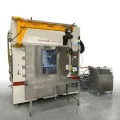

The technical challenge
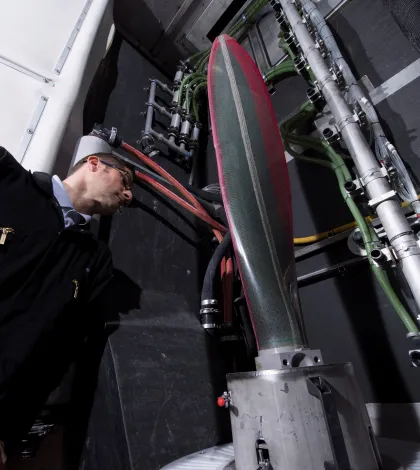
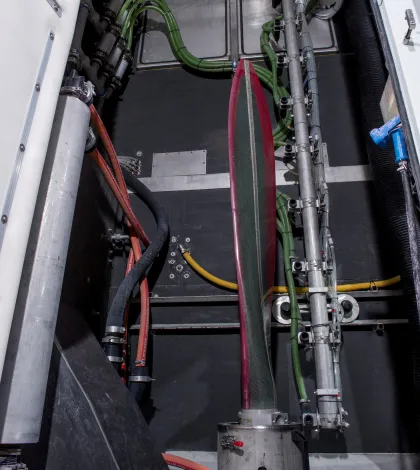
Aerospace engine components do not present flat surfaces to a blast nozzle. They twist, taper, and change section across their length, and the process specification follows every millimetre of that geometry. A machine with limited axes of motion cannot follow complex geometry without compromise. The consequence is a process record that describes what was intended, not what was delivered.
Process control and compliance
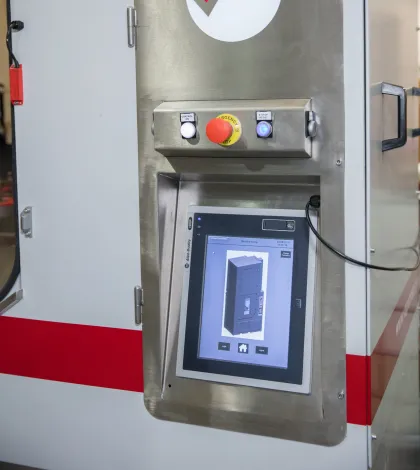
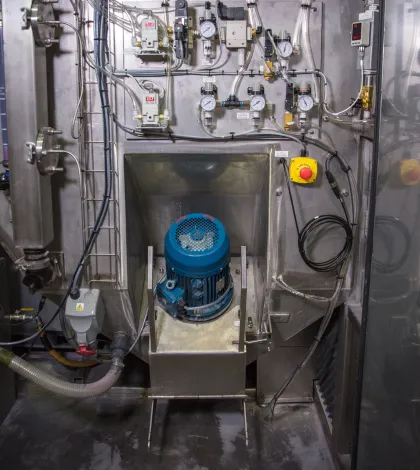
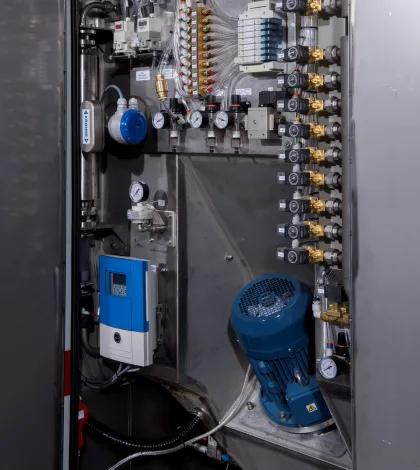
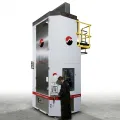
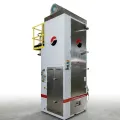
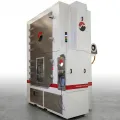
Every cycle on the Leopard Cub runs from a stored recipe, transferred automatically to the PLC on selection. Slurry pressure, blast air pressure, and airflow are monitored continuously. The optional slurry concentration sensor adds closed-loop abrasive control with watchdog limits that prevent processing if concentration drifts outside set bounds. The machine supports AMS 2432 computer-controlled shot peening, alongside Rolls-Royce RPS 428 and Pratt and Whitney POP 392-AR.
Why Vapormatt
Vapormatt invented wet blasting. No other machine builder brings the same depth of application knowledge to this component type.
- Global engine programme coverage: Trusted by global Tier 1 engine MRO operators across every major engine platform, including next-generation narrow-body programmes. Proven process. Documented results.
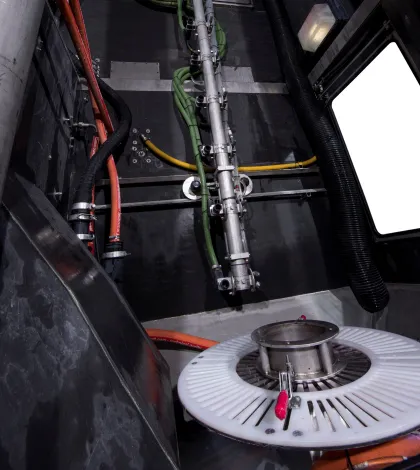
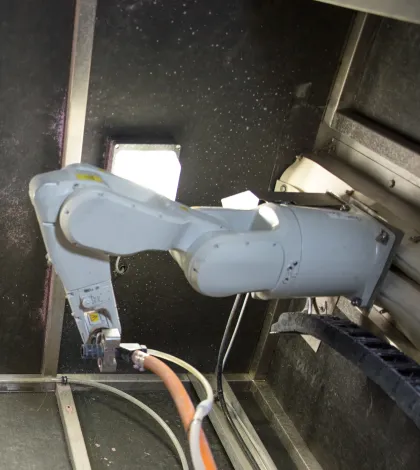
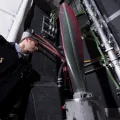
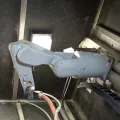
- 8-axis nozzle manipulation: Up to 8 axes of coordinated servo motion track every surface profile, twist angle, and root section to specification. Coverage is complete because the machine is engineered to deliver it, not because the operator compensates.
- A platform that adapts: Component profiles change with every new engine generation. Vapormatt's configurable clamping and application engineering mean the Leopard Cub processes components that do not yet exist at point of purchase. Your investment does not become obsolete when your customer's fleet changes.
Vapormatt's patented slurry management and nozzle technology underpin every machine in the range.
Explore Vapormatt's R&D and patents
The Vapormatt Promise: the machine meets the agreed specification, or we make it right.
The bottom line
Every engine MRO operation reaches the point where the process they have cannot satisfy the audit they face. The Leopard Cub is the machine that closes that gap: recipe-controlled, robot-precise, and supported by process engineering that has handled every major engine component in service today. The question is whether you close it before the next audit or after it.
Technical specifications
| Parameter | Specification |
|---|---|
| Load height | 1.2m (48") |
| Oscillation unit footprint | 2.5 × 4.0 × 5.1m (99" × 158" × 201") |
| Robot unit footprint | 3.7 × 4.4 × 4.0m (149" × 176" × 158") |
| Axes of control | Up to 8 (robot configuration) |
| Turntable speed | 1–10 RPM, servo controlled |
| Nozzle manipulation | Oscillation: servo-powered X/Y axes with optional A/C rotary axes. Robot: 6-axis, full nozzle manipulation |
| Electrical supply | 400/480V, 3-phase, 50/60Hz, 46A |
| Process air | 6–7 bar (90–100 psi); max 1.50 Nm³/min (53 SCFM) |
| Available options | Slurry concentration sensor, patented elutriation tower, MK9 blast guns, MES data logging |
Full technical specifications are available in the downloadable Leopard Cub machine brochure