








The technical challenge
Edge honing and pre- and post-coating treatments are not cleaning operations; they are precision surface treatments that add significant value to every insert. Every cycle must hold the edge radius and surface condition tightly enough to guarantee PVD or CVD coating adhesion and cutting performance. On a 10,000-piece batch, even a 3% scrap rate means 300 rejected inserts at their most expensive stage of manufacture.
Process control and consistency
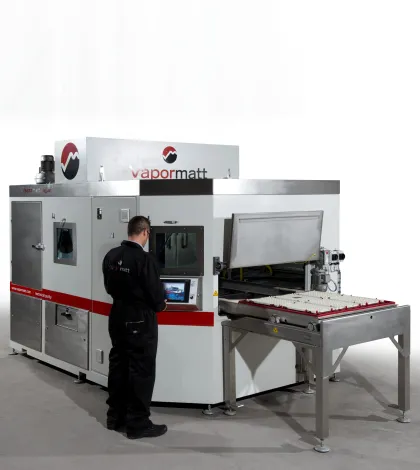
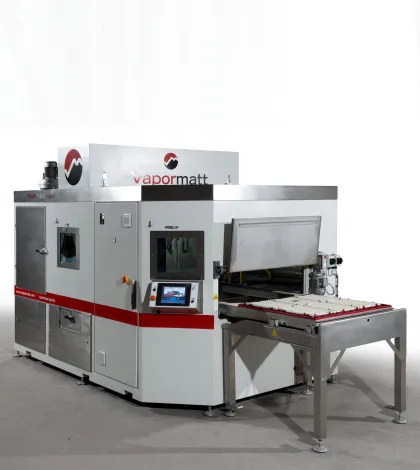
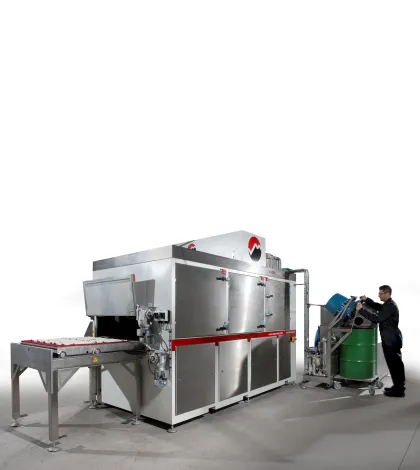
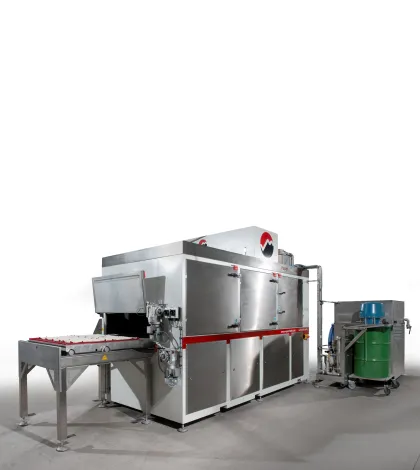
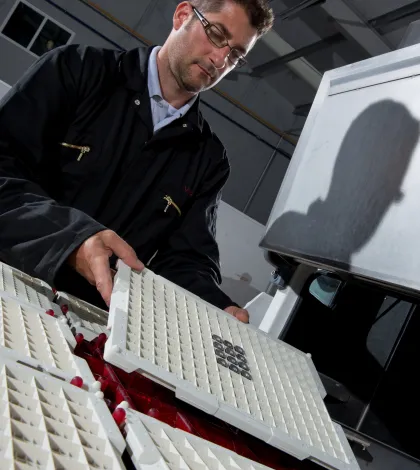
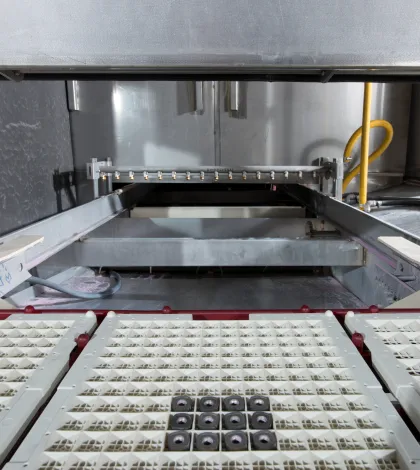
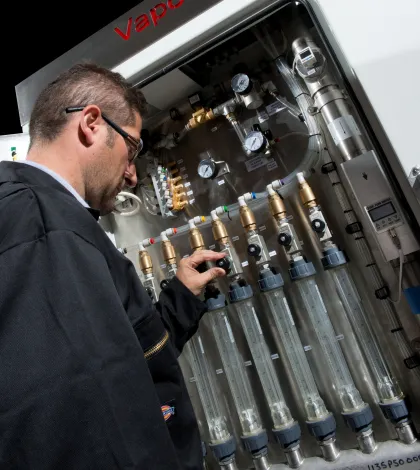
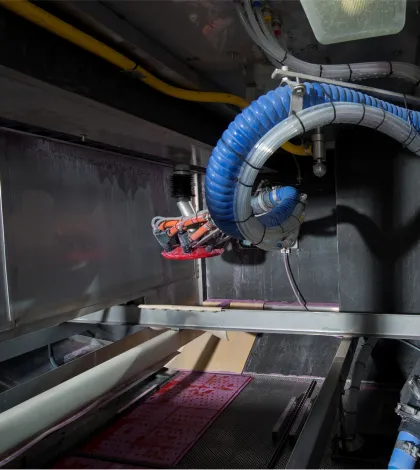
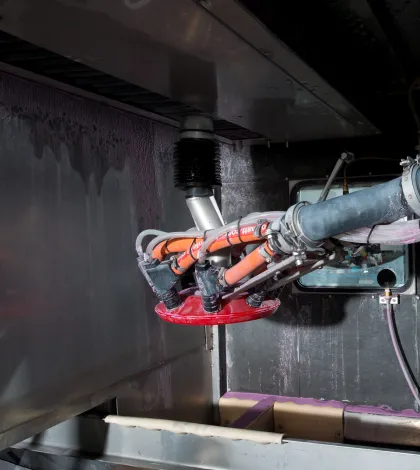
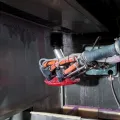
The Jaguar’s blast head carries eight Vapormatt blast guns with boron carbide nozzles, spaced evenly around a circular crown for symmetrical processing. The blast head moves through the Y and Z axes while the pallet cassette indexes through the X axis. Gun crowns are pre-set at angles between 45° and 80° to produce the K-factor each insert specification requires. Closed-loop slurry pressure control keeps blast energy consistent from the first pallet to the last, and the optional patented elutriation tower continuously removes broken-down media, so media quality does not erode over a production run. Optional blast airflow monitoring flags a fault on any individual gun before it affects the result.
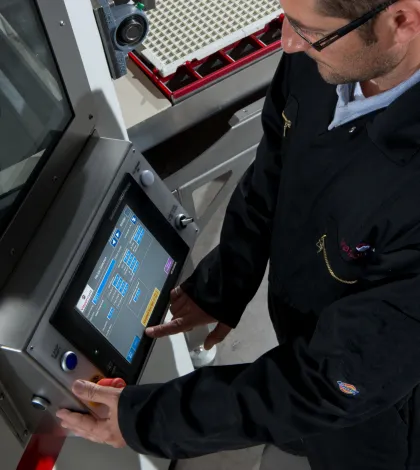
The Jaguar processes up to six pallets per cycle at approximately 4 minutes per pallet, per side. An integrated spray rinse removes most of the abrasive before inserts move on to separate washing and drying. Recipes are stored, coded and recalled by component type on the colour touchscreen HMI, so repeat production runs start where the last one finished. With the optional shuttle load/unload cell, operators load the next pallets while the current batch is being blasted.
Why Vapormatt
The Ashworth family pioneered wet blasting in the 1940s, and Vapormatt has built nothing but wet blasting machines since 1978. We built the first automated edge honing machines for cutting tool inserts in the 1980s and have supplied insert finishing systems to carbide producers across the globe. No competitor brings that depth of application knowledge to a machine with this capacity.
- Proven on production inserts: a Jaguar installed at one of Europe’s oldest hard metal insert manufacturers repeatedly produces edge hones of 30 to 40µm, within a tolerance tighter than the ±15µm the customer specified. Read the case study.
- High-capacity, sustained precision: built to process at volume continuously, the Jaguar maintains ±5 µm edge radius tolerance across extended production runs without process drift.
- Designed for uptime: large service access doors, a spacious cabinet and an externally mounted oscillation system keep media and water away from critical bearing areas and cut servicing time, while Vapormatt 4.0 remote diagnostics help keep the machine in production.
The Vapormatt Promise: every Jaguar is tested against the agreed specification at factory and site acceptance, and if it falls short, we make it right.
The bottom line
The Jaguar is the proven choice for carbide insert manufacturers who need more capacity and tighter process accountability than turntable machines offer, without moving to a fully integrated production line. A machine that cannot hold consistency cannot hold tolerances; without that control, scrap rates climb and performance cannot be guaranteed. The Jaguar closes that gap. If you need loading, blasting, washing and drying in one continuous, unattended line, the Tiger is built for that. Not sure which suits your volumes? Tell us about your inserts and we will recommend the right machine.
Technical specifications
| Parameter | Specification |
|---|---|
| Applications | Edge honing, deburring, cleaning, PVD/CVD pre-coating surface activation, post-coating peening and polishing |
| Capacity per cycle | Nominal 6 pallets (e.g. 6 Manz pallets, 383 x 281mm / 15" x 11") or up to 34 shank tools |
| Cycle time | 15–30 minutes per cycle, one side (approx. 4 minutes per pallet), depending on insert size, pallet size and process |
| Edge radius | Homogeneous edge radii up to 70µm, held to ±5µm or ±10% (subject to pre-process insert condition) |
| Blast guns | 8 Vapormatt solid polyurethane blast guns with 10 or 12mm boron carbide nozzles; Mk 9 guns optional |
| Gun crown angles | 80°, 60°, 55°, 45° or manually adjustable 45°/80° |
| Motion | Blast head Y and Z axes; pallet cassette indexes through the X axis |
| Processing trolley | Flatbed trolley, load height approx. 990mm (39"); accepts items 150–900mm (6"–35"), max height 450mm (17.5") |
| Process stages | Wet blast 1, optional wet blast 2, rinse; separate washing and drying required |
| Blast media | F150 to F320 |
| Construction | High-grade stainless steel cabinet with abrasion-resistant lining |
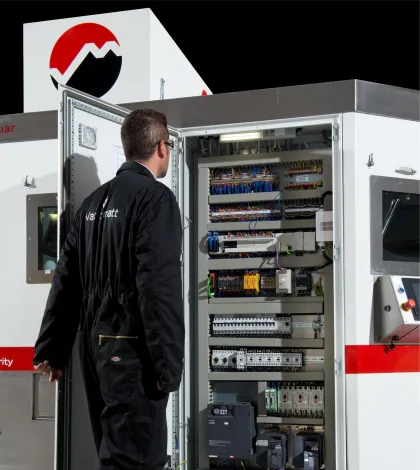
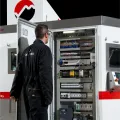
| Controls | PLC with colour touchscreen HMI, stored recipes and post-process reporting; Vapormatt 4.0 remote diagnostics; MES and barcode recipe loading optional |
| Blast cabinet floor area | 6.98 x 2.3 x 3.02m high (275" x 91" x 119" high), including filtration |
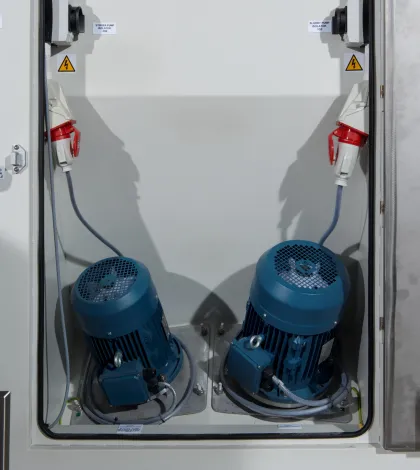
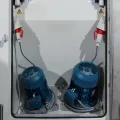
| Slurry system | 2 Vapormatt vortex slurry pumps; closed-loop pressure control; polyurethane pumping elements |
| Electrical supply | 400/480V, 3 phase, 50/60 Hz, 36 amp |
| Process air supply | 6-7 bar (90-100 psi); 5.6 Nm³/min (209 SCFM) for 8 guns |
| Water supply | 2-4 bar (30-60 psi); 13 L/min (3 gpm) intermittent |
| Sound attenuation | Internal sound reduction panels and sound-deadening maintenance doors; operational noise specifiable to 75 dBA |
| Vertical gun head manipulator | 200mm (7.9") Z-axis stroke, ±0.5mm accuracy (optional) |
| Load/unload cell | Shuttle system with safety cage for continual pallet loading during production (optional) |
| Blast airflow monitoring | Per-gun fault detection for air jet or hose failure (optional) |