
Having invested in the most reliable and accurate industrial 3D printers and quality inspection equipment, it’s built its reputation on delivering design and engineering excellence, and the highest-quality products
SLS explained
SLS works by raising a bed of polymer powder to within 10 degrees of its melting point. Next, a laser sinters the powder together in selected areas to create the component.
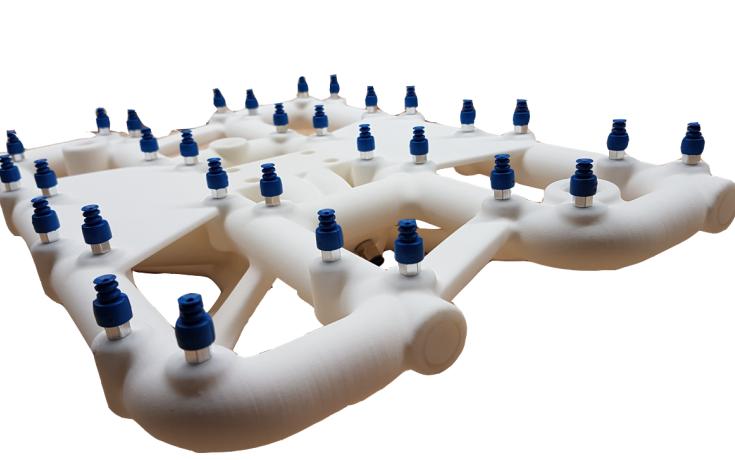
Anubis 3D’s Selective Laser Sintering produces components that are almost impossible to make using alternative production processes. Components with complex internal channels for example
Beyond the limits of dry blasting
Two key finishing processes are required for the creation of a component: the removal of un-sintered powder from around and within its channels; the production of a high-quality surface finish. Anubis quickly discovered that its existing dry blasting machine wasn’t very effective at the former. In fact, dry blasting often compounded the problem, with the dry blast residue settling on top of the un-sintered powder already trapped in channels
A cleaner, more efficient process
Our Vapormatt Puma wet blasting system helped to change the game for Anubis. The Puma is not only able to completely remove trapped powder but gives a useful indication that removal has been achieved when the wet blast mixture flows out of the channels.
Protect health, safety… and budget
Sinter powder, like many powders distributed in air, can be explosive. The Puma’s wet blasting process helps to contain the powder and eliminate risk – a significant advantage over Anubis 3D’s incumbent dry blasting machine. (Although explosion proof dry blasting equipment is available, it’s a lot more expensive and much harder to justify from an ROI perspective.)
Achieve the perfect finish
As expectations of additive manufacturing increase, a high-quality finish has become mandatory and is particularly important for the even application of coatings, like paint for example. Wet blasting produces a high-quality and even surface finish that’s difficult to achieve with dry blasting. In fact, dry blasting, if not done with care, can ‘burn’ components, causing them to be instantly rejected.
Metal components produced by the Direct Metal Laser Sintering (DMLS) process would originally have to be placed onto a CNC machine to produce the required finish. Wet blasting removes the need to do this
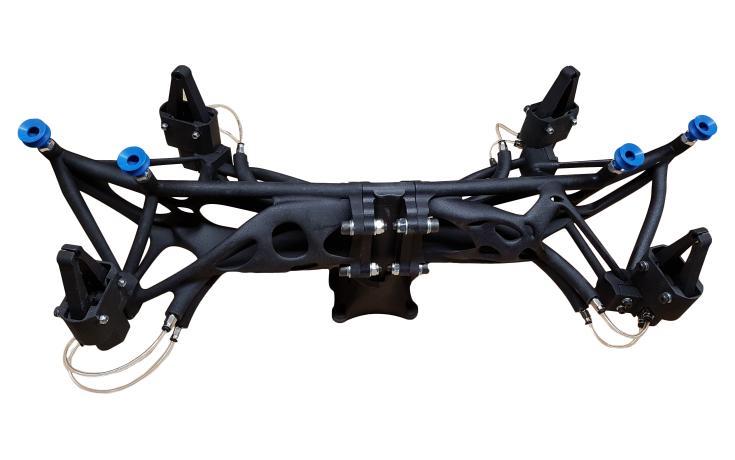
Wet blasting in action: saving time and resources
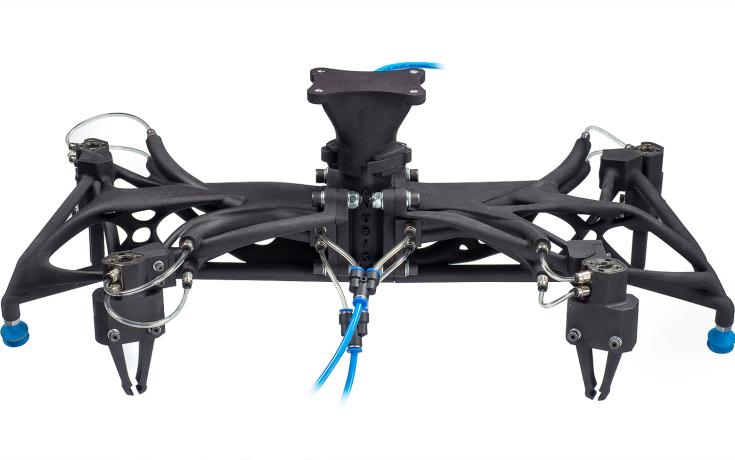
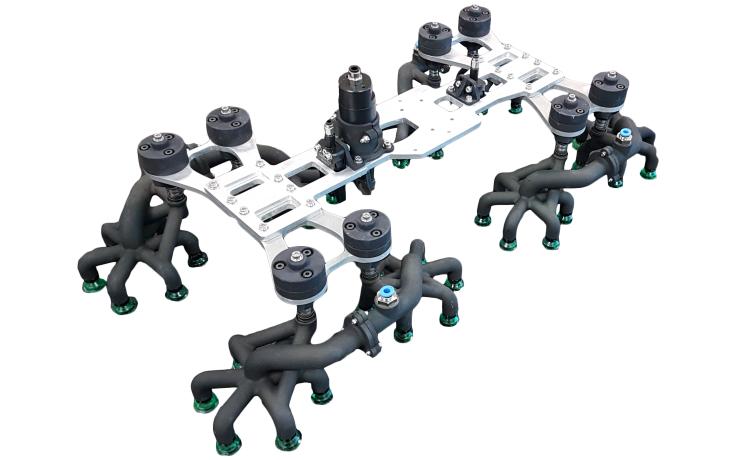
Used in state-of-the-art, fully autonomous grocery stores, Anubis manufactures a ‘surface gripper’ that once attached to a robotic arm and vacuum is capable of lifting parcels of up to 40kg (88lb).
With numerous complex internal channels, it’s the type of component that can only be made by additive manufacturing, Equally, the design of the gripper is only made feasible because Anubis has absolute confidence that its Vapormatt Puma will fully clear all internal channels. Without fully clear channels, the gripper would underperform – falling short of its specified lift capacity.
Knowing that all channels are definitely clear of powder means any rare issues with lift performance, highlighted by Anubis’ rigorous quality testing, can be quickly and easily isolated to a faulty solenoid – a part that’s straight forward to replace.
Realise new possibilities
In summary, Anubis has designed and developed a complex component for a futuristic autonomous retail store that can only be produced by cutting-edge additive manufacturing technology. A component that in turn is only made possible thanks to Vapormatt wet blasting.
If you’d like to learn more about the many advantages of wet blasting for your additive manufacturing business, or if you have a specific requirement you’d like to discuss, please contact us, we’ll be happy to help.