
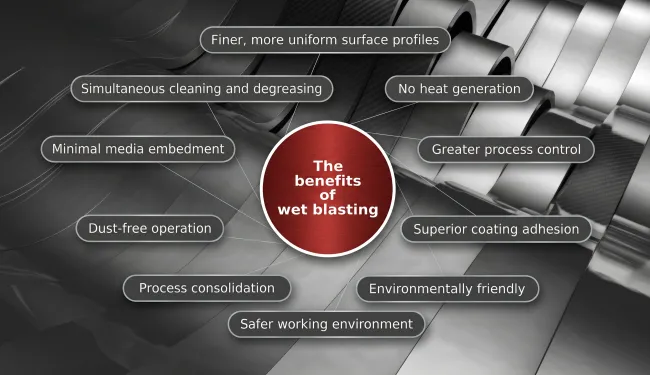
Talk to an applications engineer about the benefits of wet blasting over other processes
Wet blasting (also known as vapor blasting) mixes abrasive media with water, so each particle flows across the surface instead of hammering into it. The main benefits over dry blasting and other finishing processes are a finer, more uniform finish down to 0.2µm Ra, minimal media embedment, no heat distortion, virtually no airborne dust, and cleaning, degreasing and finishing in a single cycle, all repeatable through 15 adjustable process variables.
The result is a process that delivers finer finishes, tighter tolerances and cleaner operations than dry blasting, chemical etching or manual finishing, across a wider range of components and industries.
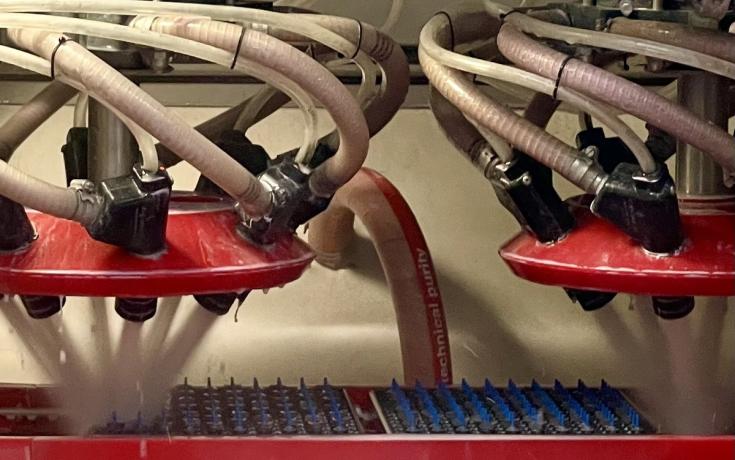
How water changes the mechanics of blasting
In dry blasting, abrasive particles strike the surface at full velocity and ricochet at steep angles, typically between 45 and 90 degrees. This creates an aggressive, impact-driven process that produces rough, inconsistent profiles with media fragments frequently embedded in the substrate.
Adding water fundamentally changes this behaviour. The water cushions each particle on impact, reducing the ricochet angle and converting the action from impact to flow. Media travels across the surface in a lapping motion rather than hammering into it. This produces five measurable differences:
- Virtually no airborne dust. Any airborne particles are contained in the water, protecting operators from harmful dust, carcinogens and uncomfortable working conditions.
- Simultaneous cleaning and degreasing. The water carries away oils, grease and contaminants during blasting, removing the need for a separate pre-wash stage.
- Finer, more uniform surface profiles. The surface roughness values are consistently lower, down to 0.2µm Ra, across the entire component, including complex geometries and internal passages.
- Minimal media embedment. The water barrier prevents abrasive particles from lodging in the substrate, critical for soft metals like aluminium, titanium and copper alloys.
- No heat generation. Water absorbs thermal energy on contact, eliminating the risk of warping, distortion or metallurgical changes to heat-sensitive components.
These are not incremental improvements. They represent significant advantages of introducing water to the process.
The controllable factors of wet blasting
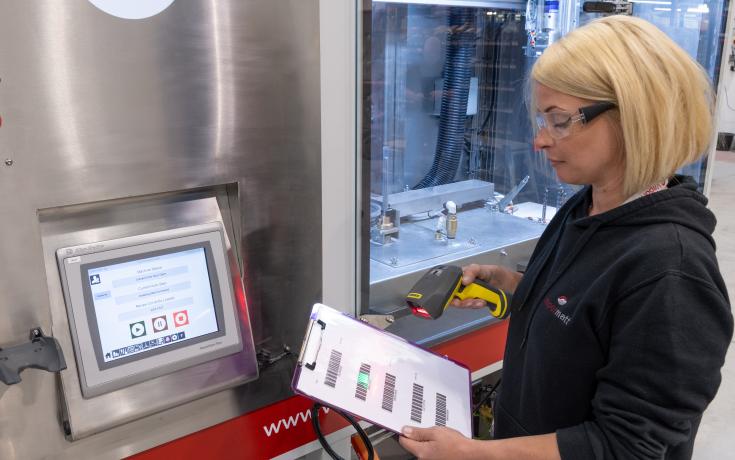
The 15 variables of wet blasting
Wet blasting offers more independently adjustable process variables than any comparable mechanical surface treatment. With 15 parameters, engineers can define and hold an exact finish, then repeat it across thousands of components:
- Air: pressure, flow
- Slurry: pressure, flow, temperature
- Media: density, size, shape, hardness
- Gun setup: number of guns, nozzle length, nozzle diameter
- Motion: blast range, blast angle, speed of guns
This level of control matters in three ways.
- First, it allows manufacturers to hold tight surface finish tolerances batch after batch.
- Second, it provides the data trail that quality systems and OEM specifications increasingly require.
- Third, Vapormatt's engineering team uses these parameters to develop and prove the optimal process for each application, then configures it into a standardised machine. The result is proven performance from day one, not a prototype that needs refining on the factory floor.
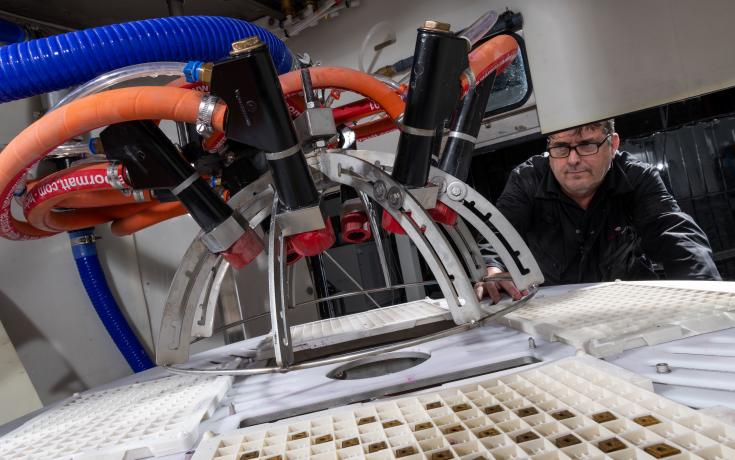
Process consolidation: multiple steps in one cycle
Where conventional finishing requires separate stages for degreasing, blasting, cleaning and surface preparation, wet blasting combines these into a single operation.
Components go in contaminated. They come out clean, profiled to a defined finish, ready for the next production step.
This means less handling between stages, less floor space dedicated to multiple machines, shorter cycle times and fewer opportunities for recontamination between process steps.
For applications where the finished surface must be immediately ready for coating, bonding or inspection, this matters. Wet blasting produces an exceptionally clean, reactive substrate in one cycle, which is why coating adhesion after wet blasting typically outperforms adhesion after any other mechanical surface treatment.
Safer for operators, better for the environment
Wet blasting produces virtually no airborne dust. The water captures all particulate matter within the slurry, eliminating operator exposure to harmful dust and removing the need for dust extraction systems. It also eliminates static charge build-up, which in dry blasting environments creates explosion risk when processing certain metals and powders.
No harsh process chemicals are needed, only low-concentration additives such as corrosion inhibitors and biocide where required. The abrasive media is recyclable. The water is recyclable. And the enclosed, self-contained system means no contamination enters the wider working environment. For manufacturers looking to reduce their environmental footprint alongside their compliance burden, wet blasting addresses both.
Vapormatt machines typically run at around 75 dB(A), below the 80 dB(A) level at which UK hearing protection duties begin.
Read about the health, safety and environmental benefits of wet blasting
Wet blasting vs dry blasting and other finishing processes
Wet blasting is not the right choice for every application. Dry blasting remains effective for heavy material removal where finish quality is less critical. Drag finishing excels at high-gloss polishing of individually fixtured components. Brush finishing delivers precise deburring and polishing of flat and rotary components. Each technology has its place.
But for applications where surface quality, consistency, process control and safety are priorities, the comparison below shows where wet blasting holds structural advantages.
Surface finishing process comparison
| Wet blasting | Dry blasting | Drag finishing | Brush finishing | Vibratory/tumble finishing | Chemical etching | |
|---|---|---|---|---|---|---|
| Surface consistency | Uniform surface roughness, down to 0.2µm Ra, across complex geometries including internal passages | Variable. Inconsistent on complex shapes | Excellent on external surfaces. Cannot reach internal passages | Good on accessible edges and flat faces. Limited on complex 3D geometries | Good for bulk batches. Limited control on individual components | Good on flat surfaces |
| Media embedment | Minimal. Water barrier prevents particle lodging | Common, especially on soft metals | Minimal | Not applicable (abrasive bonded to brush) | Possible with aggressive media | Not applicable |
| Heat / distortion risk | None. Water carries heat away, so thin and heat-sensitive sections don't distort | Heat build-up, with a risk of distortion on thin sections | Low. Some friction heat in dry mode | Moderate. Friction heat at the brush contact point unless coolant is used | Low. Usually run wet with compound | Minimal. No mechanical impact or friction |
| Degreasing in same cycle | Yes. The slurry carries away oils and grease during blasting | No. Parts usually need degreasing first, as oil contaminates the media | Partial in wet mode with cleaning compound. Otherwise parts need cleaning first | No. Separate cleaning usually needed | Partial. Wet compounds can remove light oils | No. Parts must be degreased before etching for an even result |
| Process control | 15 independently adjustable parameters | Typically two to three variables | Carousel speed, spindle speed, media type, immersion depth, dwell time | Brush type, speed, pressure, angle | Speed, media type, time | Chemical concentration and dwell time |
| Environmental and safety | Virtually no airborne dust, no dust extraction needed, recyclable media and water | Dust extraction required. RCS exposure risk | Low impact (wet and dry modes available) | Moderate impact (dust extraction typically needed) | Low environmental impact | Chemical storage, handling and disposal required |
| Best suited for | Cleaning, degreasing, surface preparation, peening, coating prep across diverse components and geometries, edge honing of cutting tools | Heavy material removal, rust and scale stripping | High-gloss polishing and edge rounding of individually fixtured high-value components | Precision deburring and polishing of flat and rotary components | Bulk deburring of robust components | Specific substrate and geometry combinations requiring chemical precision |
Capital and running costs by process
| Cost type | Wet blasting | Dry blasting | Drag finishing | Brush finishing | Vibratory/tumble finishing | Chemical etching |
|---|---|---|---|---|---|---|
| Capital cost | High | Medium | High | Low | Low | High |
| Running cost | Low | Medium | Medium | Low | Low | High |
Wet blasting has a higher capital cost than dry blasting but one of the lowest running costs of any process compared. No dust extraction is needed, media and water are recycled, and cleaning, degreasing and finishing happen in a single cycle.
FAQs
What are the main benefits of wet blasting?
Wet blasting gives a finer, more uniform surface finish (down to 0.2µm Ra) than dry blasting, with minimal media embedment, no heat distortion and virtually no airborne dust. It also cleans, degreases and finishes a component in a single cycle. With 15 adjustable process variables, the same finish can be repeated across thousands of parts.
Is wet blasting better than sandblasting?
For precision components, yes. Sandblasting fires dry abrasive at full velocity, which can embed grit in the surface, build up heat and create dust that needs extraction. Wet blasting cushions the abrasive in water, giving a finer finish with virtually no airborne dust. Sandblasting remains faster and cheaper for stripping heavy rust and scale from large steel structures.
Is wet blasting faster than dry blasting?
For heavy material removal, dry blasting is usually faster. For finished components, wet blasting is often faster overall, because cleaning, degreasing and finishing happen in one cycle instead of several. GE Aerospace cut total component processing time from 430 hours to 88 hours with a Vapormatt Leopard automatic wet blasting machine.
Is wet blasting more expensive than dry blasting?
Upfront, usually yes: a wet blasting machine typically costs more to buy than a dry blasting cabinet. Running costs are lower, because no dust extraction is needed, abrasive media lasts longer, and cleaning, degreasing and finishing happen in one cycle instead of across several machines. Over the machine's life, total cost of ownership is often lower.
What are the disadvantages of wet blasting?
Wet blasting has a higher upfront cost than dry blasting, and the process water needs managing, with a biocide programme for Legionella and corrosion inhibitors to prevent flash rust on ferrous parts. For heavy rust, mill scale or thick coatings on large steel structures, dry blasting is usually faster and cheaper. Where surface quality, repeatability and operator safety matter most, these trade-offs are usually outweighed.
Does wet blasting improve coating adhesion and bond strength?
Yes. Coatings and adhesives bond best to a surface that is clean, free of oil and embedded particles, and uniformly profiled. Wet blasting delivers all three in one cycle, leaving a reactive surface ready for coating, painting or bonding, including on composites, without fibre damage.
Will wet blasting affect the dimensions of precision parts?
Not when the process is correctly set. Because the water cushions each particle, wet blasting cleans and finishes with very little material loss. Vapormatt machines hold edge hone tolerances to within ±2µm, and the water carries heat away, so thin or heat-sensitive sections don't distort. See how process control holds tolerances.
Can wet blasting replace manual polishing?
In many applications, yes. Automatic wet blasting gives a consistent finish on every part without depending on operator skill. Pharmaceutical machinery manufacturer Iskra PIO replaced manual polishing and brushing with Vapormatt machines, achieving faster, more consistent hygienic stainless steel finishes below 0.8µm Ra.
Is wet blasting environmentally friendly?
Compared with dry blasting and chemical processes, yes. Vapormatt machines are closed-loop systems that recycle both water and media, need no dust extraction and use no harsh process chemicals. The waste slurry still has to be collected and disposed of correctly, but the volume is small and contained within the machine.
Can wet blasting meet aerospace and medical OEM specifications?
Yes. The 15 controllable parameters allow engineers to define, document and repeat exact process recipes to meet the traceability and documentation requirements of aerospace MRO and medical device manufacturing standards. Our wet peening systems are built to comply with AMS 2432, the aerospace specification for computer-monitored shot peening.
Is wet blasting safer than dry blasting?
Yes. Wet blasting captures particles in water, so it produces virtually no airborne dust, needs no dust extraction and removes the dust explosion risk of dry blasting. Vapormatt machines also run at around 75 dB(A). A COSHH assessment is still required for the media and any coatings being removed.
How does wet blasting compare to drag finishing or brush finishing?
These are complementary rather than competing technologies in many applications. Drag finishing excels at high-gloss polishing of individually fixtured components. Brush finishing is proven for deburring and polishing of flat and rotary components. Wet blasting offers broader versatility: cleaning, degreasing, surface profiling and finishing in a single operation, across a wider range of component sizes and geometries, with the added benefits of virtually no airborne dust, no heat distortion and minimal media embedment. Edge honing with wet blasting is quicker and more repeatable over large batches than other processes.