Image


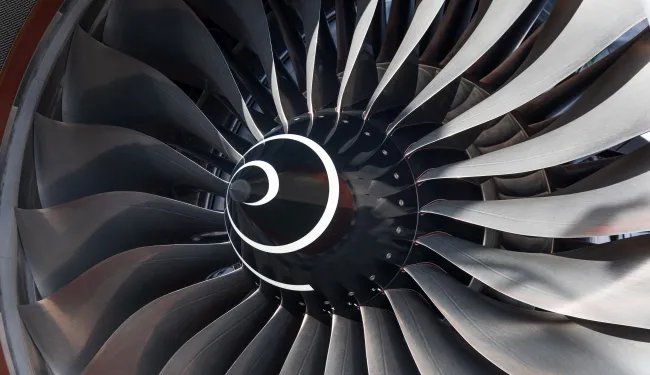


One operation replaces three, putting components on the inspection line faster
No peening risk, no dust, no ATEX requirement, no harmful chemicals
Every cycle produces the same result, with full parameter traceability
Approved in the specifications of Rolls-Royce, Pratt and Whitney, GE, and Airbus
A surface that looks clean is not the same as a surface ready for inspection. Jet engine components arrive at your cleaning line carrying combustion deposits, heat scale, oils, and carbon build-up accumulated across thousands of flight cycles. If any of it remains in a fir tree slot, disc bore, or blade root, you risk missed indications, false calls, and the re-inspection cost and schedule pressure that follows. The margin for error, when the component goes back on a flight-critical engine, is zero.
Vapormatt's wet blasting machines have prepared jet engine components for NDT since the late 1940s, when Norman Ashworth developed the first wet blasting process alongside Sir Frank Whittle during the development of the jet engine itself. That origin matters here: the process was created specifically to meet the surface quality demands of engine components. Every machine we build today carries that accumulated specification knowledge.
Read the jet engine compressor hub NDT case study
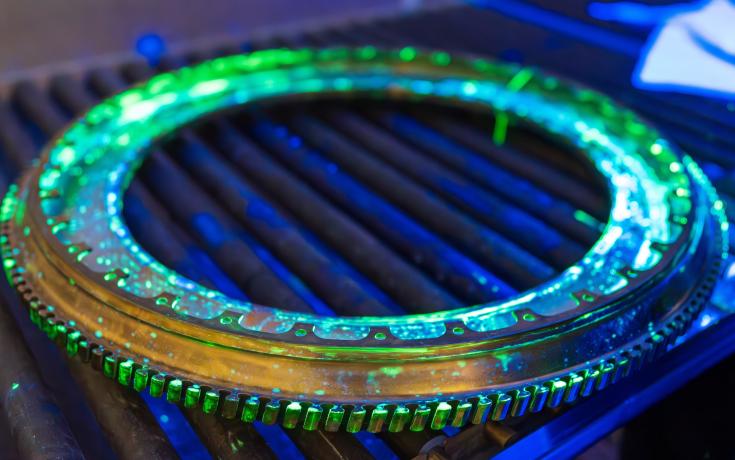

The three processes most commonly used ahead of wet blasting share a common failure: none of them reliably produce the consistent, contamination-free surface that accurate NDT depends on.
vs. dry blasting: Dry media blasting creates a fundamental conflict with NDT. The impact-driven process can peen the surface, closing the very discontinuities - cracks, micro-porosity, fatigue initiations - that the inspection is designed to find. Dry blasting also embeds media particles into the surface, adding a new source of false signal. It generates dust throughout, requiring full component cleaning and drying before inspection can proceed, adding a handling stage and time. When working with titanium engine components, dry blasting introduces ATEX filtration requirements that raise both the capital cost and the operational complexity of the process.
vs. chemical cleaning: Chemical processes can remove combustion deposits and heat scale effectively but carry their own cost. Multi-stage immersion processes - alkaline degreasing, acid etch, rinse, neutralise, dry - are time-consuming, require controlled disposal of effluent, and are poorly suited to in-line production environments. They can also attack substrate material at concentrations necessary to fully remove tenacious deposits, and they provide no mechanical action to open crack faces for penetrant entry.
vs. manual cleaning and hand scrubbing: Cleaning time for a typical compressor hub by hand can run to six hours or more per part. That is a skilled inspector's time consumed before a single measurement is taken. The result varies with operator, with fatigue, and with tool access. Complex geometries - fir tree slots, blade roots, cooling holes - are rarely fully cleaned. Residual contamination in these areas suppresses FPI penetrant migration and distorts eddy current signals, producing unreliable indications.
Find out how wet blasting compares with other finishing processes
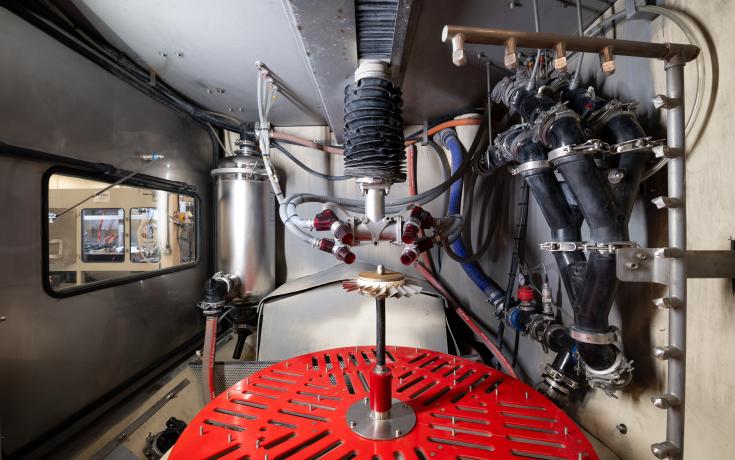
Compressor hub processing time cut from 3 hours to just 20 minutes by installing an automatic Vapormatt Leopard Cub, which precisely blasts every angle of a hub's complex "fir tree" geometry.

Vapormatt's Leopard horizontal automatic wet blasting machine cut total component processing time from 430 hours to 88 hours (an 80% reduction) while eliminating the material loss risk associated with dry blasting.
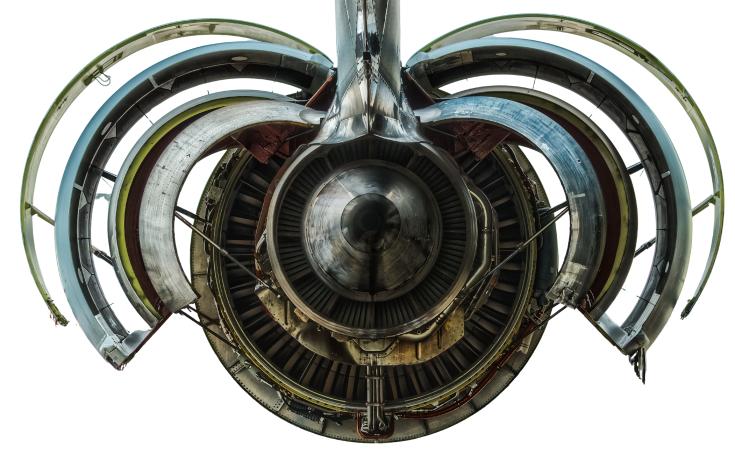

The mechanism that makes wet blasting reliable for NDT preparation is the flow of the slurry. Where dry blasting impacts, wet blasting flows. The water-carried media moves over and through complex geometries, flushing contaminants clear of blisks, discs, casing and other engine components rather than compacting them. Crack faces are opened and cleaned, not closed. The surface emerges contamination-free and ready for penetrant application without a separate degreasing stage.
A couple of outcomes distinguish this from alternatives. First, no risk of peening: the wet blast recipe for NDT preparation uses flow rates and media selections specifically calibrated to prevent it, so the surface condition the inspector sees is the surface condition the component actually has. This precision extends to micro nozzles, which access recessed features, cooling holes and tight geometries that conventional blast nozzles simply cannot reach, allowing wet blasting to clean deeper into a component's architecture where competing processes fall short. Abrasive flow through these micro nozzles is equally controlled, ensuring consistent media delivery without localised pressure spikes that could compromise surface integrity. Second, process consistency: every parameter - blast pressure, slurry concentration, media grade, nozzle angle and travel speed - is monitored and recorded, producing the same result on part one and part one thousand. Robotic delivery reinforces this further, with programmed toolpaths executing repeatable, multi-axis movement around complex aerofoil profiles and internal passages, removing the variability inherent in manual handling and ensuring that each component receives exactly the same preparation regardless of operator or shift.
In an automated Vapormatt machine, a compressor hub that takes six or more hours of manual cleaning can be processed without operator intervention and with full process traceability recorded to the Vapormatt 4.0 system.
The specification record here is not incidental. Wet blasting for jet engine surface preparation is written into the approved process documentation of the OEMs whose engines your MRO facility works on. Pratt and Whitney's SPOP16 covers wet glass bead blast cleaning. POP315-AC covers wet abrasive blasting and POP317-N covers glass bead wet blasting specifically. Rolls-Royce RPS386 and RRP56001 both cover abrasive blasting. GE's P11TF8 covers metallic shot peening. Airbus's AIPS02-02-003 specifies wet blasting directly by name.
These approvals exist because the process, properly controlled, delivers surfaces the inspection methods can trust. Vapormatt machines are deployed across jet engine MRO and OEM operations globally, processing compressor hubs, turbine discs, and fan blades for NDT using blast recipes developed and refined over decades of application engineering. Our case study on jet engine compressor hub NDT preparation documents the before-and-after in detail, including how automated nozzle positioning and slurry concentration monitoring produce the consistency that manual cleaning cannot.
Incomplete pre-cleaning before NDT produces one of three outcomes: a missed defect that reaches the engine, a false indication that drives unnecessary component rejection, or a re-inspection that absorbs time and cost the shop cannot afford. Wet blasting eliminates all three risks by delivering a controlled, consistent, contamination-free surface every cycle. No peening risk. No separate degreasing stage. The process was created for jet engine components. It remains the most reliable preparation method available for them.
The cost of continuing with a slower, less controlled process is measured in inspector hours, re-inspection cycles, and, ultimately, the margin for error that no engine MRO facility has.
No. The flowing nature of the slurry opens and cleans crack faces rather than closing them, making surface discontinuities more visible to penetrant and eddy current methods, not less.
Yes. The flowing slurry reaches into fir tree slot profiles, blade root geometries, disc bores, and cooling passages that manual cleaning tools and dry blast media cannot consistently access. This is a core advantage for pre-inspection cleaning of compressor and turbine discs, where contamination in the attachment geometry is a primary source of missed FPI indications. Vapormatt's patented micro-nozzles, watch the Leopard Cub video on this page, are a major stope forward when it comes to the preparation of fir-tree slots for NDT by wet blasting.
Wet blasting prepares components for fluorescent penetrant inspection (FPI), eddy current testing (ECT), magnetic particle inspection (MPI), and ultrasonic testing (UT). The process meets the requirements of ASNT, the British Institute of Non-Destructive Testing, the European Federation for Non-Destructive Testing, and relevant ASTM and ISO standards, as well as OEM-specific process approvals including Pratt and Whitney, Rolls-Royce, and GE specifications.
Yes. Vapormatt 4.0 is an Industrial Internet of Things (IIoT) solution fitted as standard to new Vapormatt machines and available as a retrofit to existing ones. It continuously monitors and records key process parameters including blast pressure, slurry concentration, abrasive concentration, and the speed of moving parts, creating a production history that can be accessed remotely from any platform with an internet connection.
This data logging capability supports process control and quality documentation requirements, and the recorded process history can form part of the evidence base for NADCAP accreditation and OEM process approval documentation, when integrated within the facility's wider quality management system.