Image


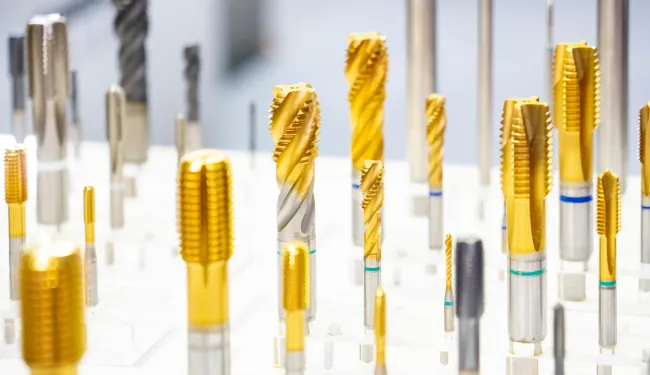


The coating looks right, the tool ships, and the delamination happens on the customer's machine.
Wet blasting removes the contamination and surface irregularities that prevent PVD and CVD coatings from bonding at the substrate interface. The slurry simultaneously cleans, activates, and conditions the surface in a single controlled process, producing a substrate that the coating can hold to under the thermal and mechanical loads of real cutting conditions. Every process variable is locked and repeatable, so the surface going into the coater is consistent across the batch, not just across the sample.
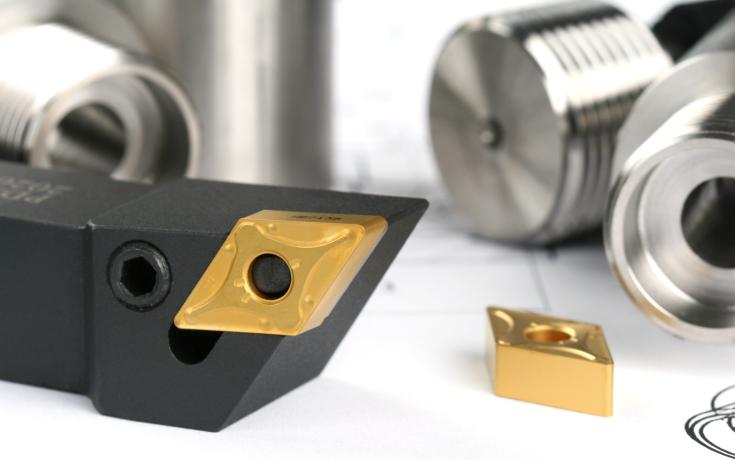
The slurry stream carries fine abrasive particles in a water cushion that cleans and activates the substrate without introducing the micro-cracking that dry processes can cause. Pressure, abrasive concentration, and gun geometry are held within tight tolerances, so the surface condition delivered to the coater is defined and repeatable rather than operator-dependent. For PVD and CVD applications, where coating adhesion is sensitive to nanoscale contamination and surface energy, that repeatability is the difference between a coating that bonds and one that does not.
Typical setup: PVD/CVD coating preparation
The parameters below are confirmed for the component types listed. All figures are indicative ranges; exact parameters are set during application development for your specific substrate and coating system.
| Component type | Typical size or weight | Process mode | Achievable outcome | Minimum control |
|---|---|---|---|---|
| Cutting inserts | ~15 x 15 x 8 mm | Automatic (radial or X-Y) | Cleaning and surface activation to provide an excellent surface for PVD / CVD bonding and subsequent extended tool life | Automatic motion, air pressure control |
| RSTs (rotary single-point tools) | ~Ø15 mm x 70 mm | Automatic (vertical) |
Cutting tools processed for PVD and CVD coating preparation sit within a broader family of precision cutting applications. Vapormatt's work with cutting insert and solid round tool manufacturers is covered in more detail on the cutting tool inserts industry page and the solid carbide tools industry page.

"The accuracy of edge prep applied to the tools was excellent with little to no error present. Vapormatt achieved the highest level of edge prep accuracy against all of the competition."
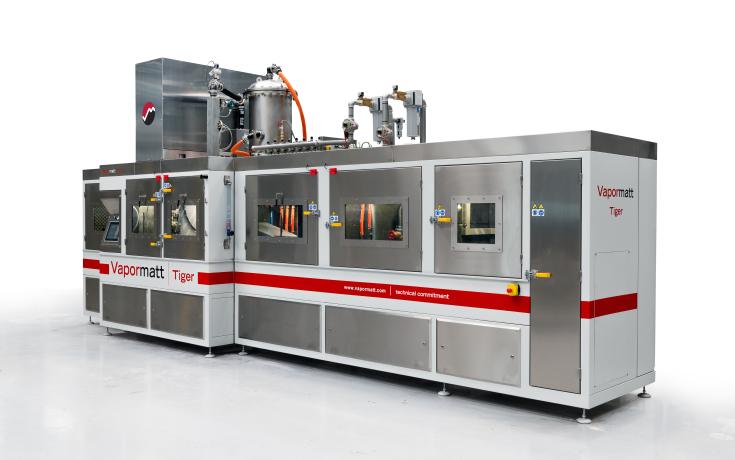
PVD and CVD coatings bond at the atomic level and are applied under high temperature and vacuum conditions. Any contamination or surface inconsistency on the substrate at that point becomes a failure site. The coating may pass visual inspection and still delaminate under load, the adhesion was never fully established. Getting the substrate right before the tool reaches the coater is the only point in the process where that risk can be removed.
Automatic motion control and closed-loop air pressure control remove the two biggest sources of batch variation. Every part follows the same path at the same distance from the guns, at the same pressure, for the same duration. Process data can be logged, so if a batch falls outside tolerance you have the records to identify where and why.
Yes, but not in the same machine cycle. Inserts and RSTs require different gun configurations: crown geometry for inserts, vertical oscillation with satellite drive for RSTs. Production lines running both component types route them through separate dedicated setups or a machine specified to switch between configurations.
Yes. Wet blasting is a fully parameterised process: abrasive type and mesh size, pressure, gun configuration, motion path, and cycle time are all set, locked, and logged. That means the preparation step can be documented to the same standard as any other stage in a controlled manufacturing process. If your coating supplier or quality system requires evidence that surface preparation was consistent across a batch, the process data is there.
Fine aluminium oxide at 320 to 500 mesh is the standard abrasive for this application. The mesh size matters because it controls the energy delivered to the surface at a microscopic level. Too coarse and you risk altering the substrate in ways that affect coating uniformity; too fine and the activation effect is insufficient. Aluminium oxide at this range cleans and activates without compromising the substrate, and it performs consistently across carbide and other common cutting tool materials.