Post-processing is not an afterthought in additive manufacturing. It is where the value of the print is either realised or lost.
As-printed titanium or Inconel components typically carry a surface roughness of 15 to 20 microns. Many aerospace and medical specifications demand 1.6 or below. That gap does not close itself, and the wrong finishing process will cost you far more than the print.
This is where wet blasting does what no alternative process can replicate in a single operation.
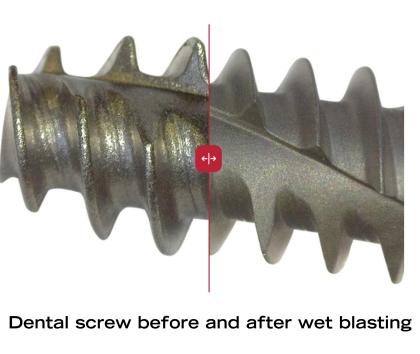
The water-borne slurry cushions the abrasive impact, protecting tight tolerances whilst the media works the surface with genuine precision. Media concentration, air pressure, nozzle angle, and dwell time are each independently controllable. The result is a specific Ra, delivered to specification, across the entire component including recesses and internal channels that dry blasting, chemical etching, and mass finishing cannot reliably treat.
There is also a confirmation mechanism built into the process that matters: when wet blast slurry exits a cleared internal channel, you can see it. There is no equivalent in dry blasting, where un-sintered powder can be compacted further into a channel without any visible indication.
If your AM operation is scaling to production volumes, the finishing process needs to keep pace with the printer. We can show you how.
Learn more about the applications and advantages of wet blasting for AM components