Image




Faster die turnaround keeps lines running with fewer stoppages
Automated wet blasting delivers the same clean-to-inspect finish every time
Gentle, controlled cleaning extends die life and reduces damage risk
Lower labour, less scrap, and higher throughput deliver rapid ROI
Every die pulled prematurely costs production time you cannot recover. Every hour your die correctors spend working on an inadequately cleaned bearing face is an hour not spent on actual correction. And every inspection that misses a fault because the die surface was not clean enough sends that problem to the press.
Die shop efficiency lives or dies on the quality of your cleaning process. If your current method leaves residual aluminium, discolouration, or caustic trace on the bearing surfaces, everything downstream, inspection accuracy, correction quality, and die success rate, is compromised before it begins.
Vapormatt has designed and manufactured wet blasting machines for aluminium extrusion die shops for decades. We invented the process. We built the machine the industry relies on.
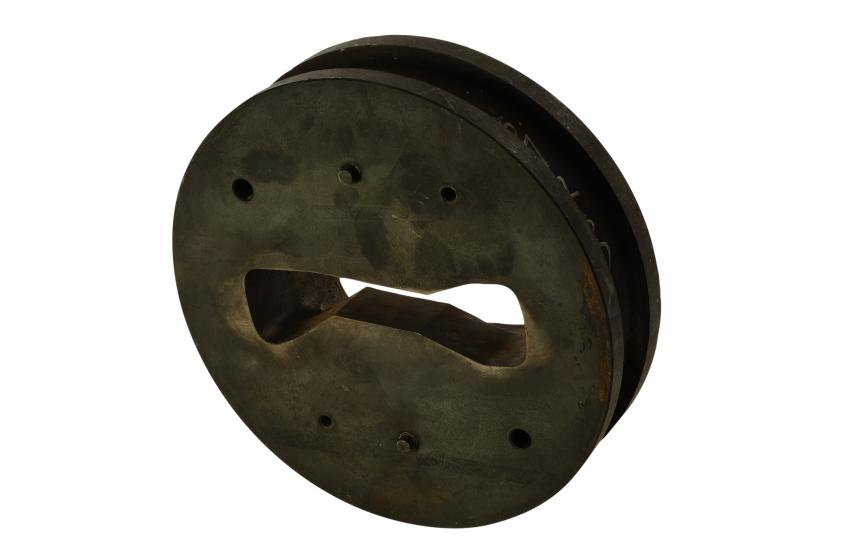
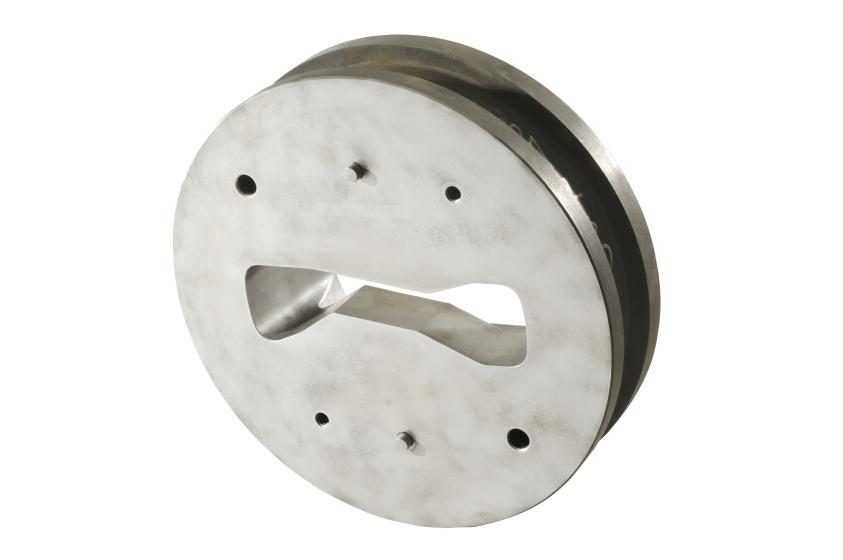
The caustic soda dip is essential, but it is not sufficient. It removes bulk aluminium effectively. What it leaves behind, fine residual particles, carbonisation, discolouration from heat and pressure, is precisely what makes accurate die inspection difficult.
vs. shot blasting: Steel shot removes contamination aggressively but with poor control over the bearing surface. Complex port holes and intricate bearing profiles are not reliably reached, and the process cannot begin until the die is fully dried after the caustic rinse, adding non-productive time to every cleaning cycle. The abrasive impact also risks unwanted material removal at the die edges: the sharp, precise geometry that defines the bearing surface can be dulled or deformed, requiring corrective work before the die returns to press.
vs. manual polishing: Skilled die correctors are expensive and finite. Applying their time to cleaning work that a machine should handle is a structural inefficiency that compounds across a full day's die volume.
Find out more about wet blasting vs. other finishing processes
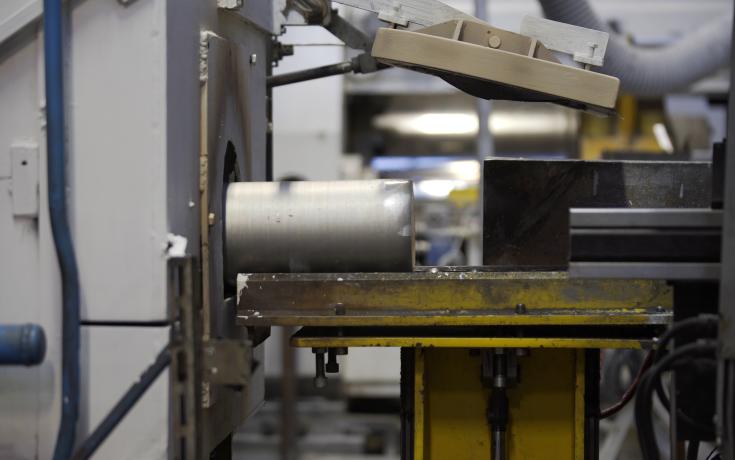
Wet blasting works differently at a mechanical level. The slurry, a calibrated mixture of abrasive media suspended in water, is propelled under controlled pressure through nozzles positioned above the die. The water lubricates the abrasive particles as they flow across the bearing surface, allowing the slurry to navigate complex port geometries uniformly, cleaning where shot cannot reach, without altering die profile geometry.
Three outcomes result directly from this mechanism:
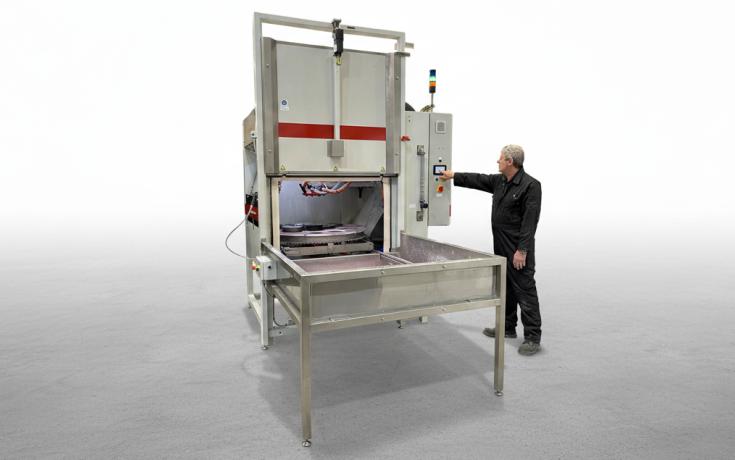
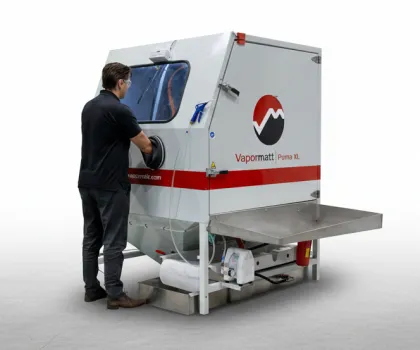
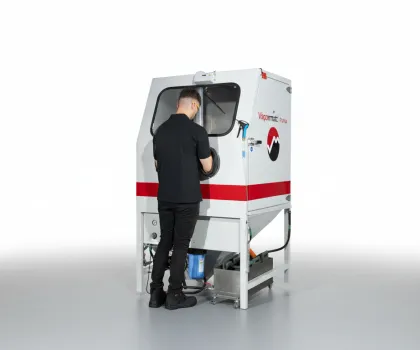
Vapormatt machines handle dies from 70mm (2.5") to over 1,100mm (43") in diameter, and from around 8kg for small architectural profile dies to 250-300kg for large structural tooling. For the largest dies, running into several tonnes, Vapormatt builds heavy duty machines to specification.
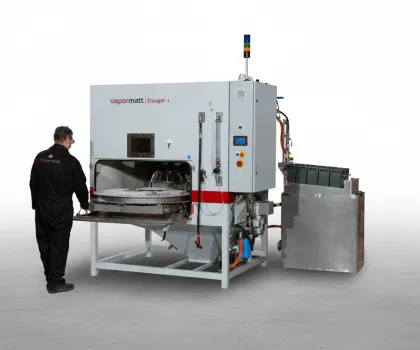
Throughput scales to your operation. Smaller die shops processing 5 to 10 pieces per day use the single load-end Cougar+ configuration. High-volume operations processing up to 300 pieces per day run the double load-end configuration, where one turntable loads while the other cleans, removing dead time from the cycle entirely.
Learn more about the Cougar+ in single load end configuration

“The machine works well and does a great job at cleaning dies.”
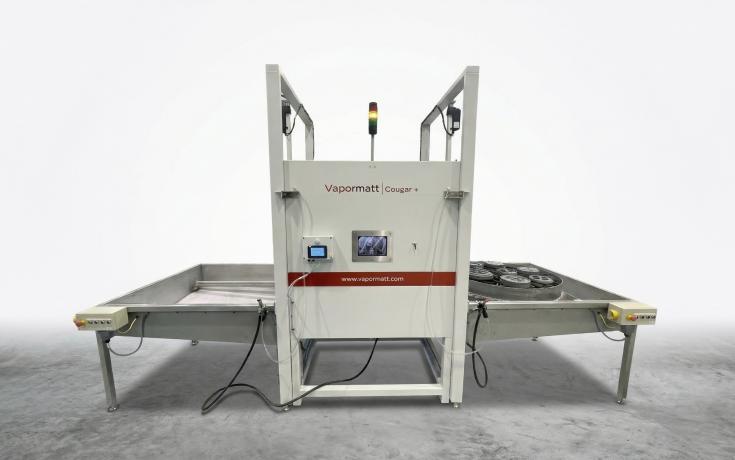
Extrusion die shops are demanding environments. Dies arrive hot, heavy, and contaminated. They are moved by overhead crane at production speed. Caustic residue, aluminium fines, and process water are constant. The Cougar+ is built for this, with turntables rated to 1,000kg (2,200lbs), enclosures engineered to resist continuous caustic and abrasive exposure, and wear components selected for die shop reality, not laboratory conditions.
Machine downtime in a die shop is a direct constraint on press output. Vapormatt has been manufacturing wet blasting machines since 1978, is family-owned, and remains solely focused on wet blasting.
Learn more about the Cougar+ in double load end configuration
A die shop running shot blasting or manual polishing carries costs it does not need: extended cleaning cycles, inconsistent bearing surface quality, and die corrector time spent on preparation rather than correction. Wet blasting eliminates each of these at the source. Dies leave the machine clean enough for accurate inspection, geometrically intact, and ready for correction or nitriding.
The most useful next step is a direct conversation. Tell us your die volumes, your profile mix, and where your current process is costing you -- we will tell you exactly what the improvement looks like.
No. The cushioning effect of water buffers the abrasive particles throughout the process, preventing the edge damage associated with shot blasting. The bearing surface geometry remains intact, and the fine, uniform finish produced by wet blasting makes subsequent inspection and correction more accurate, not less.
Yes. The lubricating action of the slurry allows it to flow into complex geometries, including the internal port surfaces of porthole dies and multi-void profiles -- that shot blasting cannot reliably reach. This is one of the primary reasons die shops with complex profile mixes move away from shot blasting.
Wet blasting leaves the die surface in an activated state that aids nitrogen diffusion during nitriding. A corrosion inhibitor can be added to the system to prevent oxidation between cleaning and the nitriding cycle. Dies that are not nitrided benefit equally, the process is specified for cleaning quality, not coating preparation alone.
Yes. Wet blasting produces no airborne dust, the primary health risk associated with dry shot blasting and silica-containing abrasive media. The process runs within a sealed enclosure, effluent is filtered and recirculated, and solid waste is separated for disposal. The working environment around the machine is cleaner and safer than shot blasting at equivalent throughput.
The most reliable way is a conversation about your die mix, volumes, and current process. We have worked with die shops processing 5 pieces a day and operations running 300 or more, across the full range of die sizes and profile complexity. Our team can tell you quickly whether the process fits, what throughput configuration makes sense, and what the likely process improvement looks like for your specific operation.