
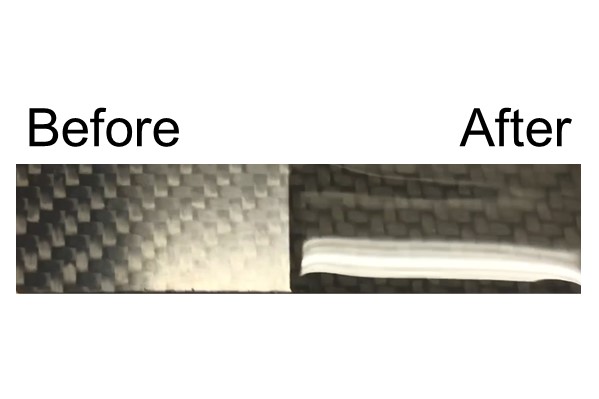
Carbon fibre leaves the autoclave with a hydrophobic resin surface. Release agents and waxy residues mean adhesives bead rather than wet out properly, and that's before you factor in fibre damage from aggressive prep methods.
Wet blasting solves both problems:
Surface energy: Wet blasting achieves a water contact angle of 43-48°, compared to 86° for dry grit blasting and 88° for manual sanding. Lower contact angle = better adhesive wetting = stronger bonds.
Bond strength: Independent testing for a major European airframe OEM recorded fracture toughness (GIC) of 757 J/m², well above the 450 J/m² minimum requirement, and significantly ahead of dry blasting (385-578 J/m²).
Zero fibre damage: The water in the slurry cushions the abrasive media, preventing the fibre fracture confirmed by microscopy with dry blasting methods.
Simultaneous cleaning: Contaminants are removed at the same time as surface preparation, with no separate degreasing step required.
Surface stability: The prepared surface stays bond-ready for over two weeks, with contact angle stable at 43-54°. Dry blasting creates static charge that attracts recontamination almost immediately.
NASA, the FAA, and aerospace OEMs have all confirmed that preparation method directly controls surface energy, bond strength, and long-term durability. Westland Helicopters listed vapour-blast as the preferred preparation method for thermoset composites at the CAA/FAA Bonded Structures Workshop.
If your process still relies on manual sanding, peel ply, or dry grit blasting, the variability is built in and the cost shows up in scrap, rework, and risk.
Learn more about the benefits of wet blasting for composite components.