Image


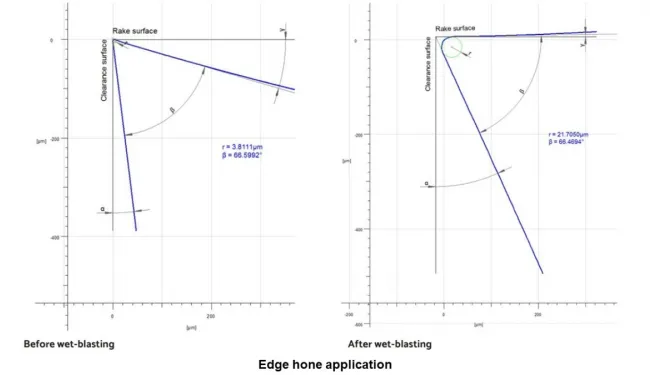


Wet blasting delivers a controlled, repeatable edge radius across the full cutting edge geometry in a single cycle. The slurry cushions the abrasive, preventing the micro-chipping that dry processes risk on carbide and HSS edges. Because pressure, abrasive grade, and media flow are independently adjustable, the process can be dialled to a specific target radius and held there across a production run.
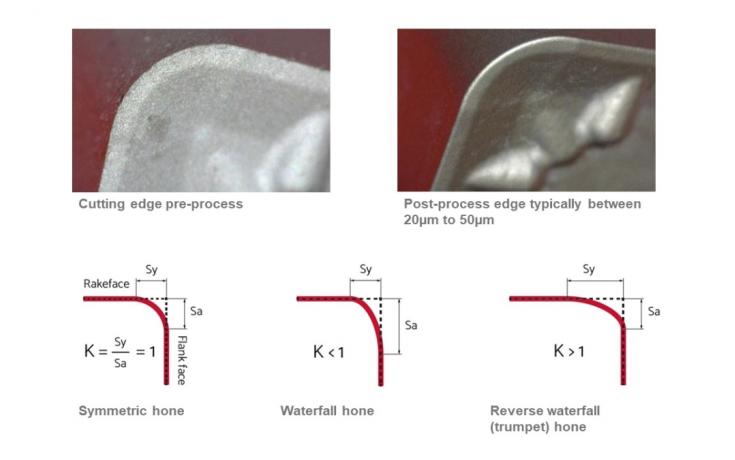
The slurry stream combines abrasive, water, and air to deliver a consistent, dampened cutting action across every surface it reaches. On a cutting edge, this produces a controlled radius by removing the fragile edge and micro-fractures left by grinding. Air pressure, oscillation sped and abrasive size can all be adjusted to control the edge radius.
Typical setup: edge honing
The parameters below are indicative and confirmed for the component types listed. The process handles the range of parts shown from small carbide inserts through to continuous bandsaw blade.
| Component type | Typical size or weight | Process mode | Achievable edge radius | Minimum control |
|---|---|---|---|---|
| Cutting inserts (e.g. replaceable tungsten carbide inserts) | ~15 x 15 x 8 mm | Automatic (radial or X-Y) | 5 to 70 µm | Automatic motion, air pressure control |
| Round shank tools (RSTs, e.g. solid carbide end mills, drills) | ~Ø15 mm x 70 mm | Automatic (vertical oscillation with satellite drive) | 5 to 40 µm | Automatic motion, air pressure control |
| Bandsaw blade (bi-metal or carbide tipped) | 34 to 41 mm wide, continuous | Automatic (Profelis conveyor) | 5 to 50 µm | Air pressure control |
In Vapormatt sample processing trials, tungsten carbide replaceable inserts (SP91 type, ~15 mm) were processed on a semi-automatic Lynx with R&D oscillation using 180 mesh aluminium oxide at 45° gun angle. The aim was a 40 µm edge radius across the full cutting edge. Results for the single-sided insert type were excellent: average edge radius across processed inserts was 42 to 46 µm, with K factor within specification throughout.
Wet blasting edge honing is used across the cutting tool industry and the precision engineering sector - follow the links for application context specific to each sector.

"Our old dry blasting machine was a bottleneck in the production process."
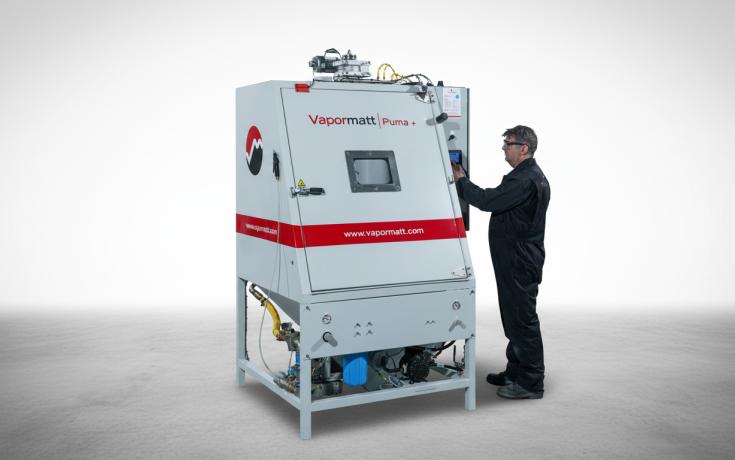
Edge honing at this application is always automatic. The differentiating factor is throughput and control specification.
The process removes material only from the cutting edge, not the rake or clearance faces. In Vapormatt trials on carbide inserts with a 40 µm target radius, tool length either did not change or changed only within the controlled tolerance specified by the customer. Gun angle, pressure, and fixturing are set to protect geometry from the outset.
The process is controlled by fixed air pressure and automatic motion, not operator feel. Once a recipe is established on sample pieces and verified with measurement (Alicona Edgemaster or equivalent), the same recipe runs production. Any drift in pressure is visible in process data before it reaches the component. That is why automatic motion with air pressure control is the minimum recommended configuration for this application.
Yes. Bespoke pocket trays with 3D printed holders are routinely used to secure small inserts at the required blast angle. In trials on replaceable carbide inserts processed at 45°, custom holders in a Manz pocket tray prevented movement and allowed all cutting edges to be reached consistently.
A customer processing round shank tools reported a 50% improvement in tool performance compared with their previous blasting-only process, and a 100% improvement when wet blasting was combined with a new coating. Consistency across a batch is the primary gain: manual processes vary by operator, shift, and fatigue. Automatic wet blasting does not.
Vapormatt runs sample processing trials on customer-supplied components before any machine is specified. Results are measured and reported with full data, including edge radius readings per cutting edge and K factor where relevant. You receive the measurement data, not just a visual assessment, so you can make the decision on confirmed figures.