
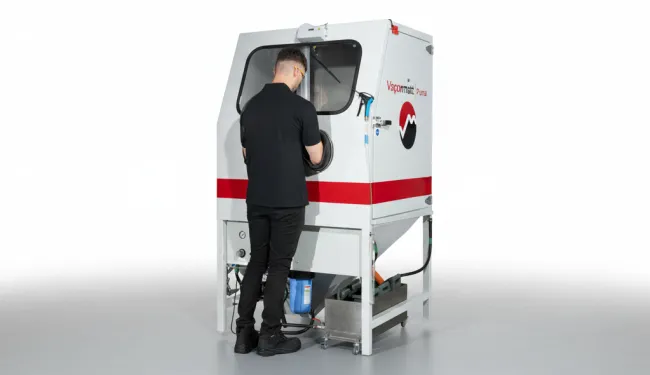
A wet blasting machine combines water, abrasive media and compressed air into a single controlled slurry stream, projecting it at a component to clean, finish and degrease it in one pass. The water cushions every particle of abrasive on impact, which is what separates the result from dry blast cabinets: no embedded media, no dust, and a finish that's the same on part one as it is on part ten thousand - provided the machine is engineered to hold that consistency.
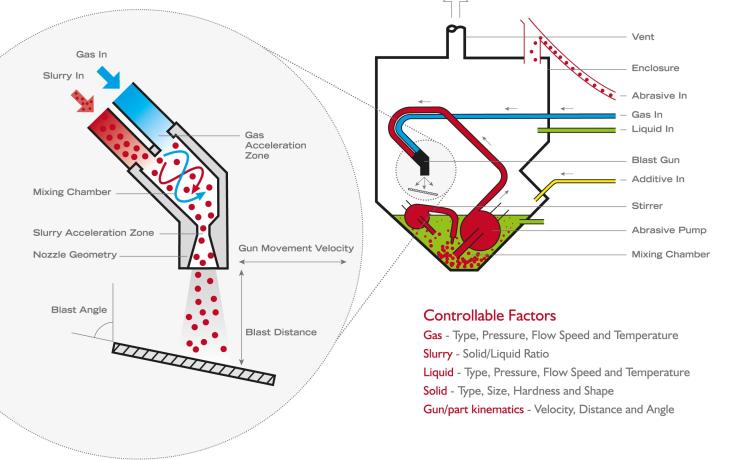
Not every machine that mixes water and abrasive delivers a repeatable result. The variable that separates a good wet blasting machine from a poor one isn't the concept, it's the engineering underneath it:
- Slurry management. Abrasive concentration has to stay constant throughout the cycle, not just when the tank is freshly mixed.
- Pressure and flow control. Air pressure and slurry flow need to be held within tolerance, part after part, shift after shift.
- Recycling. Media and water should be continuously filtered and reused, rather than discarded and remixed, which is both a cost driver and a consistency risk if done badly.
- Cabinet and component durability. A slurry environment is abrasive by nature - pumps, seals, and internal geometry all wear faster in a poorly specified machine.
- Manual or automatic operation, depending on volume, part geometry, and how much of the process needs to be operator-independent.
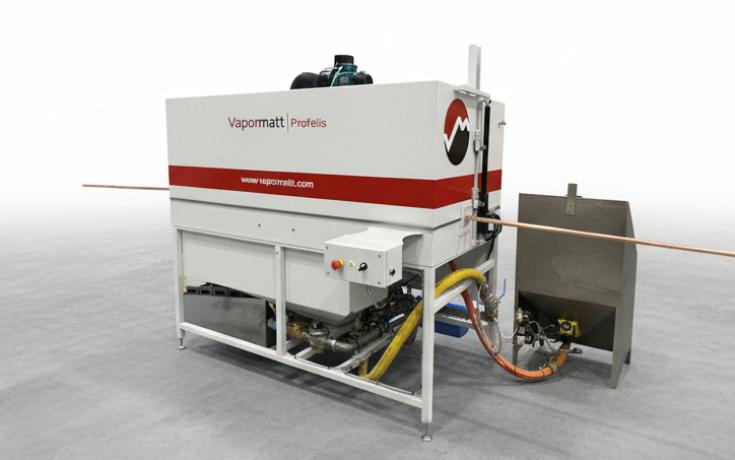
The Vapormatt wet blasting machine range
Vapormatt has built nothing but wet blasting machines since inventing them in the late 1940s. The range spans:
- Automatic machines - for high-volume, repeatable production where the process needs to run without operator intervention. Browse automatic wet blasting machines
- Manual machines - for lower volumes, prototype work, or where a skilled operator handling varied part geometry is more efficient than automation. Browse manual wet blasting machines
Both are built to the same underlying engineering standard, so scaling down to a manual machine never means compromising on build quality.
Where wet blasting machines are used
Wet blasting machines are specified for aerospace component finishing and peening, cutting tool manufacture, aluminium extrusion, medical and dental implants, and general industrial cleaning, deburring and coating removal.
Buying a wet blasting machine
This is a capital purchase, and the decision usually needs a business case before it goes anywhere near procurement. Read our full guide to buying a wet blasting machine for what to expect at each stage, from discovery through to specification and delivery.
FAQ's
What is a wet blasting machine?
A wet blasting machine is a piece of surface-finishing equipment that mixes water and abrasive media into a slurry, then projects that slurry at a component using compressed air. It cleans, degreases and finishes a surface in a single pass, without the dust or embedded media associated with dry blasting.
What's the difference between a manual and an automatic wet blasting machine?
A manual machine is operated by hand, with a technician controlling the blast gun and part positioning - well suited to lower volumes or varied part geometry. An automatic machine runs the process without operator intervention, holding parameters consistently across high production volumes.
How much does a wet blasting machine cost?
Cost depends on the level of automation, process control and monitoring the application requires. Our guide to buying a wet blasting machine explains how that specification is built and why the purchase price isn't the full picture - running costs and machine lifespan matter as much as the ticket price.
Is a wet blasting machine the same as a vapor blasting machine?
Yes. Wet blasting and vapor blasting are two names for the same process, so a wet blasting machine and a vapor blasting machine are the same equipment. "Wet blasting" is the more precise engineering term; "vapor blasting" is the more commonly searched name.