
A patented answer to a costly installation problem
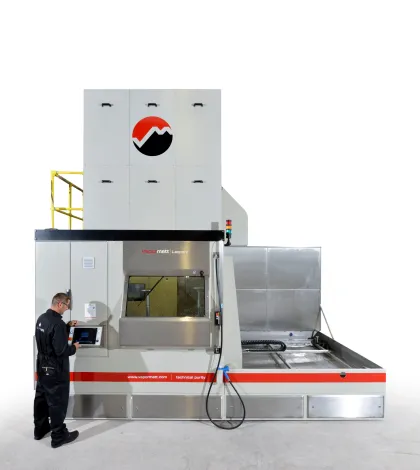
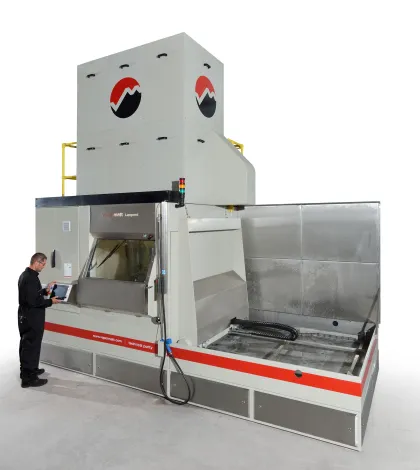
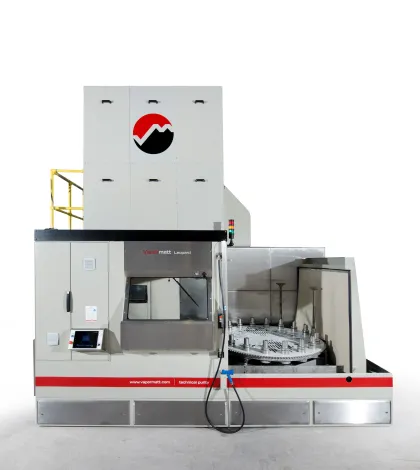
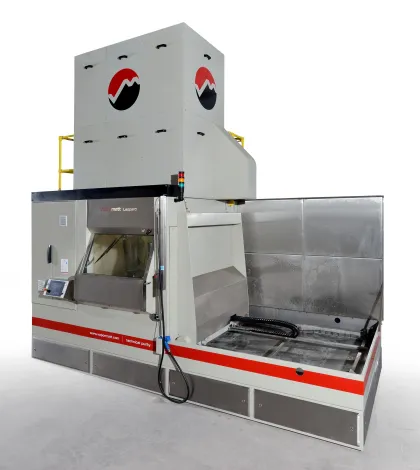
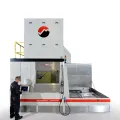
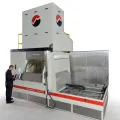
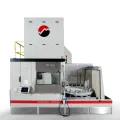
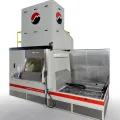
The Leopard Horizontal holds components up to 5,000 kg (11,023 lb) on a 1,850 mm (73") stainless-steel turntable. At that scale, the sump required to sustain consistent slurry delivery is large. Conventional engineering places that sump below floor level, which means a pit. Vapormatt's R&D team invented and patented an alternative: the Doughnut Sump.
Water and abrasive circulate continuously around a ring-form sump, thoroughly mixed prior to delivery to the blast guns. This keeps the machine's load height accessible for crane or forklift loading, with no floor modification required. A powered trolley drives the turntable out to the load station, so components can be loaded and unloaded at a customisable low level without compromising access or operator safety.
The result: no pit, no civil works, no delay — and a slurry mixing action that sustains consistent abrasive concentration throughout the entire blast cycle.
No competitor in this category publishes an equivalent solution.
Semi-automatic processing: controlled where it matters, flexible where it counts
The Leopard Horizontal runs a semi-automatic cycle. Once the operator loads components, selects the recipe on the HMI, and drives the turntable back into the machine, the blast cycle runs automatically. The machine monitors slurry pressure, blast air pressure, airflow, and abrasive-to-water ratio continuously throughout processing. A water-wash window with on-demand wiper gives the operator full visibility without interrupting the cycle. An automatic rinse follows the blast cycle. Where component geometry requires attention to a specific face or cavity, manual touch-up is available from an integrated workstation fitted with twin glove ports, a 10mm (0.4") boron carbide blast gun, and a trigger-operated wash jet.
This hybrid approach is deliberate. It delivers the throughput and repeatability of automation with the adaptability that complex, high-value, or mixed-batch aerospace components demand.
The Leopard Horizontal processes heavy and large-format components across a wide range of industries and applications:
- Large wheels, hubs, and brake assemblies
- Fan discs, compressor discs, and engine casings
- Landing gear struts, beams, and actuator housings
- Structural forgings and castings
- Composite structures requiring surface activation for bonding or coating
- Large-diameter pipes, flanges, and pressure vessel components
- Defence vehicle drivetrain and powertrain components
- Components requiring NDT preparation: paint removal, oxide removal, and surface conditioning for dye penetrant or magnetic particle inspection
- Pre-coating surface preparation for thermal spray, HVOF, anodising, and adhesive bonding
- Shot peening of high-value structural components
- Titanium scale removal and reactive surface creation
The bottom line
If your operation processes heavy, large-format components and your current approach involves installation compromises, inconsistent surface results, or a finishing process that cannot produce the traceability record an audit demands, the Leopard Horizontal changes the calculation.
Five-tonne capacity. A 1,850 mm (73") turntable. A patented sump that installs without floor modification. Process monitoring across every critical variable. Vapormatt 4.0 traceability from the first cycle. Delivered and commissioned by the company that focuses exclusively on wet blasting, with the proven process knowledge to back every machine it builds.
The cost of continuing with an inadequate process is not just operational. It is the audit finding, the rework rate, and the inspection result that stops production.
Key specifications
| Parameter | Specification |
|---|---|
| Turntable diameter | 1,850 mm (73") |
| Maximum component weight | 5,000 kg (11,023 lb) |
| Turntable speed | 1–10 RPM, servo-motor driven |
| Automation | Semi-automatic: HMI recipe-driven cycle with integrated manual touch-up station |
| Blast guns | Vapormatt MK3, solid polyurethane, 10mm (0.4") boron carbide nozzles |
| Slurry pumps | 2 x Vapormatt 50mm (2") vortex pumps, 5.5 kW each, swing-out mounted |
| Sound attenuation | Maximum 80 dBA |
| Sump design | Patented Doughnut Sump: no floor pit required |
| Slurry conditioning | Hydrocyclone with settling tanks; elutriation tower available |
| Process monitoring | Live HMI trend lines: slurry pressure, blast air pressure, airflow, abrasive concentration, actuator movement |
| Electrical supply | 400/480V, 3-phase, 50/60 Hz, 63A |
| Process air supply | 6–7 bar (87–101 psi); 1.15 Nm³/min (40 SCFM) per gun at 10mm (0.4") nozzle |
| Water supply | 2–7 bar (29–101 psi); 13 L/min (2.86 gpm) intermittent; drinking quality |
| Machine footprint | 7,000mm L x 4,000mm W x 4,000mm H (276" x 158" x 158") |
| Industry 4.0 | Vapormatt 4.0 standard fit |
| Configuration | Bespoke to application |
Full technical specifications are available in the downloadable Leopard machine brochure