
Rapid
Cleans and prepares components for NDT in one step
Dependable
Cleans cracks and does not peen over them
Repeatable
Automation ensures consistent finishing every time
Compliant
With aviation authorities worldwide
Introduction
Accurate non-destructive testing begins before the inspector ever reaches the component. Surface contamination, residual coatings, heat scale, and carbon deposits all mask defects — and a missed defect on a flight-critical component is never acceptable.
Vapormatt wet blasting removes oils, greases, combustion deposits, and coatings in a single controlled operation, leaving jet engine components clean, with cracks cleaned out, and ready for fluorescent penetrant inspection (FPI), eddy current testing (ECT), magnetic particle inspection (MPI), and other NDT methods. The same process that originated in the development of the first jet engine remains the preferred preparation method for the world's leading aerospace engine manufacturers today.
Learn how wet blasting works

Sector challenges and desired outcomes
The challenges
By the time a disc, blade, hub, or casing arrives in the inspection bay, its surface typically carries layers of contamination that must be completely removed before any NDT method can be trusted.
The challenges facing NDT preparation engineers and MRO shop managers include:
- Contamination complexity. Heat scale, carbon deposits, combustion residue, oxidation, oils, greases, and residual coating layers can all mask fine surface cracks.
- Risk of crack concealment. Dry blasting and shot-based processes risk peening the surface and closing fatigue cracks or even embedding blast media into the cracks - the very defects NDT is designed to detect.
- Dimensional sensitivity. Many jet engine components carry tight tolerances. Over-blasting on high-value parts is not a recoverable situation.
- Inspection productivity. Slow or inconsistent cleaning ties up skilled inspectors and extends aircraft-on-ground time.
- Compliance and traceability. Aerospace NDT preparation is governed by OEM specifications, NADCAP accreditation requirements, and international standards. The preparation process must be repeatable, documented, and auditable.
- Material diversity. Modern engine builds include titanium alloys, nickel superalloys, aluminium, composites, and additive manufactured components - each requiring a tailored preparation approach.
See the aerospace specifications our technology can help support
Desired outcomes
- A thoroughly clean surface with no contamination that could cause a false indication or mask a genuine defect.
- Cracks cleaned and made more visible, not concealed.
- No dimensional change or substrate damage to high-value components.
- Consistent, repeatable results across every component in a batch.
- Throughput fast enough to maintain inspection schedules.
- Full process documentation for compliance and audit purposes.
Discover the machines that can deliver these outcomes
Applications for wet blasting in jet engine NDT preparation
Wet blasting prepares a broad range of jet engine components for NDT across both OEM quality inspection and MRO overhaul operations:
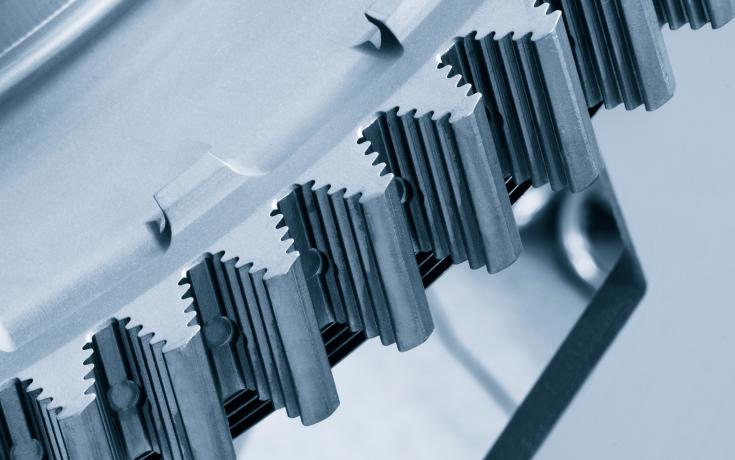
- Compressor discs and hubs — removal of carbon, heat scale, and oxidation from disc bores, blade retention slots, and fir-tree root features prior to FPI or eddy current inspection.
- Turbine discs — controlled cleaning of complex geometries including fir-tree slots and bolt holes without risk of crack concealment or dimensional change.
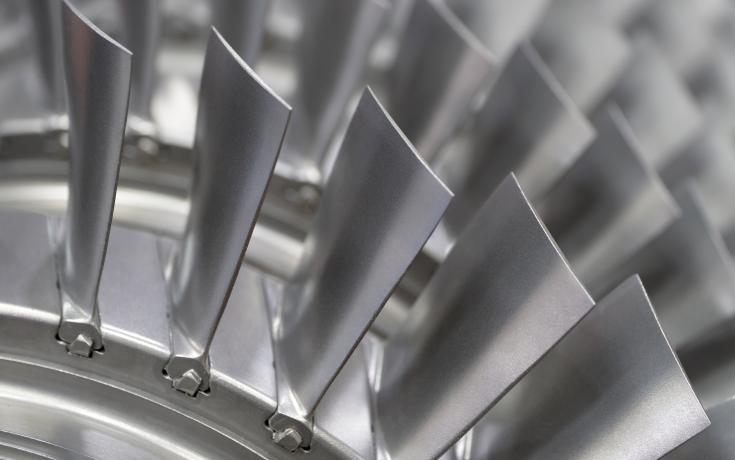
- Fan blades and turbine blades — thorough cleaning of aerofoil surfaces and root features for fluorescent penetrant and visual inspection.
- Blisks (bladed discs) — uniform preparation of integrally machined components where geometry makes manual cleaning impractical.
- Drive shafts — cleaning of surfaces and spline features prior to magnetic particle or eddy current inspection.
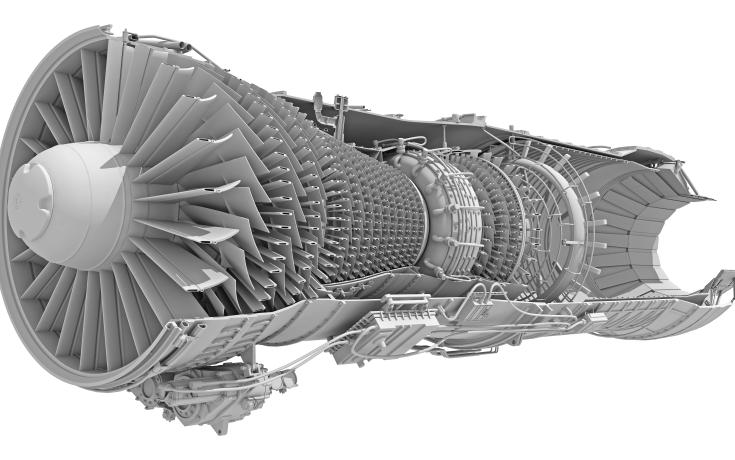
- Engine casings — removal of carbon, heat scale, and combustion deposits from outer and accessible interior surfaces.
- Combustion components — precise, non-damaging cleaning of combustion casings and chambers prior to FPI.
- Fixings, nuts, and bolts — batch cleaning of fasteners and small components in preparation for inspection.
- Additive manufactured (AM) engine components — removal of residual powder, partially sintered material, and surface contaminants from complex geometries prior to NDT.
- Composite engine components — preparation of composite fan blades and structural components without fibre damage.
See the general applications for which wet blasting is suited
NDT preparation versus peening
The blast formula for NDT preparation — media selection, mesh size, flow rate, and pressure — is calibrated to clean without introducing compressive stress. It is a fundamentally different recipe from Vapormatt's wet shot peening applications, even where the same machine is used. A single Vapormatt machine can switch between the two with a change of blast media and a touch of a button.
Learn about jet engine peening by wet blasting
Case spotlight
Preparation of stage-one compressor hubs prep for NDT by automated wet blasting
- The problem: A major jet engine manufacturer was spending 2–3 hours manually wet blasting complex 'fir tree' geometries on safety-critical compressor hubs, a labour-intensive process prone to human error and costly scrapping risks on parts worth at least $50,000 each.
- The solution: Replacing the manual process with an automatic Vapormatt Leopard Cub cut processing time to just 20 minutes per hub while eliminating human error through precise, consistent, multi-axis automated blasting.
Read the full case study
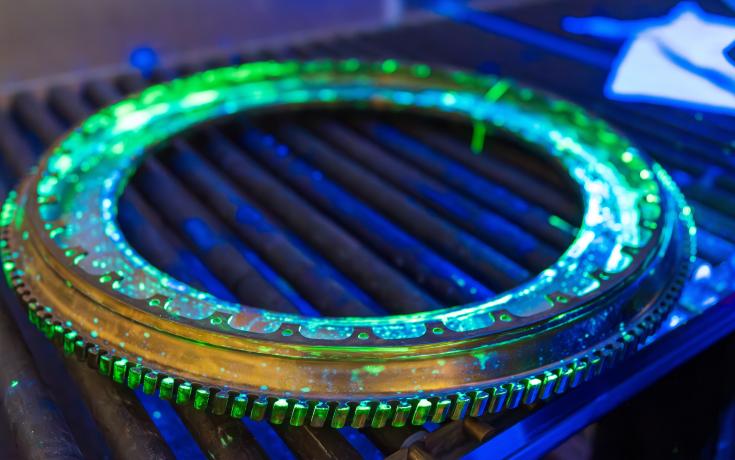
Watch the Leopard Cub precisely clean and prepare for NDT the fir-tree slots of a turbine disc
See our full range of machines for jet engine component preparation for NDT


Why choose Vapormatt wet blasting for jet engine NDT preparation
It cleans without concealing
The greatest risk of any surface preparation process is that it masks the defect it was meant to expose. Dry blasting and shot-based processes can close fatigue cracks through their peening action, rendering fine discontinuities invisible before the inspector has seen them. Wet blasting on a non-peening recipe cleans cracks, making surface defects more visible, not less.
It removes everything in one pass
Oils, greases, heat scale, carbon deposits, combustion residue, loose coatings, and oxidation are all removed simultaneously, with no separate degreasing step required. For MRO operations this means reduced handling, shorter cycle times, and lower consumable costs.
It protects high-value components
The cushioning effect of water moderates impact energy, protecting tight-tolerance features, critical sealing faces, and composite materials from damage that is unacceptable on flight-critical hardware.
It is precisely controllable - and stays that way
Every process variable — blast pressure, media type, mesh size, water-to-media ratio, nozzle angle, gun distance, traverse speed, and dwell time — can be set, locked, and monitored. Vapormatt's patented slurry concentration technology holds the blast formula consistently across a production run and between shifts, even as media wears over time. Any variation in preparation quality affects the reliability of subsequent inspection; Vapormatt's process control eliminates that variability.
It reaches where manual methods cannot
Automated Vapormatt systems are programmed to position blast guns accurately and index around complex component geometries — disc bores, fir-tree slots, blade root features, and internal surfaces. Manual methods cannot deliver the same coverage consistently, and the time penalty is significant: processing a typical compressor hub manually can exceed six hours. Automation removes that burden without the risk of over-processing.
It replaces acid etching safely
Acid etching has historically been used to prepare metal surfaces for NDT. It carries significant health, safety, and environmental risks, generates hazardous waste, and demands specialist handling. Wet blasting delivers a comparably clean and active metal surface without hazardous fumes, acid waste, or the substrate attack risk of chemical processes.
It supports compliance
Wet blasting for NDT preparation is compatible with the standards used across aerospace engine overhaul, including those referenced by ASNT, BINDT, ICNDT, and EFNDT. Vapormatt systems provide the process documentation, repeatability records, and audit trail that NADCAP-accredited facilities require.
Our technology can also prepare aircraft wheels for NDT, learn more
Wet blasting vs other NDT preparation processes
| Preparation method | Crack concealment risk | Removes oils/grease | Substrate damage risk | Process control | Chemical waste | Suitable for titanium/composites |
|---|---|---|---|---|---|---|
| Wet blasting | None - non-peening recipe | Yes — single operation | Very low | High — fully programmable | None | Yes |
| Dry blasting | Moderate to high | No — requires pre-degrease | Moderate | Moderate | None | Limited |
| Shot peening (dry) | High | No — requires pre-degrease | Higher | Moderate | None | Limited |
| Acid etching | None | Yes | Moderate — attack risk | Process dependent | Significant | Conditional |
| Manual cleaning/brushing | None | Partial | Low | Low — operator dependent | Low | Yes |
| Tumbling / mass finishing | Low–moderate | Partial | Low–moderate | Moderate | Low | Limited |
Crack concealment risk is the decisive factor for NDT preparation. Dry blasting and dry shot peening carry a documented risk of closing surface-breaking fatigue cracks. Wet blasting on a non-peening recipe does not.
Acid etching remains the historical reference method for activating surfaces prior to FPI. Wet blasting can replace it in many applications, without the safety, regulatory, and waste-handling overhead.
Manual methods are inherently inconsistent, operator-dependent, and impractical for complex geometries such as fir-tree slots, disc bores, and blade root features.
Learn more about the advantages of wet blasting compared with other finishing processes
Final takeaway
Wet blasting was born in the development of the jet engine, and it remains the most precise, controllable, and inspection-safe method for preparing engine components for NDT today. Whether you are running a high-throughput MRO overhaul line or preparing flight-critical parts at the OEM stage, Vapormatt has the process knowledge, the machine capability, and the proven track record to get your components inspection-ready — accurately, consistently, and on time.
Brochure and case study downloads
All downloadsFAQs
What is jet engine component preparation for NDT?
Jet engine prep for NDT is the controlled cleaning and surface conditioning of engine parts so defects are detectable and inspection results are consistent. The goal is an NDT-ready surface free from oils, carbon, oxides, corrosion products, sealants or coatings that can mask indications.